DC2000 – Installation Manual 22
HHO Plus, Alternative Energies, Lta – Travessa das Serras 33, Vieira de Leiria, Portugal – Tel. 00351244697116 – Email: info@hhhoplusgas.com
injected in order to maintain the predetermined air/fuel ratio. If more air is going into the engine then more
fuel will be injected in the engine and vice-versa.
The MAF/MAP sensor pick a 5 volt signal from the ECU, and returns a lower voltage signal in accordance with
the aspiration in the engine and the quantity of air going inside. A higher output voltage means more air
passing, which is then calculated as "more fuel is needed". Lower output signal indicates higher engine
vacuum, which requires less fuel.
It's not just fuel control. The MAF/MAP sensor signal gives the computer a dynamic indication of engine load.
The computer then uses this data to control not only fuel injection, but also gear shift and cylinder ignition
timing.
Lambda sensors
Also called oxygen sensors as it measure the amount of the oxygen in the exhaust gases. This information is
used by the engine´s computer system to control engine operation. There are few types of lambda sensors
available, but here we will consider most commonly used - voltage-generating type.
Normally the lambda sensors are presented in all petrol cars after 1992. In diesel cars only in the last
years these sensors have been installed.
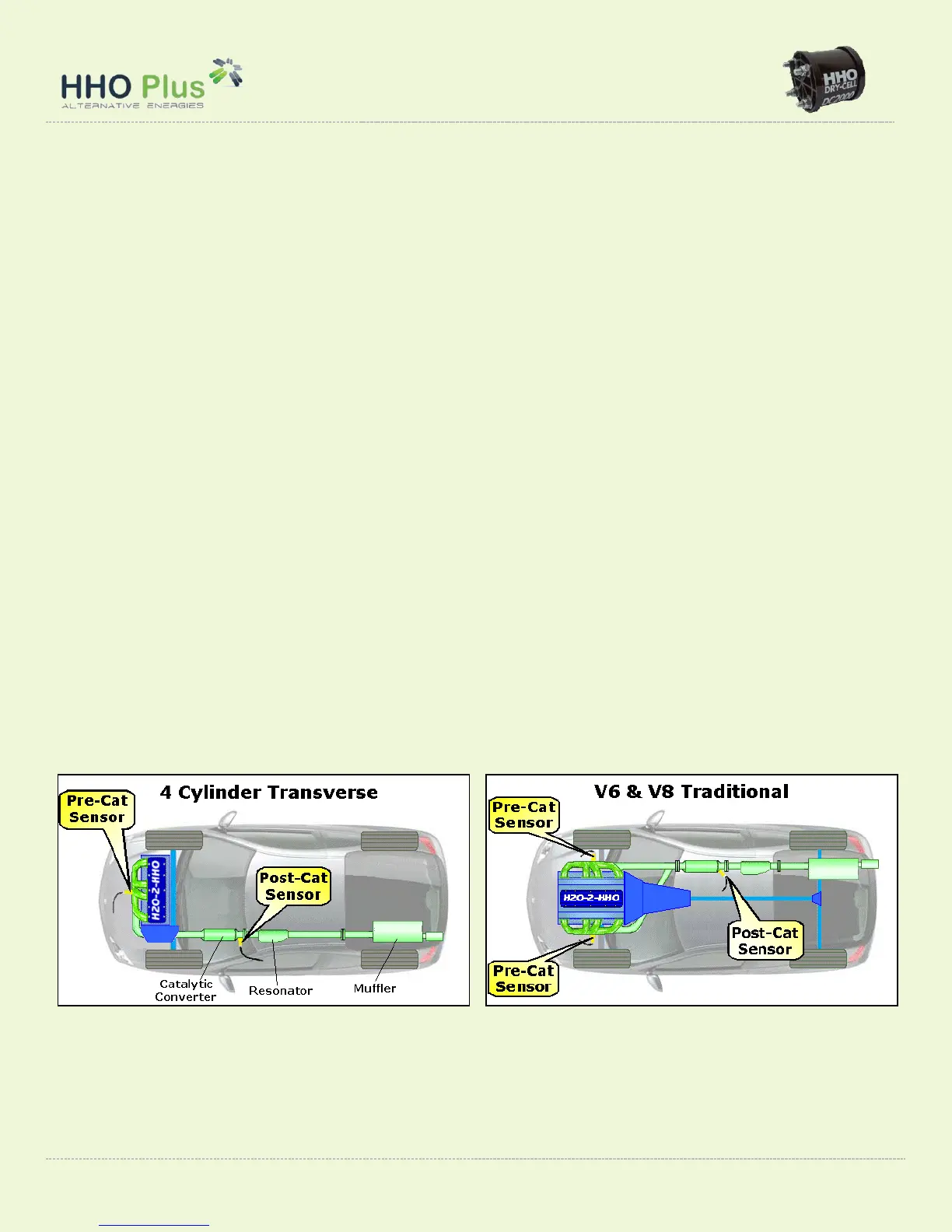
The lambda sensors can be found in a variety of places, depending on the vehicle make, model and engine
type. The accompanying illustrations depict some of the more common locations. As a general rule, each
exhaust manifold has at least one pre-cat sensor. Most vehicles manufactured since the early 1980s are
equipped with pre-cat sensors. With the advent of Onboard Diagnostic Systems II (OBDII) in the mid-1990s,
Lambda sensors were positioned both upstream and downstream of the catalytic converter.
Front (upstream) lambda sensor
Front or upstream lambda sensor located in the exhaust manifold or in the downpipe before catalytic
converter. It monitors the amount of oxygen in the exhaust gases and provides the "feedback" signal to the
engine computer. If the sensor senses high level of oxygen, the engine is running too lean (not enough fuel).


 To Next Page