
 Need help?
Do you have a question about the HIKVISION DS-D5022FN-C and is the answer not in the manual?
Provides instructions for using the product, subject to change without notice.
Details Hikvision trademarks and legal disclaimers regarding product use and liability.
Covers FCC compliance, interference guidelines, and necessary precautions for operation.
Details CE marking, WEEE, and Battery Directives compliance for European markets.
Specifies applicable models and defines symbols used in the manual for clarity.
Provides essential safety precautions for operating the monitor, including electrical safety.
Details critical safety warnings regarding battery ingestion, replacement, and disposal.
Covers ventilation, USB port usage, placement, installation, and hearing protection.
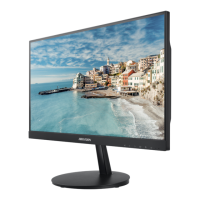
Highlights the monitor's main technical specifications and capabilities.
Lists all items included in the product package for user verification.
Guides on how to power on the device using AC or DC power sources.
Details the different rear panel interface configurations (Type A, B, C).
Explains the function of each port, including HDMI, VGA, AUDIO, and POWER.
Describes the function of each button located on the monitor's front panel.
Instructions on how to select the active input signal source for the monitor.
Covers accessing and adjusting image, VGA, system, OSD, and software version settings.
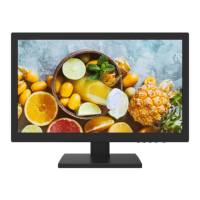
This document outlines the features, operation, and maintenance of the Hikvision 22-inch Monitor. Designed for a variety of environments, this monitor offers a user-friendly experience with robust display capabilities and customizable settings.
The Hikvision 22-inch Monitor serves as a visual display unit, primarily for presenting digital content from various input sources. Its core function is to provide clear, high-definition imagery, making it suitable for surveillance, office, and general multimedia applications. The monitor supports both AC and DC power devices, offering flexibility in different power supply environments. It is equipped with multiple input interfaces, including HDMI and VGA, to ensure compatibility with a wide range of devices such as computers, digital video recorders (DVRs), and network video recorders (NVRs). The monitor's internal processing capabilities include advanced image enhancement technologies like a 3D digital comb filter and 3D noise reduction, which work together to deliver sharper images and reduce visual artifacts, particularly in dynamic scenes. The monitor also features a Hi-Fi color OSD (On-Screen Display) and a user-friendly menu system, allowing for intuitive navigation and adjustment of display settings. Furthermore, it incorporates programmable 12-bit RGB gamma correction, which helps in achieving accurate color reproduction and consistent image quality across different content types. The inclusion of software spread spectrum technology is a notable feature, as it helps to reduce electromagnetic interference (EMI) radiation, contributing to a more stable and compliant operating environment.
The Hikvision 22-inch Monitor is designed for straightforward and flexible usage. Users can easily power on the device by connecting it to an appropriate power source, whether it's an AC mains socket-outlet or a DC power adapter, and then pressing the power button. The monitor's rear panel interfaces are clearly defined, with different types (Type A, Type B, Type C) offering varying combinations of HDMI, VGA, AUDIO, and DC 12V inputs, catering to diverse connectivity needs. For instance, Type A interfaces include HDMI, VGA, and AUDIO, along with AC power, while Type C provides HDMI, VGA, and DC 12V for power adapter use.
Switching between signal sources is a simple process, initiated by pressing a dedicated button on the panel to bring up the source page, where users can select their desired input (e.g., Auto, VGA, HDMI). The monitor's menu operation is intuitive, accessible via panel buttons located at the bottom-right corner of the front panel. These buttons allow users to navigate through the main menu, check first-level menus, and adjust various parameters. The "Menu" button typically exits the current page or displays the main menu, while "OK" confirms selections. "Add/reduce" buttons are used for adjusting values or navigating through options, and a "Switch to next one" button helps in cycling through menu pages.
The monitor offers extensive customization through its menu settings. Under "Image Settings," users can select from different picture modes such as Standard, Soft, Dynamic, and Custom. Each mode provides a preset configuration, and in Custom mode, users gain granular control over parameters like brightness, contrast, color, sharpness, and hue. This allows for fine-tuning the display to suit specific viewing preferences or environmental conditions. For instance, "Soft" mode is ideal for dark rooms, while "Dynamic" mode enhances visibility in bright rooms. The "Eye Protection" mode, available on certain models, helps reduce eye strain during prolonged use.
When using VGA as the input source, the "VGA Settings" menu becomes particularly useful. Here, users can adjust parameters like H-Position, V-Position, Phase, and Clock to ensure the picture is correctly positioned and scaled on the screen. The "Auto Adjust" function can automatically optimize these settings, especially when the device is restarted, a VGA input source is accessed, or the input source is switched to VGA. However, manual adjustments are also possible for precise control.
"System Settings" provide options for configuring general monitor behavior, including language selection, volume control (on applicable models), and screen saver preferences (Black Screen/Blue Screen). Users can also enable "Auto Sleep" to conserve energy after a period of inactivity and adjust the "Scaling Mode" (e.g., 16:9, 4:3) to fit different aspect ratios. The "User Restore" option allows for resetting settings to default, which can be helpful for troubleshooting or reconfiguring the monitor.
Finally, "OSD Settings" enable customization of the On-Screen Display itself. Users can adjust the horizontal and vertical position of the OSD menu, its transparency (Off/Weak/Medium/Strong), and the OSD Time Out duration (how long the OSD remains visible). A unique feature is "OSD Rotation," which, when enabled, rotates the OSD by 270 degrees clockwise, with the origin point at the bottom-left corner, offering flexibility for specific mounting orientations. The "Software Version" menu provides information about the monitor's firmware, which can be useful for support and updates.
Maintaining the Hikvision 22-inch Monitor involves adhering to several safety guidelines and best practices to ensure its longevity and safe operation. The manual emphasizes strict compliance with electrical safety regulations of the nation and region where the monitor is used. This includes ensuring the equipment is connected to an earthed mains socket-outlet and that the wiring for AC mains supply is correct. For DC devices, the correct power adapter (12 VDC, 2 A) must be used. Users are advised to power off the device and disconnect the plug if it is not in use for an extended period, which helps prevent potential electrical issues and conserves energy.
Environmental considerations are also crucial for maintenance. The monitor should not be exposed to dripping or splashing liquids, and no objects filled with liquids, such as vases, should be placed on it. Proper ventilation is essential to prevent overheating; therefore, ventilation openings should never be blocked by items like newspapers, tablecloths, curtains, or by placing the equipment on soft surfaces such as a bed or sofa. A minimum distance of 20 cm between the radiator and the user's body is recommended for safe operation.
The manual also provides specific instructions regarding battery safety, particularly for devices that contain a coin/button cell battery. It warns against ingesting the battery due to chemical burn hazards and advises keeping new and used batteries away from children. If the battery compartment does not close securely, the product should be stopped from use and kept away from children, and medical attention sought if a battery is suspected to have been swallowed. The risk of explosion is highlighted if the battery is replaced by an incorrect type, or if it is disposed of in fire, mechanically crushed, or exposed to extremely high temperatures or low air pressure. Used batteries must be disposed of according to instructions, often by returning them to the supplier or designated collection points, in compliance with directives like 2006/66/EC (Battery Directive).
For physical installation, the monitor must be securely attached to the floor or wall in accordance with installation instructions to prevent injury. It should be kept upright when moving or using it. The manual explicitly states that the equipment is for use only with a specified Hikvision monitor stand; using other carts, stands, or carriers may result in instability and potential injury.
Regarding the USB port, it is specified for connecting only to a mouse, keyboard, or USB flash drive, limiting its use to essential peripherals and preventing potential issues from unauthorized or incompatible devices. The manual also cautions against placing items that might tempt children to climb on top of the equipment, ensuring a safe environment.
Finally, the manual includes regulatory information, such as FCC compliance statements, which outline measures to correct potential interference issues (e.g., reorienting antennas, increasing separation from receivers). It also details EU Conformity statements, indicating compliance with EMC, LVD, and RoHS directives, and provides guidance on WEEE (Waste Electrical and Electronic Equipment) disposal, encouraging proper recycling of the product and its components. These guidelines collectively ensure that the monitor is maintained in a way that is safe, compliant, and extends its operational life.
 General
| Panel type | - |
|---|---|
| Color gamut | 72 % |
| Pixel pitch | 0.0831 x 0.241 mm |
| Screen shape | Flat |
| Response time | 6.5 ms |
| Backlight type | Direct LED |
| Display diagonal | 21.5 \ |
| Display technology | LED |
| Maximum refresh rate | 60 Hz |
| Viewable size, vertical | 260.28 mm |
| Contrast ratio (typical) | 3000:1 |
| Viewable size, horizontal | 478.656 mm |
| Display brightness (typical) | 250 cd/m² |
| HDMI | Yes |
| Energy efficiency scale | A to G |
| Power consumption (standby) | 0.5 W |
| Power consumption (typical) | 22 W |
| Storage temperature (T-T) | -20 - 60 °C |
| Operating temperature (T-T) | 0 - 40 °C |
| Storage relative humidity (H-H) | 10 - 90 % |
| Operating relative humidity (H-H) | 20 - 90 % |
| Panel mounting interface | 75 x 75 mm |
| Package depth | 403 mm |
| Package width | 644 mm |
| Package height | 108 mm |
| Package weight | 3800 g |
| Product color | Black |
| Market positioning | Business |
 Weight and Dimensions
| Bezel width (side) | 19.06 mm |
|---|---|
| Depth (with stand) | 200.2 mm |
| Width (with stand) | 492.356 mm |
| Height (with stand) | 390.11 mm |
| Weight (with stand) | 2500 g |
| Bezel width (bottom) | 30.87 mm |
| Depth (without stand) | 43.88 mm |
| Height (without stand) | 289.68 mm |




 To Next Page