12
Chapter 4 Product Installation and Use
4.1 Battery installation
The monitor adopts built-in Li-ion battery which is unable-dismantled, and do not replace it
without authorization, when the capacity of battery is going to run out, please recharge the
monitor by using USB.
4.2 Wear the monitor
Hingmed wearable ABPM is integration design, it suggests wearing the cuff on left arm,
click the power on/off button (the middle button) to open the monitor, and press it for about
5 seconds to close the monitor.
4.2.1 Wear cuff correctly
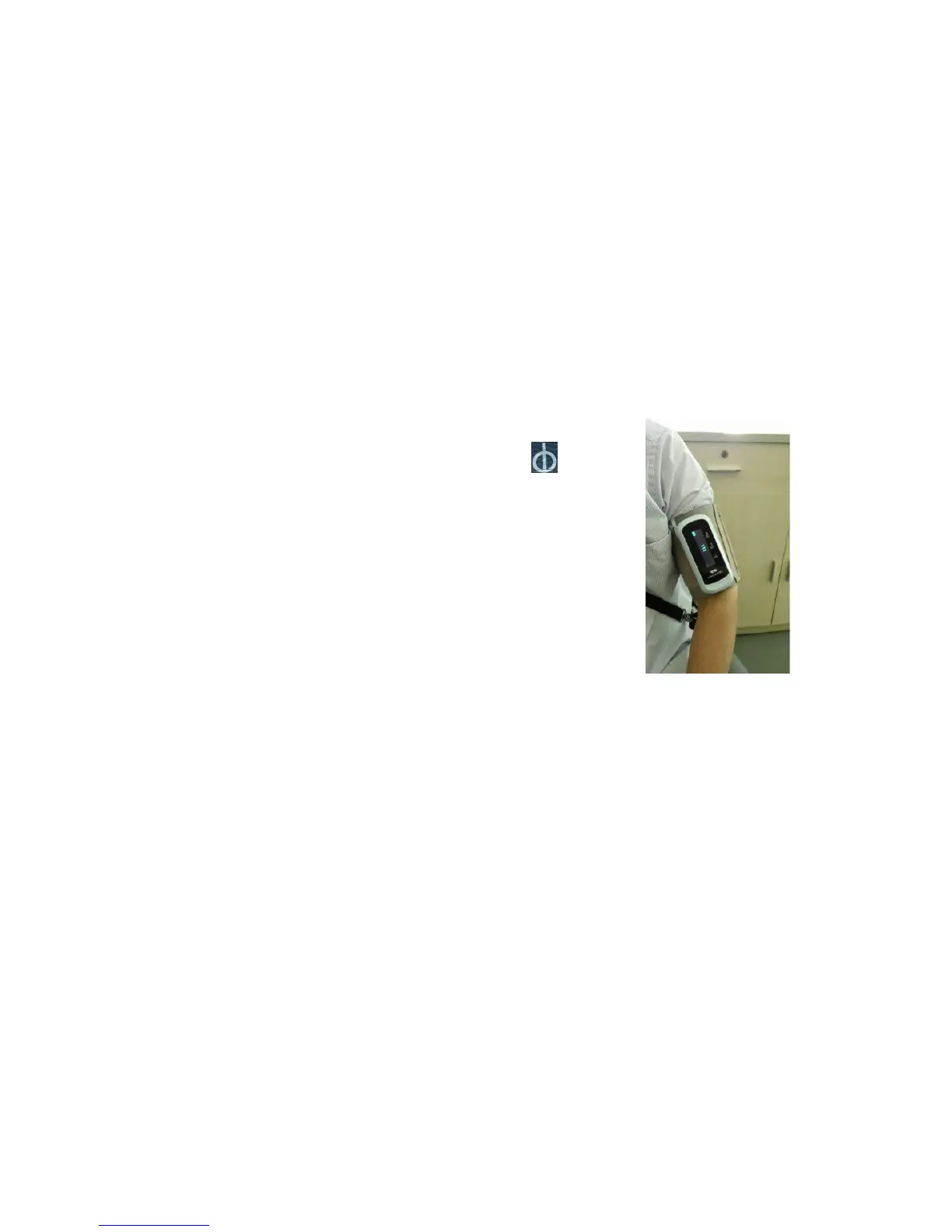
Wear cuff correctly, the bottom of the cuff should be 2-3 cm above
the fossa cubitalia. Make sure that the artery sign is against
the artery brachialis and points to fossa cubitalis, adjust the position
of monitor to outside place, see the picture right:
Note: 1 Improper size of cuff will lead to error of readings and
affect the accuracy of measuring.
2. Do not wrap the cuff on the diseased skin directly,
wrap a partition like cloth or film before wrapping the
cuff, to avoid cross-infection.
4.2.2 Start for single measurement
Press “start/stop” button to start measuring (the middle button), it
only measures for one time, after measuring, user can read the data on OLED screen,
also, user can click forward button or backward button to read history data.
For programming measurement, please refer to sections 4.3-4.4 of this user manual.
4.2.3 Ready for use
For ambulatory blood pressure study, a good preparation of patient is important.
● Patient should avoid overstress, excitement and tightened muscle.
● When start inflating, patient should keep the measuring arm away from body slightly,
and keep quiet and still as soon as possible.
● During programming monitoring, patient may press the button of “start/stop” to
start/stop measuring at any time.
● Never remove the cuff in the process of measuring, if the cuff slips below the elbow or
falls off, patient could take it off and rewrap.
● Data would not be lost if battery is run down, or monitoring program is interrupted, or,
monitor is manually force closed.
●Guidepatienttorecordtheeventsthataffectbodypositionobviouslyduringmeasuring;
● Make sure that patient know how to check the monitor. The monitor should be dry and
avoid falling and bumping.
● If monitor or cuff causes excessive pain or abnormal pain, patient should remove the



 To Next Page