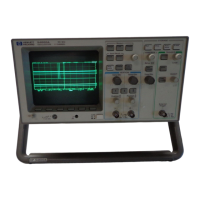
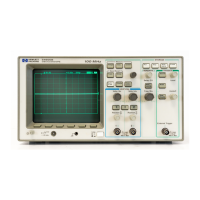
Model
182C Theory
SECTION
IV
PRINCIPLES OF
OPERATION
4 1. INTRODUCTION.
4-2. This section provides information
about
the circuits
used in the
Model 182C and
how they operate. Refer to
the overall
block diagram (Figure 4-1) and the schematics
in Section
VIII while reading the text.
4-3.
GENERAL DESCRIPTION.
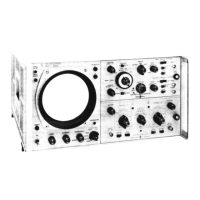
4-4. The Model 182C is
an X-Y axis
display instrument
designed to be used
with
a plug-in vertical
amplifier
and a
plug-in time base generator. The instrument contains the
CRT and its controls, low voltage and high voltage reg-
ulated power supplies, a horizontal amplifier, and a gate
amplifier.
A sweep-gate
output
amplifier and
a
calibrator
are also included,
4-5.
To obtain a useful display
on
the
CRT, three signals
are
necessary: vertical
deflection,
horizontal deflection
and intensity. The signal required for vertical
deflection
(Y-axis) of the
CRT is supplied from a plug-in vertical
amplifier. This signal is connected directly
to
the
CRT
vertical deflection plates. The horizontal (X-axis) deflec-
tion signal
Is
generated
by the time base plug in. It is
further
amplified by the oscilloscope horizontal amplifier
before being applied
to
the CRT horizontal deflection
plates.
4-6. The signal for
CRT
intensification
must be time
coincident with the horizontal deflection
signal to
increase
the CRT
brightness
as the beam is swept through the CRT
display area. This intensity determining signal
is
called the
unblanking gate. It is developed in the time base plug-in
and amplified
by
the
gate
amplifier for
application to
the
CRT control grid.
4 7. Signals for horizontal deflection
and intensity mod-
ulation may also be applied
to
the
oscilloscope
from
external sources other than the plug-in
units.
External
input jacks are provided for
this purpose.
4-8.
INPUT POWER.
4-9.
Either 115V or 230V
ac (±10%)
single phase,
48 to
440
Hz, can be applied as operating power. A rear-panel
SELECTOR switch
allows operation
from
either Input
line voltage. This switch connects two windings of the
instrument
power
transformer
in parallel for 115V oper-
ation. The SELECTOR switch also selects the proper size
fuse
for 115V or
230V
operation.
It is
not necessary
to
change fuses.
4 10.
With power
applied to the power
transformer
pri-
mary windings, several secondary voltages
are produced.
Rectified, filtered
and regulated
as
required,
they are
used
as
the source of power for
the various circuits of the
oscilloscope and for
operation of the vertical and
time
base
plug-ins.
4-11.
HORIZONTAL DEFLECTION.
4-12. The horizontal amplifier
may be used with either
internal or external deflection
signal sources. Positioning
the HORIZONTAL DISPLAY switch
to INT
arranges
the
circuitry to operate from
signals
supplied from
the time
base
plug-in.
In
this
condition ihe-IOOV power is applied
to the plug-in, allowing it to operate and produce both
a
sweep signal and an unblanking
gate
signal.
4 13. The sweep signal from the time base plug-in
is
coupled to the oscilloscope horizontal
output
amplifier.
Here it is converted to a differential signal, amplified
and applied
to
the CRT horizontal deflection
plates.
4 14. Horizontal position of the
X axis sweep signal is
controlled at the
input to the
first
stage of the horizontal
output amplifier.
A two section potentiometer, mechan-
ically interconnected,
is used to provide both fine and
coarse positioning controls
from a single knob.
4-15.
Horizontal amplifier
gam is controlled by the
MAGNIFIER switch.
Two settings can be selected:
XI or XI 0.
With
XI selected, the sweep speed corresportds
to
the
selected
time base plug-in sweep speed. In X10
operation the sweep speed
is
ten
times that selected
at
the time base plug-in.
4-16.
The unblanking gate from The Time
base plug-in is
coupled to the gate amplifier where
it is summed with the
Z-axis
input and chopped blanking
signals (if
they
are
applied). The resulting signal is amplified and coupled
through the high
voltage supply
to
the
CRT control grid
to set the intensity of
the displayed signals.
4-17,
At
the
end of each unblanking
gate the
gate ampli-
fier produces an alternate
trigger signal. This signal
is
coupled to the vertical
plug-in and is a negative
going
pulse. The alternate trigger is
used by
the
vertical plug-in
to synchronize the channel switching of multichannel
vertical plug-ins.
4-18.
With the HORIZONTAL
DISPLAY switch set to
EXT.
operating
power (-100V) is removed from
the time
base plug-in. Without
this -100V, the time
base plug-in
does not produce an internal
sweep signal or an
unblanking
gate.
4-1



 To Next Page