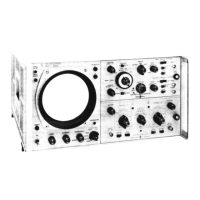
Model 182C
Table
8-2- Miscellaneous Troubleshooting
Tips
Symptom Suggested Checks
Intermittent deflection Check
for loose or corroded connections to
I
CRT neck pins.
Check for intermittent
open
in deflection
leads. (Refer to note for additional
tips.)
Intensity variation
causes trace shift
(either
axis).
Check for open deflection
lead in axis affected.
If trouble
is vertical axis, check vertical plug-
in connector and mating connector in oscilloscope.
No output from Gate or
Sweep
output jacks.
Check emitter-follower for
output affected
Check
circuit interconnections (cables, connectors).
Improper Z-axIs
modulation.
Check normal operation
with plug-ins installed.
If
OK,
check
connections and check in-puts.
(Refer
to note
for additional
tips.)
CRT trace develops
distortion over long
period.
Instrument may have been subjected
to
high
magnetic field, magnetizing
CRT elements.
Possible CRT malfunction.
Improper deflection If
symptom is apparent in both vertical
and
horizontal
axes,
check
High Voltage.
If
H.V. is low, expanded display results.
If
H.V. is high, causes contracted display.
Vertical
axis
only:
check vertical plug-in,
deflection leads and connectors.
Horizontal
axis only: check with replacement
time base plug-in. If OK. problem is in time
base plug-in.
otherwise
check oscilloscope
horizontal amplifier, deflection leads
and
connectors.
NOTE
It may
be
helpful
to isolate the Gate amplifier from the H.V. supply to
isolate
the
problem. Disconnect the Gate
Out cable connection from the
High Voltage supply
and
ground the High
Voltage Gate Coax connection.
This
will eliminate the
Gate
amplifier
as a source of H.V. intensity trouble.
In this mode, CRT intensity
will only be controlled
by
the INT LIMIT
adjustment. This potentiometer
is
located
on
the
H.V. Osc & Rectifier
Assembly, A6.



 To Next Page