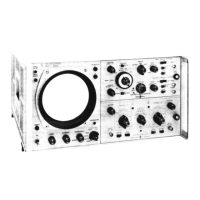
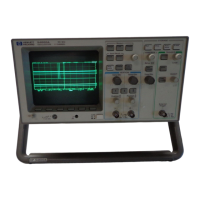
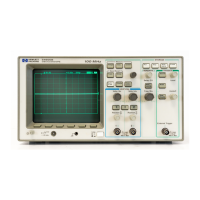
Model 182C
General Information
SECTION
I
GENERAL
INFORMATION
1-1. INTRODUCTION
.
1-2.
This manual provides operating and servicing infor-
mation for the Hewlett-Packard Model
182C Oscilloscope.
The
manual
is divided into
eight
sections,
each
covering
a
specific topic or
aspect
of the instrument.
All schematics
are located at the rear of the manual
and can be
unfolded
and
used
for reference while reading
any
part of the
manual
1-3.
This section contains complete instrument specifi
cations {Table 1-1),
a
description of features,
warranty in-
formation, data for manual and instrument identification,
and information regarding accessories available for use
with the instrument. Table
1-2
lists
and
describes the
abbreviations used in this manual.
1-4.
INSTRUMENT DESCRIPTION.
1-5.
The
Model
182C
(Figure 1-1) is
a
solid-state, light-
weight laboratory and general-purpose oscilloscope with
plug-in capabilities. It is designed to display complex high
frequency
waveforms and to measure alternating- and
direct-current voltages. Complete specifications
are given
in Table
1-1.
1-6. The Model 182C is a
cabinet type instrument with
a
built-in tilt stand, convenient carrying harrdle on
top, and
feet
mounted on both bottom and rear
for
either bench or
upright
operation.
Controls are
arranged and located to
simplify operation.
1-7.
For minimum size and weight with maximum reli-
ability. the
Model 182C has
solid-state
circuitry
through-
out except
for the
CRT.
Power consumption, with plug
ins,
is less
than
120
watts
at
normal line voltage. The instru-
ment is convection cooled and designed to operate within
specifications at temperatures between
0°
C and
55°
C
with
up to 95%
relative humidity at
40°
C.
1-8. Alt power supplies,
a dual output calibrator,
a
hori-
zontal amplifier,
a gate
amplifier
and the CRT are
contained in this instrument. Operation
at either 1 15V or
230V ac
is selectable
by a switch located on the rear
panel
of
the
oscilloscope.
Located on the rear
panel are
connectors
for
main and delayed
gate, and main
and
delayed sweep
output signals. Connection for input
of an
external signal for
intensity modulation (Z-axis
input) is
provided at the rear panel. An input signal of approx-
imately -I-2V having
a
pulse width of greater
than
about
50
ns will blank
a
trace of normal
intensity.
1-9.
The
Model
182C is designed to operate with a
number of different plug-in vertical amplifiers and time
bases.
Presently available plug-ins provide a wide choice
of operating capabilities such as wide bandwidth, sensi-
tivities,
dual or four-channel operation, single or delayed
sweeps, sampling and time-domain
reflectometer
oper-
ation.
1-10.
Modular type construction has been used through-
out
the instrument. This makes it easy and simple to
remove units
for quick maintenance. Assemblies are
constructed with interconnecting plugs and jacks and
each assembly can be
removed
without
unsoldering
connections.
1-11.
A
calibrator provides a square-wave signal of
approximately 1
kHz with
a
risetime of less than
3
fxsec.
The calibrator output is available at the front panel at
amplitudes
of
250 mV and 10V p-p with an accuracy
of
±1%. The signal may be used to check
horizontal
and
vertical
deflection factors
and to compensate divider
probes.
1-12.
The oscilloscope horizontal amplifier accepts sweep
signals from the time base plug-in or an external
signal.
Bandwidth is dc
to 5
MHz.
dc
-coupled,
and 5 Hz to 5 MHz
with capacitive coupling. Two deflection factor ranges are
front panel selectable: 1 V/div (XI), and
0.1 V/div ±5%
(X10). In addition,
a
vernier control provides
continuous
adjustment between ranges, The maximum
external input
level is 3(X) Vdc, ac-coupled. with a dynamic range of
+20V.
1-13. A beam finder pushbutton
control assists the oper-
ator in
rapidly bringing a displaced beam on screen. Its
use
increases intensity and reduces vertical
and horizontal
amplifier
gain to quickly locate trace position.
1-14. CATHODE-RAY
TUBE.
1-15.
The Model
182C uses a post-accelerator
aluminized
CRT with
a large eight by ten
division display area of
133 cm^. Each division is 1.29 cm with 0.2-div sub-
divisions provided
on the major
axes. The graticule
is
internal to the CRT,
eliminating display parallax.
Option
01 1 instruments are provided with
a
P11
phosphor CRT.
The display intensity
will not Increase when FIND BEAM
is depressed.
This prevents phosphor
burn.
1-16. The
standard CRT supplied with this
instrument
has a P31
aluminized phosphor, P2. P7 and P1
1
phosphors
are also
available as options.
1-1



 To Next Page