EasyManua.ls Logo

HP 3465B - AC-To-DC Converter; A-D Conversion Using a Monopolar Reference

HP 3465B
58 pages
Print Icon
To Next Page IconTo Next Page
To Previous Page IconTo Previous Page
Loading...
Section
IV
Model
3465B
4-47.
In
the
event
of
open
loop
(R^
=
°°),
the
ohms
amplifier
output
begins
to
drive
negative.
The
input
(negative
port),
which
is
the
auto-zero
output,
could
exceed
±
1
mV
under
an
open
loop
condition
due
to
the
lack
of
negative
feedback
through
an
R^.
This
auto-zero
output
must
be
maintained
at
<
±
1
mV
for
accurate
operation
of
the
A-D
converter.
To
satisfy
this
requirement,
an
over
load
protection
circuit
consisting
of
CR23,
CR24
and
R86
is
used.
When
the
ohms
amplifier
output
goes
below
approximately
-H.5
V,
the
zener
diode
(CR23)
turns
off.
The
overload
loop,
CR24
and
R86,
is
introduced
by
the
turn-on
of
CR24
when
CR23
is
off.
This
loop
provides
the
negative
feedback
required
to
maintain
an
auto-zero
output
<
±
1
mV.
When
an
R^
is
introduced,
CR23
turns-on,
CR24
turns-off,
and
the
overload
loop
is
inoperative.
4-48.
A
maximum
output
by
the
ohms
converter
of
<
5
V
is
guaranteed
by
a
voltage
divider
composed
of
R93
and
R95.
Additional
protection
components
of
the
ohms
converter
are:
A)
CR29
which
prevents
Q32
junction
breakdown
due
to
fast
transients,
B)
CR28
which
blocks
negative
transients
that
could
come
in
via
the
LO
terminal
point
and
C)
R91
and
C27
which
suppress
high
voltage,
high
frequency
transients.
4M-9.
Degradation
of
accuracy
in
the
ohms
function
due
to
changes
in
the
ohms
reference
with
respect
to
the
A—D
reference
is
minimized
since
both
reference
voltages
are
derived
from
the
same
-t
10
V
reference
supply.
If
the
reference
supply
voltage
changes,
both
the
ohms
reference
and
the
A—D
reference
are
affected
alike
and
any
change
is
effectively
cancelled.
4-50.
AC-to-DC
Converter.
4-51.
The
AC—to—DC
converter
is
an
average
responding
ac
converter.
It
has
a
bandwidth
of
40
Hz
to
20
kHz.
The
converter
is
composed
of
two
stages
(see
Figure
7-2).
The
fi
rst
stage,
U19,
is
an
impedance
converter.
The
purpose
of
this
amplifier
is
to
provide
a
high
impedance
to
the
input
so
loading
of
the
input
signal
does
not
occur.
It
also
provides
high
drive
capability
for
the
ac
converter
stage,
U18.
The
input
of
the
impedance
converter
is
protected
against
large
voltage
swings
by
diodes
CR35
and
CR37.
Voltages
in
excess
of
-t
10
V
or
-
7
V
peak
ac
will
forward
bias
these
diodes,
returning
excess
current
to
the
power
supply.
4-52.
The
impedance
converter,
U19,
has
a
selection
of
three
gains;
the
200
mV,
.2
mA,
200
and
20
V,
20
mA,
20
kf2
ranges
select
a
gain
of
10.
The
ac
current
function
selects
a
gain
of
9.964,
while
the
remainder
of
the
ranges
and
functions
select
a
gain
of
unity
(see
U19
Gain
Table,
Figure
7-2).
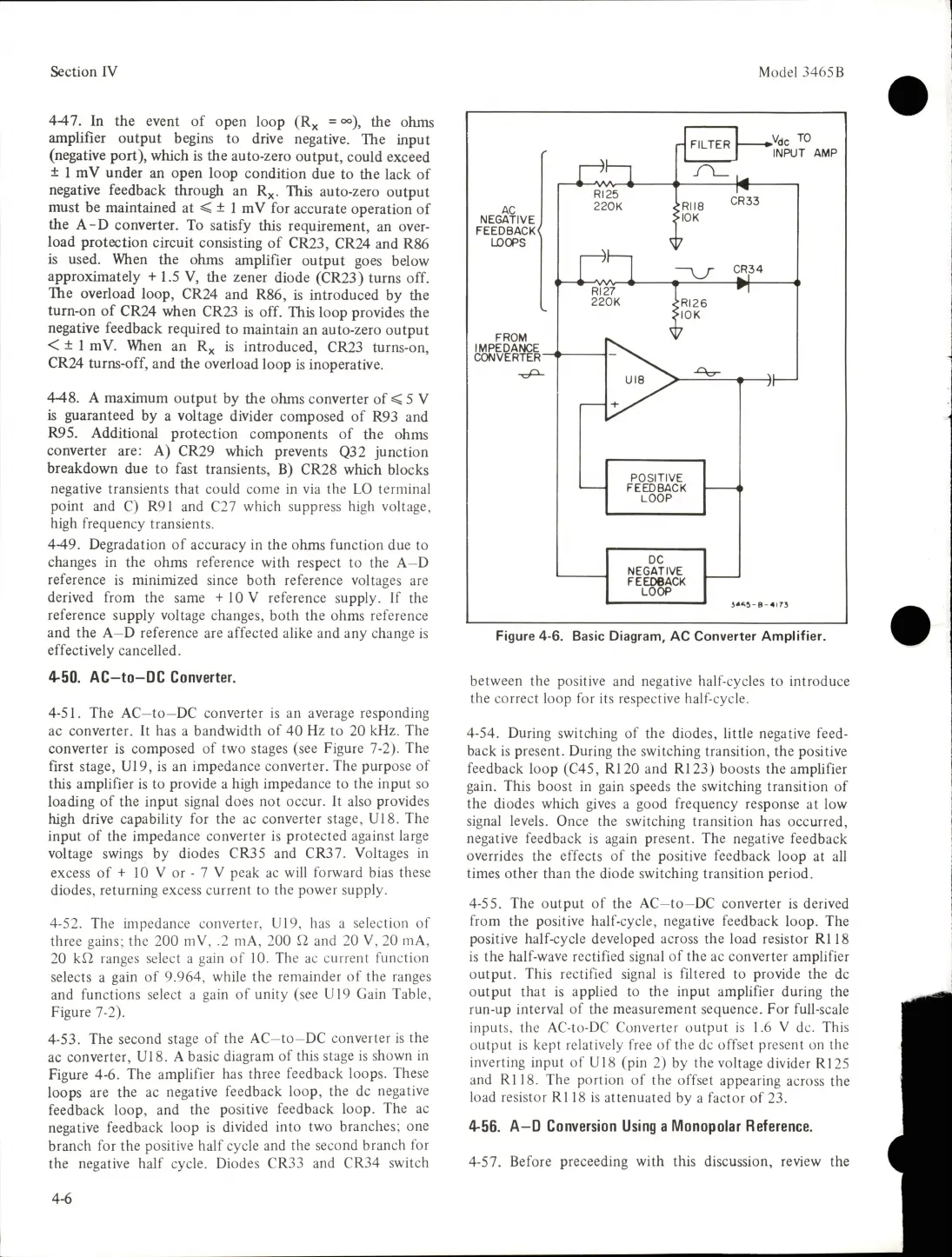
4-53.
The
second
stage
of
the
AC—to—DC
converter
is
the
ac
converter,
U18.
A
basic
diagram
of
this
stage
is
shown
in
Figure
4-6.
The
amplifier
has
three
feedback
loops.
These
loops
are
the
ac
negative
feedback
loop,
the
dc
negative
feedback
loop,
and
the
positive
feedback
loop.
The
ac
negative
feedback
loop
is
divided
into
two
branches;
one
branch
for
the
positive
half
cycle
and
the
second
branch
for
the
negative
half
cycle.
Diodes
CR33
and
CR34
switch
,V(jc
TO
INPUT
AMP
-•—wv—4-
RI25
220K
CR33
AC
NEGATIVE
FEEDBACKt
LOOPS
10
K
CR34
RI27
220K
RI26
lOK
FROM
IMPEDANCE
CONVERTER
UI8
FILTER
POSITIVE
FEEDBACK
LOOP
DC
NEGATIVE
FEEDBACK
LOOP
Figure
4-6.
Basic
Diagram,
AC
Converter
Amplifier.
between
the
positive
and
negative
half-cycles
to
introduce
the
correct
loop
for
its
respective
half-cycle.
4-54.
During
switching
of
the
diodes,
little
negative
feed
back
is
present.
During
the
switching
transition,
the
positive
feedback
loop
(C45,
R120
and
R123)
boosts
the
amplifier
gain.
This
boost
in
gain
speeds
the
switching
transition
of
the
diodes
which
gives
a
good
frequency
response
at
low
signal
levels.
Once
the
switching
transition
has
occurred,
negative
feedback
is
again
present.
The
negative
feedback
overrides
the
effects
of
the
positive
feedback
loop
at
all
times
other
than
the
diode
switching
transition
period.
4-55.
The
output
of
the
AC-to-DC
converter
is
derived
from
the
positive
half-cycle,
negative
feedback
loop.
The
positive
half-cycle
developed
across
the
load
resistor
R118
is
the
half-wave
rectified
signal
of
the
ac
converter
amplifier
output.
This
rectified
signal
is
filtered
to
provide
the
dc
output
that
is
applied
to
the
input
amplifier
during
the
run-up
interval
of
the
measurement
sequence.
For
full-scale
inputs,
the
AC-to-DC
Converter
output
is
1.6
V
dc.
This
output
is
kept
relatively
free
of
the
dc
offset
present
on
the
inverting
input
of
U18
(pin
2)
by
the
voltage
divider
R125
and
R118.
The
portion
of
the
offset
appearing
across
the
load
resistor
R118
is
attenuated
by
a
factor
of
23.
4-56.
A-D
Conversion
Using
a
Monopolar
Reference.
4-57.
Before
preceeding
with
this
discussion,
review
the
4-6

Table of Contents

Related product manuals