EasyManua.ls Logo

HP 3465B - Power Supply; Detailed Theory; Precision Resistor Pack (R75); Ohms Converter

HP 3465B
58 pages
Print Icon
To Next Page IconTo Next Page
To Previous Page IconTo Previous Page
Loading...
Model
3465
B
Section
IV
lator
and
applies
the
seven-segment
code
to
the
display
drivers.
The
display
drivers
apply
the
seven-segment
code
to
all
digits
simultaneously.
Digit
strobe
lines
activate
the
digit
corresponding
to
the
seven-segment
code
at
that
point
in
time.
Scanning
of
the
digits
is
from
the
most
significant
to
the
least
significant
digit.
To
complete
the
display,
the
proper
decimal
point
is
enabled
by
range
switching.
4-37.
Power
Supply.
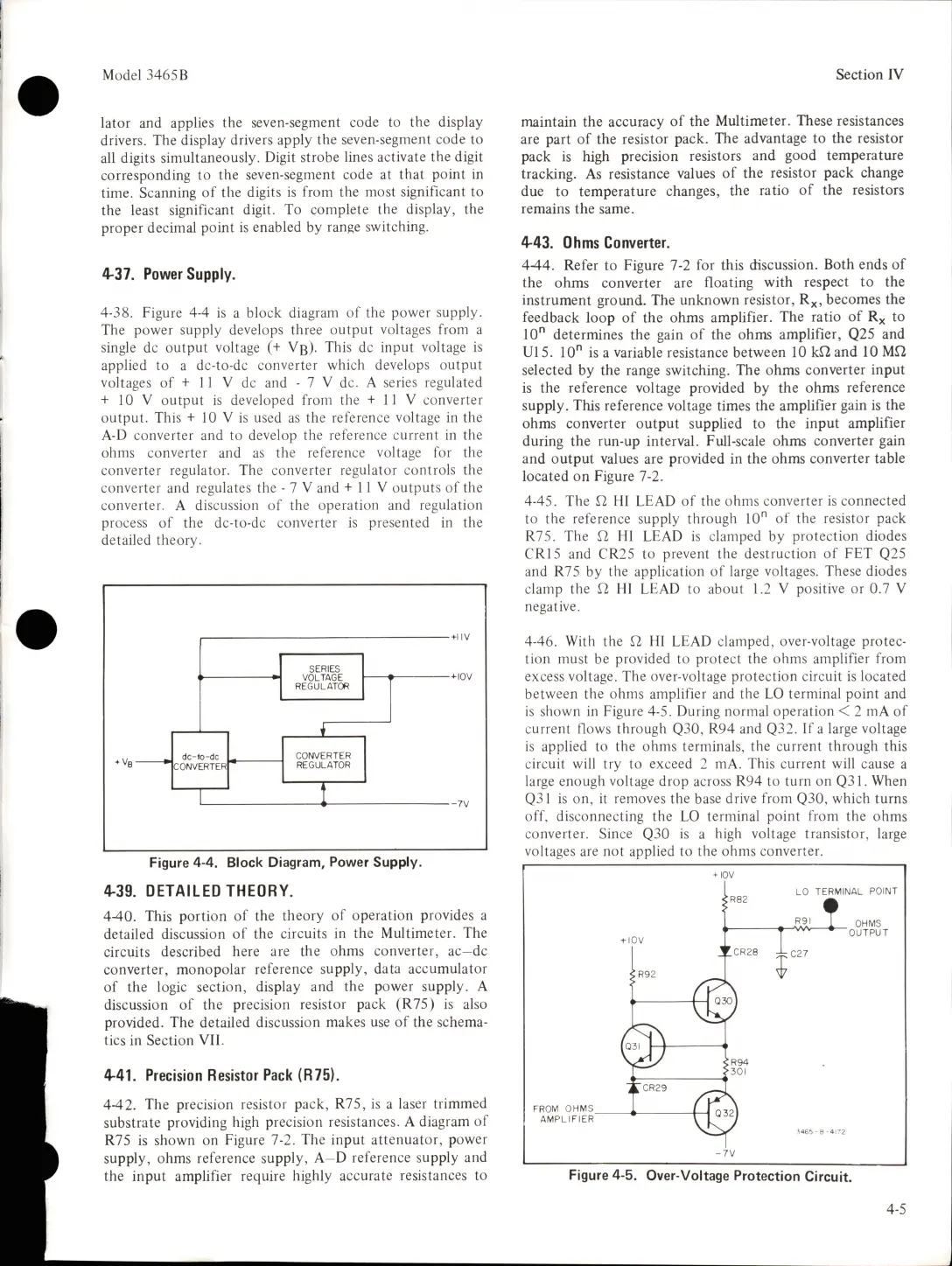
4-38.
Figure
4-4
is
a
block
diagram
of
the
power
supply.
The
power
supply
develops
three
output
voltages
from
a
single
dc
output
voltage
(+
Vb)-
This
dc
input
voltage
is
applied
to
a
dc-to-dc
converter
which
develops
output
voltages
of
-t
11
V
dc
and
-
7
V
dc.
A
series
regulated
+
10
V
output
is
developed
from
the
+
11
V
converter
output.
This
+
10
V
is
used
as
the
reference
voltage
in
the
A-D
converter
and
to
develop
the
reference
current
in
the
ohms
converter
and
as
the
reference
voltage
for
the
converter
regulator.
The
converter
regulator
controls
the
converter
and
regulates
the
-
7
V
and
-t
11
V
outputs
of
the
converter.
A
discussion
of
the
operation
and
regulation
process
of
the
dc-to-dc
converter
is
presented
in
the
detailed
theory.
SERIES
VOLTAGE
REGULATOR
dc-to-dc
CONVERTER
REGULATOR
CONVERTER
Figure
4-4.
Block
Diagram,
Power
Supply.
4-39.
DETAILED
THEORY.
4-40.
This
portion
of
the
theory
of
operation
provides
a
detailed
discussion
of
the
circuits
in
the
Multimeter.
The
circuits
described
here
are
the
ohms
converter,
ac—dc
converter,
monopolar
reference
supply,
data
accumulator
of
the
logic
section,
display
and
the
power
supply.
A
discussion
of
the
precision
resistor
pack
(R75)
is
also
provided.
The
detailed
discussion
makes
use
of
the
schema
tics
in
Section
Vll.
4-41.
Precision
Resistor
Pack
(R75).
4-42.
The
precision
resistor
pack,
R75,
is
a
laser
trimmed
substrate
providing
high
precision
resistances.
A
diagram
of
R75
is
shown
on
Figure
7-2.
The
input
attenuator,
power
supply,
ohms
reference
supply.
A—D
reference
supply
and
the
input
amplifier
require
highly
accurate
resistances
to
maintain
the
accuracy
of
the
Multimeter.
These
resistances
are
part
of
the
resistor
pack.
The
advantage
to
the
resistor
pack
is
high
precision
resistors
and
good
temperature
tracking.
As
resistance
values
of
the
resistor
pack
change
due
to
temperature
changes,
the
ratio
of
the
resistors
remains
the
same.
4-43.
Ohms
Converter.
4-44.
Refer
to
Figure
7-2
for
this
discussion.
Both
ends
of
the
ohms
converter
are
floating
with
respect
to
the
instrument
ground.
The
unknown
resistor,
Rx,
becomes
the
feedback
loop
of
the
ohms
amplifier.
The
ratio
of
Rx
to
10"
determines
the
gain
of
the
ohms
amplifier,
Q25
and
U15.
10"
is
a
variable
resistance
between
10
kfl
and
10
MS2
selected
by
the
range
switching.
The
ohms
converter
input
is
the
reference
voltage
provided
by
the
ohms
reference
supply.
This
reference
voltage
times
the
amplifier
gain
is
the
ohms
converter
output
supplied
to
the
input
amplifier
during
the
run-up
interval.
Full-scale
ohms
converter
gain
and
output
values
are
provided
in
the
ohms
converter
table
located
on
Figure
7-2.
4-45.
The
HI
LEAD
of
the
ohms
converter
is
connected
to
the
reference
supply
through
10"
of
the
resistor
pack
R75.
The
fl
HI
LEAD
is
clamped
by
protection
diodes
CR15
and
CR25
to
prevent
the
destruction
of
FET
Q25
and
R75
by
the
application
of
large
voltages.
These
diodes
clamp
the
HI
LEAD
to
about
1.2
V
positive
or
0.7
V
negative.
4-46.
With
the
SI
HI
LEAD
clamped,
over-voltage
protec
tion
must
be
provided
to
protect
the
ohms
amplifier
from
excess
voltage.
The
over-voltage
protection
circuit
is
located
between
the
ohms
amplifier
and
the
LO
terminal
point
and
is
shown
in
Figure
4-5.
During
normal
operation
<
2
mA
of
current
flows
through
Q30,
R94
and
Q32.
If
a
large
voltage
is
applied
to
the
ohms
terminals,
the
current
through
this
circuit
will
try
to
exceed
2
mA.
This
current
will
cause
a
large
enough
voltage
drop
across
R94
to
turn
on
Q31.
When
Q31
is
on,
it
removes
the
base
drive
from
Q30,
which
turns
off,
disconnecting
the
LO
terminal
point
from
the
ohms
converter.
Since
Q30
is
a
high
voltage
transistor,
large
voltages
are
not
applied
to
the
ohms
converter.
iOV
R82
LO
TERMINAL
POINT
FROM
OHMS_
AMPLIFIER
T
1
OHMS
OUTPUT
.y.CR28
V
.?465-B-4l72
Figure
4-5.
Over-Voltage
Protection
Circuit.
4-5

Table of Contents

Related product manuals