EasyManua.ls Logo

HP 48G - Page 15

HP 48G
84 pages
Print Icon
To Next Page IconTo Next Page
To Previous Page IconTo Previous Page
Loading...
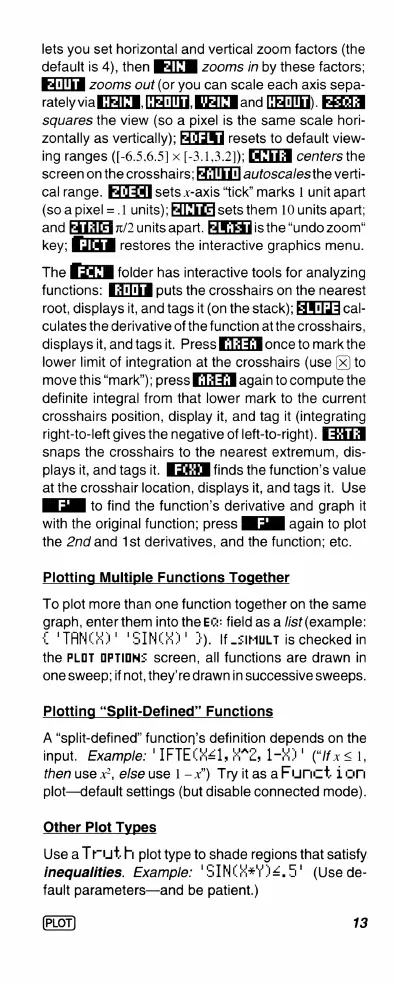
lets
you
set
horizontal
and
vertical
zoom
factors
(the
default
is
4),
then
[Tl
zooms
in
by
these
factors;
zooms
out
(or
you can
scale
each
axis
sepa-
rately
via
IIELN,
[HTH,
EERN
and
[EATH).
B
squares
the
view
(so
a
pixel
is
the
same
scale
hori-
zontally
as
vertically);
resets
to
default
view-
ing
ranges
([-6.5.6.5]
x
[-3.1,3.2]);
centers
the
screen
on
the
crosshairs;
autoscalesthe
verti-
cal
range.
[HI3H]
sets
x-axis
“tick”
marks
1
unit
apart
(so
apixel
=.1
units);
sets
them
10
units
apart;
and
m/2
units
apart.
isthe
“undo
zoom*
key;
restores
the
interactive
graphics
menu.
The
folder
has
interactive
tools
for
analyzing
functions:
puts
the
crosshairs
on
the
nearest
root,
displays
it,
and
tags
it
(on
the
stack);
cal-
culates
the
derivative
of
the
function
at
the
crosshairs,
displays
it,and
tagsit.
Press
IEIi3il
once
to
mark
the
lower
limit
of
integration
at
the
crosshairs
(use
to
move
this
“mark”);
press
i3l
again
to
compute
the
definite
integral
from
that
lower
mark
to
the
current
crosshairs
position,
display
it,
and
tag
it
(integrating
right-to-left
gives
the
negative
of
left-to-right).
snaps
the
crosshairs
to
the
nearest
extremum,
dis-
plays
it,
and
tags
it.
IIIEEH
finds
the
function’s
value
at
the
crosshair
location,
displays
it,
and
tags
it.
Use
I
to
find
the
function’s
derivative
and
graph
it
with
the
original
function;
press
I3l
again
to
plot
the
2nd
and
1st
derivatives,
and
the
function;
etc.
Plotting
Multiple
Functions
Together
To
plot
more
than
one
function
together
on
the
same
graph,
enter
them
into
the
Ei:
field
as
a
list
(example:
£
'THMCHY
Y
"STNCHY
'
1),
If
_2IMULT
is
checked
in
the
PLOT
OPTIOM:=
screen,
all
functions
are
drawn
in
one
sweep;
if
not,
they’re
drawn
in
successive
sweeps.
Plotting
“Split-Defined”
Functions
A
“split-defined”
function’s
definition
depends
on
the
input.
Example:
'
IFTECR£],
B,
1-82"
(“Ifx<
1,
then
use
x*,
elseuse
1
—x”)
TryitasaFurzt
iom
plot—default
settings
(but
disable
connected
mode).
Other
Plot
Types
Use
a
Tr
it
b
plot
type
to
shade
regions
that
satisfy
inequalities.
Example:
'SINCH#Y1£.5'
(Use
de-
fault
parameters—and
be
patient.)
13

Related product manuals