EasyManua.ls Logo

HP 8153A - Page 173

HP 8153A
282 pages
Print Icon
To Next Page IconTo Next Page
To Previous Page IconTo Previous Page
Loading...
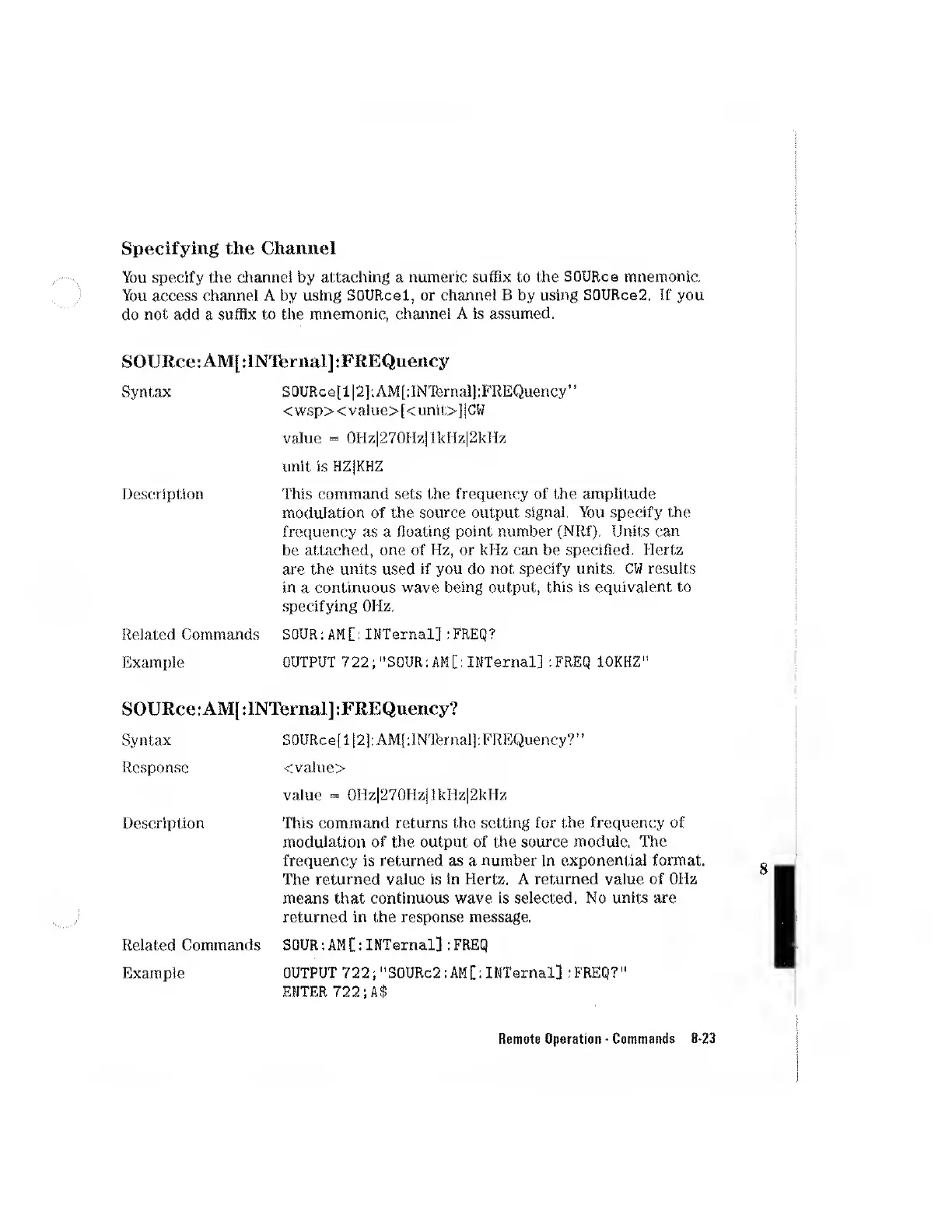
Specifying
the
Channel
You
specify
the
channel
by
attaching
a
numeric
suffix
to
the
SOURce
mnemonic.
You
access
channel
A
by
using
SOURcel,
or
channel
B
by
using
SOURce2.
If
you
do
not
add
a
suffix
to
the
mnemonic,
channel
A
is
assumed.
SOURce:AM[:INTernal]:FREQuency
Syntax
SDURce[l|2];AM[:INlbrnalj:FREQuency”
<wsp><value>[<unit>]jCW
value
=
OHzj270Hz|lkHz|2kHz
unit
is
HZ|KHZ
Description
This
command
sets
the
frequency
of
the
amplitude
modulation
of
the
source
output
signal.
You
specify
the
frequency
as
a
floating
point
number
(NRf).
Units
can
be
attached,
one
of
Hz,
or
kHz
can
be
specified.
Hertz
are
the
units
used
if
you
do
not
specify
units.
CW
results
in
a
continuous
wave
being
output,
this
is
equivalent
to
specifying
OHz.
Related
Commands
SOUR:
AM
[:
IMTernal]
:
FREQ?
Example
OUTPUT
722;
"SOUR:
AM[;
IMTernal]
iFREQ
lOKHZ"
SOURce:AM[:INTernal]:FREQueiicy?
saURce[li2]:AM[:INlbmal]:FREQuency?”
<value>
value
-
OHzj270Hz|ikHz|2kHz
This
command
returns
the
setting
for
the
frequency
of
modulation
of
the
output
of
the
source
module.
The
frequency
is
returned
as
a
number
in
exponential
format.
The
returned
value
is
in
Hertz.
A
returned
value
of
OHz
means
that
continuous
wave
is
selected.
No
units
are
returned
in
the
response
message.
Related
Commands
SOUR:
AM[;
IMTernal]
:FREq
Example
OUTPUT
722:'’S0URc2:AM[:IMTernal]
iFREQ?"
ENTER
722
;A$
Syntax
Response
Description
Remote
Operation
-
Commands
8-23

Other manuals for HP 8153A

Related product manuals