Need help?
Do you have a question about the HP E24i G4 and is the answer not in the manual?
Components with a surface greater than 10 sq cm, including I/F, SPS, Control, and Lens boards.
All types of batteries, including standard alkaline, coin, or button styles.
Components containing mercury, such as in lamps and backlights.
Displays with a surface greater than 100 sq cm, illuminated by gas discharge lamps.
Standard screwdriver for loosening screws.
Hexagon screwdriver for specific screw types.
Flathead screwdriver for prying or specific screws.
Press quick release button to separate the monitor head from the stand.
Loosen two screws with a screwdriver to remove the rear cover.
Pry open the rear cover using a flathead screwdriver and hands.
Remove tapes and unplug cables from components.
This document outlines the disassembly procedures for the HP E24i G4 monitor, model HSD-0056-Q, primarily for end-of-life recyclers and treatment facilities. Its core function is to guide the removal of components and materials that require selective treatment, adhering to the EU directive 2012/19/EC on Waste Electrical and Electronic Equipment (WEEE). The instructions are designed to ensure responsible recycling and disposal practices, focusing on environmental sustainability.
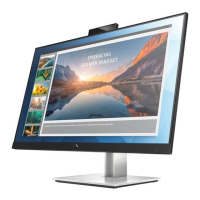
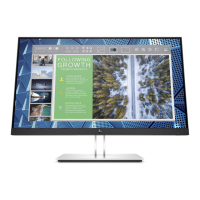
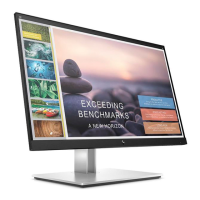
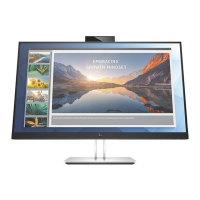
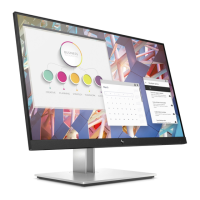
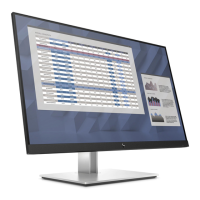
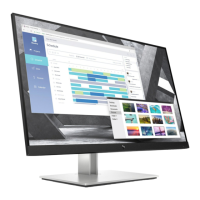
The monitor, identified as the E24i G4, is a display unit that integrates various electronic components to provide visual output. Its primary function is to serve as an interface for users to interact with computers and other video sources. As a modern display, it likely offers a range of features common to contemporary monitors, such as high-resolution display capabilities, various input options, and ergonomic adjustments. The disassembly guide focuses on the internal structure, revealing the complexity of its design and the types of materials used in its construction.
Usage features, from a user's perspective, would typically include its display quality, connectivity options (like HDMI, DisplayPort, and USB), and physical adjustability (e.g., tilt, swivel, height, and pivot). The mention of an "I/F Board," "SPS board," "Control Board," and "Lens Board" within the document hints at the sophisticated electronic architecture that enables these functionalities. The "I/F Board" (Interface Board) manages input signals, the "SPS board" (Switching Power Supply board) handles power distribution, the "Control Board" manages the monitor's settings and on-screen display, and the "Lens Board" might be related to specific optical components or backlighting. The presence of a "Panel" with a surface greater than 100 sq cm confirms it is a Liquid Crystal Display (LCD), which is the core visual component.
From a maintenance and end-of-life perspective, the document highlights several key features. It emphasizes the importance of sorting plastic materials based on their ISO 11469 marking code for proper recycling. This is a crucial maintenance feature for environmental responsibility, ensuring that plastics are not simply discarded but are channeled into appropriate recycling streams. The guide also explicitly lists items requiring selective treatment, which is a critical aspect of responsible product lifecycle management. These items include Printed Circuit Boards (PCBs) or Printed Circuit Assemblies (PCAs) with a surface greater than 10 sq cm, which are central to the monitor's electronic functions. The document specifies that the E24i G4 contains four such boards: an I/F Board, an SPS board, a Control Board, and a Lens Board.
Other components requiring selective treatment, as detailed in the guide, include batteries (excluding Li-Ion), Li-Ion batteries, mercury-containing components, LCDs with a surface greater than 100 sq cm, Cathode Ray Tubes (CRTs), capacitors/condensers (especially those containing PCB/PCT or electrolytic capacitors greater than 2.5 cm in diameter or height), external electrical cables and cords, gas discharge lamps, plastics containing Brominated Flame Retardants (BFRs) weighing over 25 grams, and components containing toner and ink. For the E24i G4, the document notes the presence of one LCD panel, one electrolytic capacitor (C605 in the SPS Board), and several external cables (HDMI, DP, USB, Power cord), which are included in the monitor carton box. It explicitly states that there are no batteries, mercury-containing components, CRTs, capacitors containing PCB/PCT, gas discharge lamps, BFR-containing plastics, or toner/ink components in this specific model. This detailed inventory is vital for recyclers to efficiently identify and separate hazardous or valuable materials.
The disassembly process itself is a maintenance feature, providing step-by-step instructions for safe and effective deconstruction. It begins with the separation of the monitor head from its stand, a common ergonomic feature that also facilitates packaging and transport. Subsequent steps involve removing the rear cover by loosening screws, using a flathead screwdriver to pry open the cover, and then systematically detaching internal components. This includes removing conductive tapes, insulating tape, and unplugging cables, which are all part of the internal wiring and shielding system. The guide then instructs on removing the internal shielding, which protects electronic components from electromagnetic interference and physical damage. Further steps involve removing insulating film, loosening screws (both standard and HEX screws) on the PCBs, and detaching gaskets, thermal pads, mylar, and spacers from the shielding. Finally, it details loosening screws on the middle frame and decoration to remove the deco and the panel itself.
The tools required for this disassembly process are also specified: a screwdriver (size 2), a Hexagon Screw Driver (size 1), and a Flathead screwdriver (size 1). This information is crucial for recyclers to prepare the necessary equipment, ensuring a smooth and efficient disassembly operation. The emphasis on specific tools and detailed steps underscores the precision required for proper selective treatment, preventing damage to recyclable components and ensuring the safe handling of potentially hazardous materials.
In summary, while the E24i G4 functions as a visual display unit with standard modern monitor features, this document primarily serves as a comprehensive guide for its end-of-life management. It meticulously details the components requiring selective treatment, their quantities, and the precise steps and tools needed for disassembly. This focus on environmental responsibility and efficient recycling is a key "maintenance feature" from a product lifecycle perspective, ensuring that the monitor's components are handled in an environmentally sound manner once its operational life concludes.
 General
| HD type | WUXGA |
|---|---|
| Color gamut | 99 % |
| Pixel pitch | 0.27 x 0.27 mm |
| Screen shape | Flat |
| Pixel density | 94 ppi |
| Display diagonal | 24 \ |
| Display resolution | 1920 x 1200 pixels |
| Display technology | - |
| Native aspect ratio | 16:10 |
| Maximum refresh rate | 60 Hz |
| Contrast ratio (dynamic) | 5000000:1 |
| Contrast ratio (typical) | 1000:1 |
| Digital vertical frequency | 50 - 60 Hz |
| Digital horizontal frequency | 30 - 80 kHz |
| Display brightness (typical) | 250 cd/m² |
| Supported graphics resolutions | 640 x 480 (VGA), 720 x 400, 800 x 600 (SVGA), 1024 x 768 (XGA), 1280 x 1024 (SXGA), 1280 x 800, 1440 x 900 (WXGA+), 1600 x 900, 1680 x 1050 (WSXGA+), 1920 x 1080 (HD 1080), 1920 x 1200 (WUXGA) |
| HP segment | Business |
| Certification | BIS; BSMI; CB; CCC; CE; CECP; CEL; EAC; ENERGY STAR®; FCC; ISO 9241-307; KC/KCC; NOM; PSB; SEPA; TCO Certified; TCO Certified Edge; TUV LBL; TUV-S; VCCI; WEEE; ISC; California Energy Commission (CEC); WW application; ICE; TGM; TUV-GS |
| Product color | Black, Silver |
| Country of origin | China |
| HDMI version | 1.4 |
| USB hub version | 3.2 Gen 1 (3.1 Gen 1) |
| Built-in USB hub | Yes |
| DisplayPort version | 1.2 |
| USB upstream port type | USB Type-B |
| USB Type-A downstream ports quantity | 4 |
| Pivot angle | -90 - 90 ° |
| Panel mounting interface | 100 x 100 mm |
| AC input voltage | 100 - 240 V |
| Power consumption (max) | 53 W |
| Power consumption (standby) | 0.5 W |
| Power consumption (typical) | 36 W |
| Operating temperature (T-T) | 5 - 35 °C |
| Operating relative humidity (H-H) | 20 - 80 % |
| Package depth | 420 mm |
| Package width | 605 mm |
| Package height | 224 mm |
| Package weight | 9120 g |
| Harmonized System (HS) code | 85285210 |
 Weight and Dimensions
| Depth (with stand) | 206.9 mm |
|---|---|
| Width (with stand) | 532 mm |
| Height (with stand) | 509.6 mm |
| Weight (with stand) | 6060 g |
| Depth (without stand) | 47 mm |
| Height (without stand) | 352.7 mm |

 To Next Page