Need help?
Do you have a question about the HP E27 G4 and is the answer not in the manual?
Printed Circuit Boards (PCB) or Printed Circuit Assemblies (PCA) requiring selective treatment.
Batteries, excluding Li-Ion, requiring selective treatment.
Li-Ion batteries requiring selective treatment.
Mercury-containing components and LCDs over 100 sq cm.
Capacitors, CRTs, and Gas Discharge Lamps.
External electrical cables and plastics containing BFRs.
Components containing toner and ink, including liquids.
Components containing asbestos, ceramic fibers, or radioactive substances.
List of tools typically used for product disassembly.
Steps to separate the head/stand and remove the rear cover.
Disconnecting cables, removing Mylar, and loosening PCBs.
Removing decorative panels and the display panel.
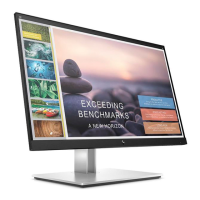
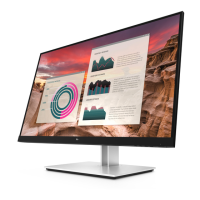
This document outlines the disassembly instructions for the HP E27 G4 monitor, also identified by the model HSD-0057-Q. It serves as a guide for end-of-life recyclers and treatment facilities, detailing the process for removing components and materials that require selective treatment, in accordance with the EU directive 2012/19/EC on Waste Electrical and Electronic Equipment (WEEE). The primary function of this document is to facilitate responsible recycling and disposal by providing clear, step-by-step instructions for dismantling the monitor and isolating specific parts.
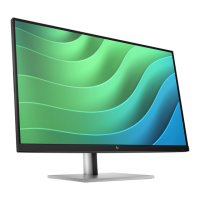
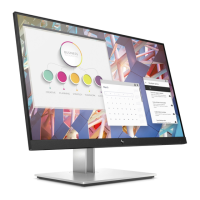
The monitor itself is designed for general display purposes, likely for office or home use, given its "Monitors & Display" product category. While the document focuses on its end-of-life process, the presence of various circuit boards (I/F Board, SPS board, Control Board, USB Board) and cables (HDMI, DP, USB, Power cord) indicates its capability to connect to multiple devices and display high-quality visuals. The inclusion of an LCD panel with a surface greater than 100 sq cm suggests a standard-sized monitor, providing ample screen real estate for various tasks.
From a usage perspective, the monitor is likely user-friendly, as indicated by the quick-release button for separating the head and stand. This feature suggests ease of assembly and disassembly for initial setup or transport. The internal components, such as the various PCBs and the LCD panel, are integral to its function, enabling it to process video signals and display images. The mention of "gaskets and thermal pad on shielding" implies a design that manages heat effectively and protects internal components, contributing to the monitor's longevity and reliable performance during its operational life.
Maintenance features, as described in the disassembly process, are primarily focused on the end-of-life stage rather than routine user maintenance. The instructions detail how to access internal components, which would be relevant for professional repair or recycling. For instance, the process of removing the rear cover, unplugging cables, and loosening screws on PCBs are all steps that would be taken by a technician or recycler. The document also highlights the importance of sorting plastic materials based on ISO 11469 marking codes, which is a crucial aspect of environmental responsibility and sustainable recycling practices. This emphasis on material identification underscores a commitment to proper waste management and resource recovery.
The document also implicitly touches upon safety considerations during disassembly. The removal of conductive tape and the careful unplugging of cables suggest that certain components might carry electrical charges or require careful handling to prevent damage or injury. The detailed steps, such as loosening specific numbers of screws (e.g., two for the rear cover, six for PCBs, nineteen for the middle frame), provide a precise guide for dismantling, ensuring that components are removed systematically and without unnecessary force.
In summary, while this document is a disassembly guide, it indirectly reveals the design and functional aspects of the HP E27 G4 monitor. It is a display device with multiple connectivity options, designed for ease of initial setup and, crucially, for responsible end-of-life management. The detailed instructions for selective treatment components underscore the manufacturer's adherence to environmental regulations and commitment to sustainable product lifecycle practices. The monitor's construction, with its various circuit boards, display panel, and internal cabling, points to a standard, functional display unit suitable for a wide range of computing tasks.
 General
| Pixel pitch | 0.233 x 0.233 mm |
|---|---|
| Screen shape | Flat |
| Display diagonal | 27 \ |
| Display technology | LED |
| Native aspect ratio | 16:9 |
| Vertical scan range | 48 - 75 Hz |
| Maximum refresh rate | 60 Hz |
| Horizontal scan range | 30 - 90 kHz |
| NTSC coverage (typical) | 72 % |
| Viewable size, vertical | 335.6 mm |
| Contrast ratio (dynamic) | 5000000:1 |
| Contrast ratio (typical) | 1000:1 |
| Display number of colors | - |
| Viewable size, horizontal | 596.7 mm |
| Display brightness (typical) | 250 cd/m² |
| HP segment | Business |
| Built-in microphone | Yes |
| Product color | Black |
| Country of origin | China |
| HDMI version | 1.4 |
| DisplayPort version | 1.2 |
| USB Type-A downstream ports quantity | 4 |
| USB Type-C downstream ports quantity | 0 |
| Pivot angle | -90 - 90 ° |
| Tilt angle range | -5 - 20 ° |
| Number of OSD languages | 10 |
| Panel mounting interface | 100 x 100 mm |
| Depth | 47 mm |
| Width | 611.7 mm |
| Height | 363.6 mm |
| Weight | 6900 g |
| Energy efficiency scale | A+++ to D |
| Power consumption (max) | 175 W |
| Power consumption (standby) | 0.5 W |
| Power consumption (typical) | 80 W |
| Operating temperature (T-T) | 5 - 35 °C |
| Cables included | DisplayPort, HDMI, USB |
| Package depth | 444 mm |
| Package width | 695 mm |
| Package height | 225 mm |
| Package weight | 10400 g |
| Harmonized System (HS) code | 85285210 |
 Weight and Dimensions
| Depth (with stand) | 53.52 mm |
|---|---|
| Width (with stand) | 61.17 mm |
| Height (with stand) | 535.2 mm |
| Depth (without stand) | 4.7 mm |
| Height (without stand) | 36.36 mm |

 To Next Page