nt
r
• Water S
stems
.
The fresh and raw water s
stems consist of the followin
om
onents
ockside Water
uppl
r
t
r
n
n
Fresh Water Pum
A
oolin
Pum
aw Water Pick-u
and Strainer
A
Pick-up and
trainer
En
ine
eacocks and
trainers
xt
r
n
v
W
t
r H
t
r
.1 Water Tanks
on board water suppl
The
resh water s
stem on
our boat has one water tank
totalin
50
allons
189L
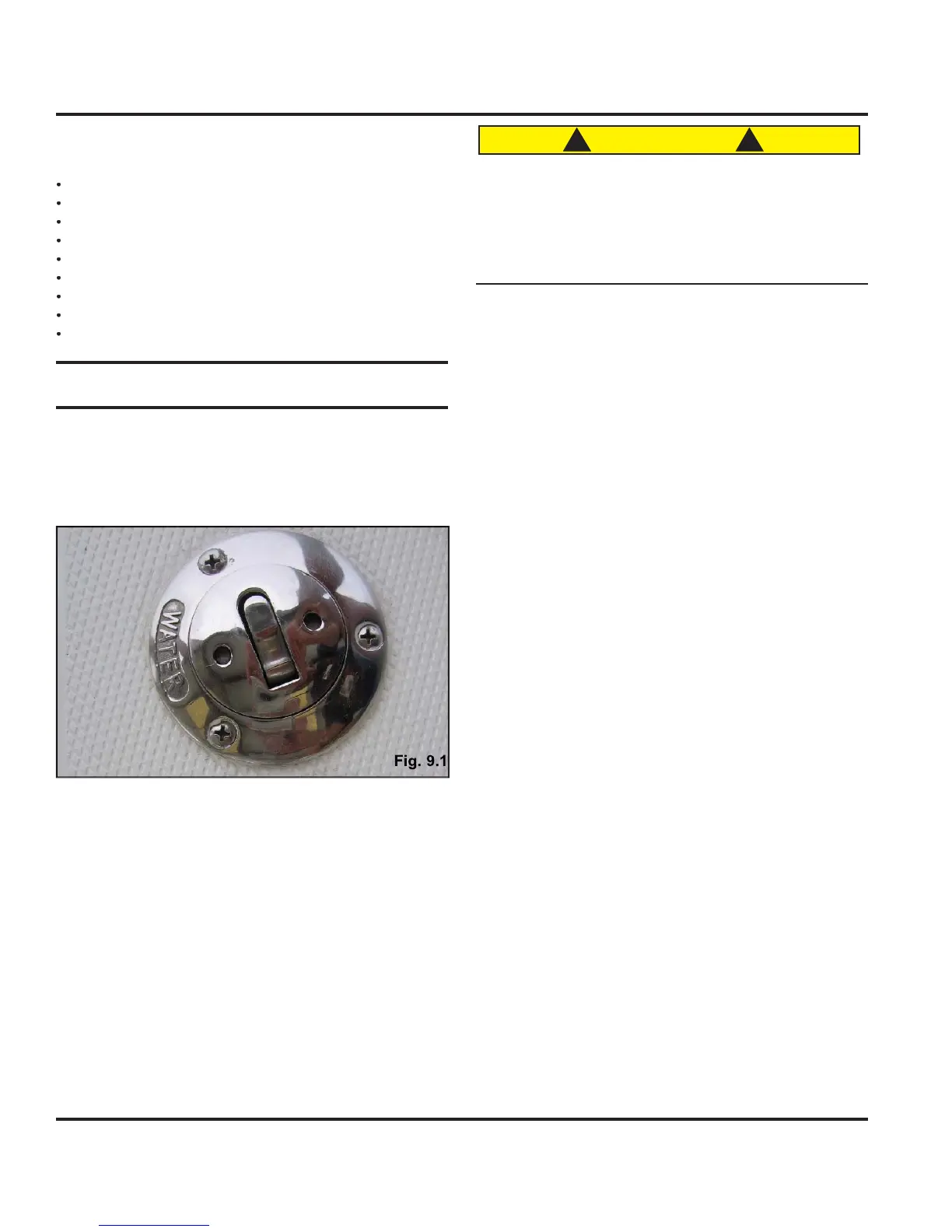
and one fresh water fill
Fi
.
.1
located at the bow. The vent for the tank is located
n the side o
the hull, at the
ill.
ee the arran
ement
drawin
at the end of this chapter for locations.
Note: Whenever servicing the fresh water pumps, shut off the
DC breaker for the water system.
.1.1 To fill the fresh water tank
1. Make sure the potable water suppl
is suitable
or
drinkin
. Not all potable water is drinkin
water. Check
with the dockmaster i
necessar
.
2.
pen the water tank fill fittin
. Fi
. 9.
. Usin
the hose
rom the potable water suppl
,
ill the
tank until water starts flowin
throu
h the vent.
4.
lose the
ill
ittin
CAUTION
! !
Alwa
s ensure that when fillin
the fresh water tanks
that
ou are fillin
throu
h the fresh water fill. Other
ills or pump outs ma
visuall
look the same. Fillin
fresh water in to the waste pump out could flood
our boat, or fillin
the diesel fuel tank could dam-
e
our fuel s
stem.
.1.2 Fresh Water Sanitation
NOTE: Be sure and read the OEM manuals that are supplied
with your boat, the next section is taken from one of those
manuals.
anitizin
Potable water s
stems require periodic main-
t
n
n
t
liv
r
n
i
t
nt
l
w
r
h w
t
r.
ependin
on use and the environment the s
stem is
su
ecte
to, san
t
z
n
s recommen
e
pr
or to stor
n
and be
ore usin
the water s
stem a
ter a period o
stor-
a
e.
stems with new components, or ones that have
een su
ecte
to contam
nat
on, s
ou
a
so
e
s
n-
t
ll
w
NOTE: The sanitizing procedure is in conformance with the
approved procedures of the US Public Health Service.)
1. Use the followin
methods to determine the amount o
mm
n h
h
l
l
h n
t
nitiz
th
t
nk
A. Multipl
“
allons of tank capacit
” b
0.13; the result
is the ounces o
bleach needed to sanitize the tank
30
allons X .13 = 3.9 oz bleach
.
B. Use the number o
liters o
tank capacit
to determine
th
n
m
r
f millilit
r
f
l
h n
t
nitiz
the tank
120 liters of tank capacit
= 120 milliliters o
bleach
2. Mix into solution the
ro
er amount of bleach within a
nt
in
r
w
t
r
. Pour the solution
water/bleach
into the tank and fill
the tank with potable water
4.
pen all faucets
hot and cold
allowin
the water to
r
n
ntil th
i
tin
t
r
hl
rin
i
t
t
. The standard solution must have four
4
hours o
ontact time to disin
ect completel
. Doublin
the solution
oncentration allows for contact time of one
1
hour
. When the contact time is completed, drain the tank.



 To Next Page