Need help?
Do you have a question about the Huvitz CDR-3100 and is the answer not in the manual?
This document is a service manual for the HUVITZ CDR-3100 refractor, providing detailed information for maintenance and troubleshooting.
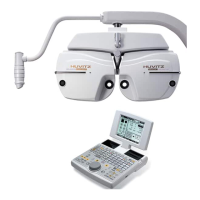
The HUVITZ CDR-3100 is a refractor designed for eye examination, specifically for measuring refractive errors. It utilizes a system of disks and gears to present various lenses and prisms to the patient's eye, allowing for precise determination of vision correction needs. The device can be controlled via an Operation Panel, which is crucial for both normal operation and service procedures like calibration.
The internal structure of the CDR-3100 involves multiple disk assemblies (DISK1 ASS'Y to DISK6 ASS'Y), SPH-GEAR ASS'Y, VD-MIRROR ASS'Y, and I-GEAR ASS'Y, as detailed in the "Main body (#1)" section. These components are responsible for the optical functions of the refractor.
The "Main body (#2)" section highlights sensor components: DISK1 SENSOR ASS'Y, DISK3 SENSOR ASS'Y, AUX-GEAR2 SENSOR ASS'Y, AUX-GEAR3 SENSOR ASS'Y, DISK2 SENSOR ASS'Y, DISK4 SENSOR ASS'Y, REF-PLATE ASS'Y1, REF-PLATE ASS'Y2, and DISK5 SENSOR ASS'Y. These sensors are critical for monitoring the position and movement of the various disks and gears, ensuring accurate measurements.
The "Main body (#3)" section lists the motors driving the system: DISK2 MOTOR, DISK1 MOTOR, DISK5 MOTOR, DISK4 MOTOR, DISK3 MOTOR, AUX-GEAR3 MOTOR, DISK6 MOTOR, AUX-GEAR2 MOTOR, AUX-GEAR1 MOTOR, and DISK6 SENSOR ASS'Y. These motors facilitate the precise rotation and positioning of the optical components.
The "Auxiliary gear ass'y" consists of AUX-GEAR1, I-GEAR SPACER2, I-GEAR SPACER1, I-AXIS HOLDER, I-GEAR AXIS, I-GEAR SPACER, and AUX-GEAR2. These parts contribute to the auxiliary gear mechanism.
The "SPH gear ass'y" includes SPH SHAFT TOP, SPACE WASHER, DISK1 GEAR, SPH-SHAFT, SPH-SHAFT BASE, and DISK2 GEAR, which are essential for the spherical lens adjustments.
The "REF-PLATE ass'y" comprises REF-PLATE HOLDER1, REF-PLATE HOLDER2, REF-PLATE SHAFT, and REF-PLATE, which are involved in the reference plate mechanism.
The device's power supply system, as described in the "Wiring diagram of the CDR-3100 Junction Box," supports AC 100-120V/200-240V input. The Junction Box contains an SMPS (Switched-Mode Power Supply) that outputs DC 18V for motors, DC 5V for all digital circuitry, and DC 7V for the thermal printer. It also includes fuses for protection.
Communication within the device relies on CAN (Controller Area Network) boards. The "CAN board (interior type)" and "CAN board (exterior type)" diagrams show connections for CANH, CANL, 5V, RX, NC, and GND, with a DC 9V power input for the exterior board. The communication port supports CANH and CANL signals. The manual specifies that CAN communication uses only 2 wires, the main line can reach up to 100m, and the sub line is limited to 3m. A terminator must be placed at the ends of the main line, and only one terminator is needed if there is only one system on the CAN.
The CDR-3100 is designed for precise refractive error measurement. The "2.2 Simplified procedures for the 2nd QC check" section outlines the steps for aging tests and post-aging test procedures. These include checking PD adjustment, convergence function, initialization sequences, and auxiliary lenses. The device allows for adjustment of PD (pupillary distance) and convergence, and the selection of auxiliary lenses. The operation panel provides a user interface for these functions, with specific key sequences for various adjustments.
The "2.3 Recommended system configuration for QC check" illustrates how multiple Refractor Bodies can be connected in a daisy-chain configuration for QC checks, with a maximum length of 500m. An Operation Panel (QCs version) and Junction Box are used in this setup.
The service manual provides comprehensive instructions for maintenance, including disassembling procedures, parts descriptions, replacement procedures, and troubleshooting.
Disassembly and Assembly:
Lens Cleaning:
Troubleshooting:
Calibration:
The manual emphasizes that modifications without prior notice for improvement are possible, and in case of instrument repair, product and problem status information (serial number, product version, OS details, symptom) should be provided to HUVITZ.
 General
| Brand | Huvitz |
|---|---|
| Model | CDR-3100 |
| Category | Medical Equipment |
| Language | English |

 To Next Page