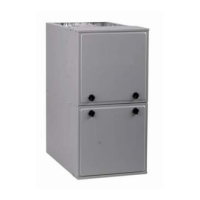
Two- Stage Multi Position Furnace
Service
Manual
10
440 08 2002 02
12. CONTROL WIRING
Control wiring is an important part of the total equipment
installation, since it provides the vital communications link
between t he ther mos t at , and t he equipm ent . It is oft en
overlooked as the source of equipment malfunctions. Con-
trol wiring that is either too long, undersized, or improperly
connect ed (be it simply loose, or on the wrong t er minal)
can in fact be the source of many equipment problems.
ALWAYS check to make sure that the control wiring is con-
nected to the proper terminal(s) of the equipment and ther-
most at you are us ing. Rem ember, also, t hat t her mos t at
terminals are not always identified alike by different ther-
mostat manufacturers. Connections MUST be clean and
tight to insure trouble--free operation.
The cont r ols of this series of 2--Stage furnac es ar e de-
signed to provide 2--Stage operation using a Two (2) Stage
Thermostat, ONLY as follows:
The 2--stage furnace control will operate with either a single
stage or a two stage heating thermostat and will provide
2--stage heating operation. For single stage thermostat
installations, the R and W wires from the thermostat connect
to the R and W1 connections on the furnace control. Note:
The fourth (4th) DIP switch must be in the off position, failure
to change DIP switch will result in Lo Fire ONLY operation.
(See furnace wiring digram) See “Furnace Wiring Diagram”
for switch settings. Failure to set DIP switch will result in Lo
fire operation ONLY with single stage thermostat. During op-
eration, the furnace will operate on low fire for 12 minutesIf
the heat request exists for more than 12 minutes. If the heat
request exists for more that 12 minutes, the furnace will auto-
matically shift to the high fire mode for the remaining duration
of the heating cycle. For two stage thermostat installations,
the R, W1 and W2 wires from the thermostat connect to the
R, W1 and W2 connections on the furnace control. During
operation, the furnace will shift from low fire to high fire as
requested by the thermostat. The thermostat heat anticipa-
tors should be adjusted to a .10 setting for both types of ther-
mostats.
Low voltage connections to furnace must be made on termi-
nal board to fan control.
The ELECT RO NI C CONT RO LS us ed on this s eries RE-
SPOND DIFFERENTLY to certain control wiring practices
which have been generally accepted in the HVAC industry
for many years.
For Example: For years, installers have run a wire from the
“Y” term inal of t he room t her mos t at and connec t ed it di-
rectly to the contactor coil of a condensing unit. (not mak-
ing any connection to the furnace with this wire) Then, run
the low voltage “Common” wire from the condensing unit
back to the “C” terminal of the furnace.
With the HO NE YW E L L S T 9162A elect r onic F an Timer/
Furnace Control used in the models of this series, howev-
er, the “Y” terminal of the furnace does in fact serve a par-
ticular purpose. Failure to connect it will result in certain
improper operation as follows:
The COOLING fan speed is energized via the “Y” terminal.
Failure to connect the thermostat “Y” terminal to the “Y”
terminal on the control will result in the failure to energize
the COOLING speed on a call for cooling from the thermo-
stat. (Depending upon the model, either the LOW HEAT-
ING speed or the CIRCULATING speed will be energized
instead via the “G” terminal)
For more detailed information about this control, see the
section on the ST9162A control beginning on page 23 of
this manual.
13. LIMIT SWITCHES
T wo (2) different kinds of limit switches are used on this se-
ries of furnaces. They are the main limit and roll out limit
switches. The main limit, and roll out limit switches are used
on all models.
NOTE: All limit switches are safety devices and other
than for testing purposes, should never be jumped out!
Limit switches are “normally closed” electrical switches, de-
signed to open when their predetermined “limit setting” has
been reached.
It should also be remembered, that when a limit switch
opens, it more than likely is not due to a bad switch! The
cause of the opening limit must be found and corrected, be-
fore the furnace can resume proper operation.
Fire hazard.
Limit controls are factory preset and MUST NOT be
adjusted. Use ONLY manufacturer’s authorized
replacement parts.
Failure to do so can result in death, personal injury
and/or property damage.
!
The specific functions of the two (2) limit switches used in
this series of furnaces are as follows:



 To Next Page