INSTALLATION PROCEDURES
3-7
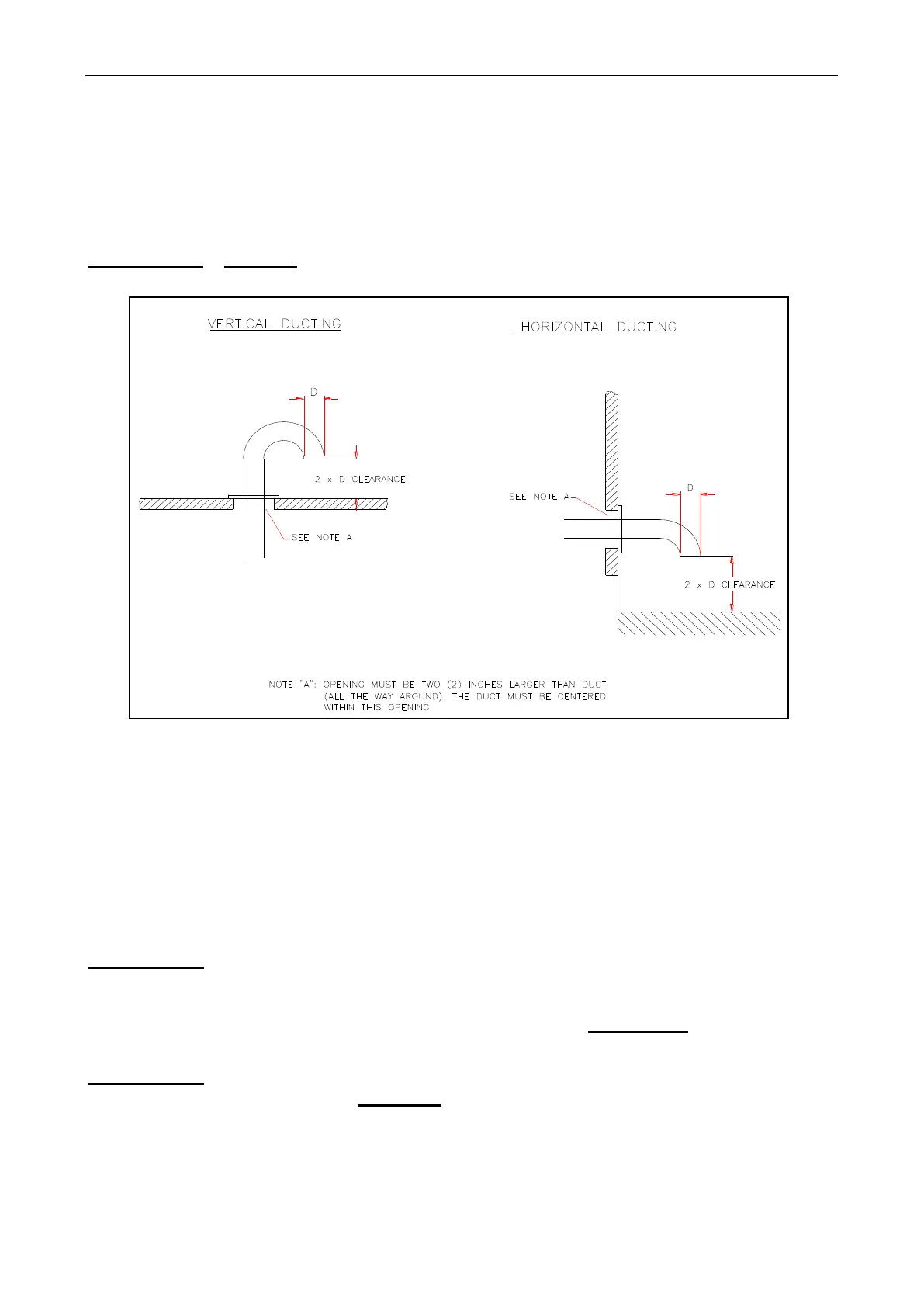
Outside Duct Work Protection
To protect the outside end of horizontal duct work from the weather, a 90° elbow bent
downward should be installed where the exhaust exits the building. If the exhaust duct work travels
vertically up through the roof, it should be protected from the weather by using a 180° turn to point
the opening downward. In either case, allow at least twice the diameter of the duct between the duct
opening and the nearest obstruction.
IMPORTANT: DO NOT use screens or caps on the outside of opening of exhaust duct work.
Figure.3-6 Outside Duct Work Protection
2. Single Dryer Venting
Where possible, it is suggested to provide a separate exhaust duct for each dryer. The
exhaust duct should be laid out in such a way that the duct work travels as directly as possible to
the outdoors with as few turns as possible. It is suggested that the use of 90° turns in ducting be
avoided use 30° and / or 45° angles instead. The shape of the exhaust duct work is not critical so
long as the minimum cross section area is provided.
IMPORTANT: Minimum duct size for a gas dryer or 72 Kw electric dryer is 14 – inches for a
round duct or 12.50” × 12.50” for a square duct. The minimum duct size for a
steam dryer or 80 Kw electric dryer is 16 – inches for a round duct or
14.50” × 14.50” for a square duct. Duct size must not be reduced anywhere
down stream of dryer.
IMPORTANT: Exhaust back pressure measured by a manometer at each basket (tumbler)
exhaust duct area should not exceed 0.3 inches of water column.
It is suggested that the duct work from each dryer (minimum 14 – inches for a gas dryer or
72 Kw electric dryer and 16 – inches for a steam dryer or 80 Kw electric dryer) not exceed twenty
(20) feet with no more than two (2) elbows (excluding dryer connections and outside exhaust
outlets). If the duct work exceeds twenty (20) feet or has numerous elbows, the cross section area of


 To Next Page