Continue on next page!
WARNING AND SAFETY NOTES
Discharging
The main purpose of discharging is to clean residual capacity of the battery, or to reduce
the battery’ voltage to a defined level. The same attention should be paid to the discharging
process as charging. The final discharge voltage should be set up correctly to avoid deep-
discharging. Lithium battery can not be discharged to lower than the minimum voltage, or it
will cause a rapid loss of capacity or a total failure. Generally, Lithium battery doesn’t need
to be discharged. Please pay attention to the minimum voltage of Lithium battery to protect
the battery.
Some rechargeable batteries have a memory effect. If they are partly used and recharged
before the whole charge is accomplished, they remember this and will only use that part
of their capacity next time. This is a ‘memory effect’ It is said that NiCd and NiMH batteries
are suffering from memory effect. NiCd has more memory effect than NiMH.
Lithium batteries are recommended to be discharged partially rather than fully discharged.
Frequent full discharging should be avoided if possible. Instead,
charge the battery more often or use a battery of larger capacity. Full capacity cannot be
reached until it has been subjected to 10 or more charge cycles. The cyclic process of
charge and discharge will optimize the capacity of battery pack.
13 14
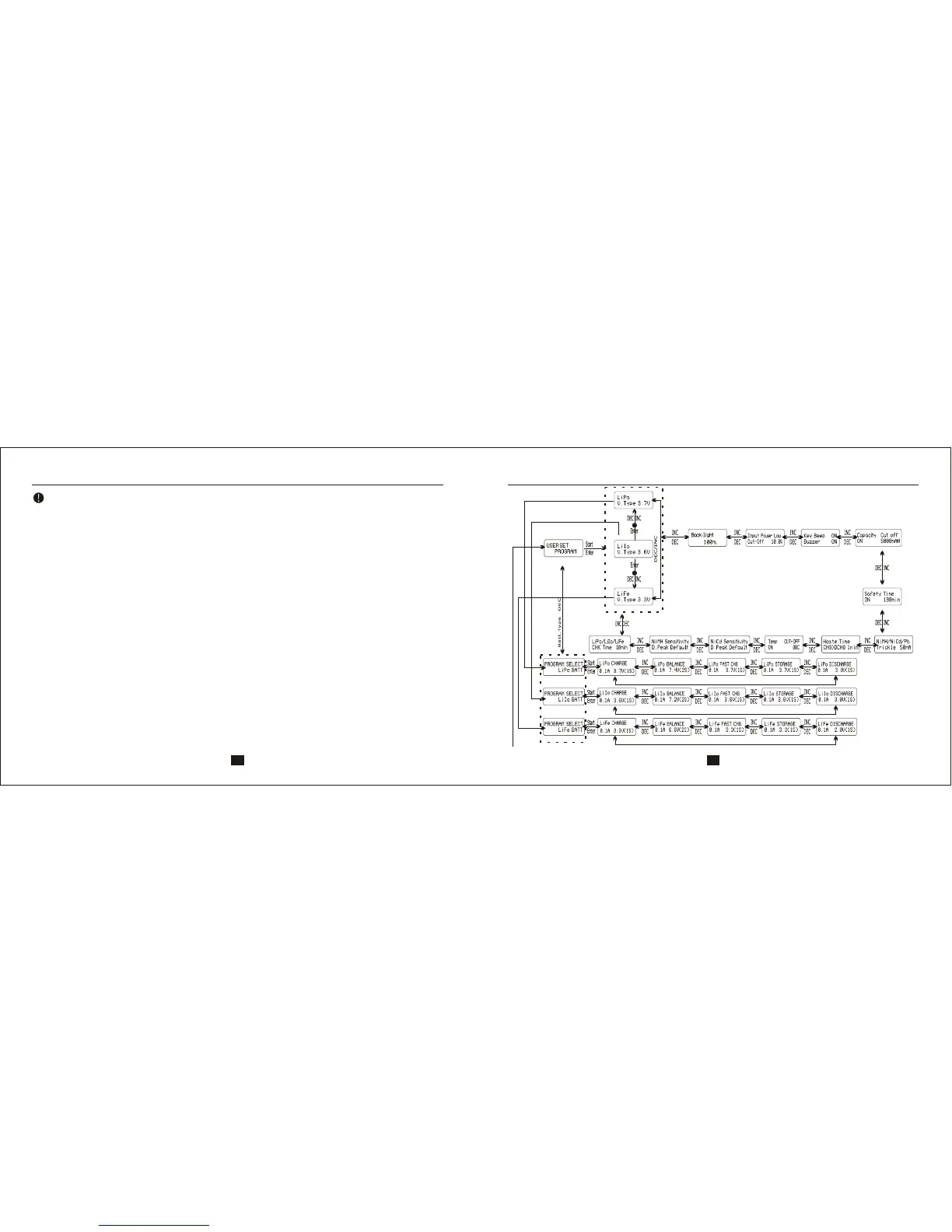
PROGRAM FLOW CHART



 To Next Page