
 Need help?
Do you have a question about the Inovance GR10-EC-6SW and is the answer not in the manual?
Introduces the GR10-EC-6SW EtherCAT module and the user guide.
Identifies intended users for this manual, including engineers.
Advises first-time users to read the manual carefully and seek support.
Records past versions and changes made to the document.
General warnings and disclaimers regarding product safety and usage.
Defines warning and caution levels to ensure user safety.
Outlines critical safety design considerations for control systems.
Essential safety warnings for installing the module, including electrical hazards.
Specific cautions to prevent faults and damage during installation.
Critical safety warnings for electrical wiring procedures.
Cautions to prevent fire, fault, and damage during wiring.
Safety warnings for operating and maintaining the module.
Cautions for safe operation and maintenance tasks.
Instructions for disposing of the product as industrial waste.
Explains the meaning of the model number and nameplate information.
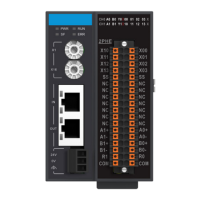
Details the functions of each interface port on the module.
Lists general operating and environmental specifications for the module.
Details specific parameters for EtherCAT communication.
Provides physical dimensions for mounting the module.
Guidance on preparing and using EtherCAT cables.
Details the pinout for EtherCAT signal transmission and reception.
Specifies the maximum allowable length for EtherCAT cables.
Lists technical requirements for EtherCAT cables.
Describes how to connect and disconnect EtherCAT cables.
Illustrates the wiring of the EtherCAT branch module within a system.
Important considerations for configuring and using the branch device.
Explains how to interpret LED indicators for fault diagnosis.
Advises on securing cables to ensure stability and prevent damage.
Details the warranty period and conditions for free maintenance.
Lists causes for which maintenance will be charged.
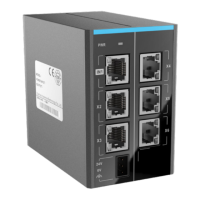
The GR10-EC-6SW is a 6-port EtherCAT branch module developed and manufactured by Inovance, designed to facilitate star-networked applications in multi-axis complex equipment and production line networking. This module serves as a crucial component in industrial automation systems, enabling efficient communication between an EtherCAT master and multiple EtherCAT slave devices.
The primary function of the GR10-EC-6SW module is to expand an EtherCAT network into a star topology. It features one EtherCAT input port (IN) and five EtherCAT output ports (X2, X3, X4, X5, X6). The input port connects to the front-end EtherCAT master, while the output ports are used for connecting back-end EtherCAT slaves. This configuration allows for flexible network design, particularly beneficial in systems where multiple slave devices need to be connected to a central master without forming a strict daisy-chain.
The module acts as a branch point, distributing the EtherCAT communication signal from the master to up to five different branches, each capable of connecting further EtherCAT slave devices. This branching capability is essential for complex machinery or production lines where devices are physically dispersed or require dedicated communication paths. The module supports EtherCAT industrial real-time bus protocol, ensuring high-speed and deterministic communication critical for industrial control applications. It operates in full duplex mode and supports DC-distributed clock synchronization, which is vital for precise coordination of multiple axes or processes in a synchronized system.
The GR10-EC-6SW is designed to be cascaded, meaning multiple branch modules can be connected in series to further extend the network and accommodate a larger number of slave devices. Each branch device occupies two EtherCAT slave station numbers, which should be considered during network configuration. By default, the module is configured to operate in DC mode as an EtherCAT slave, contributing to the overall system's synchronization capabilities. The data flow priority among the output interfaces is X2 > X3 > X4 > X5 > X6, indicating that slaves connected to X2 will have higher priority than those on X3, and so on. This priority scheme can be important for optimizing communication in time-critical applications.
The GR10-EC-6SW is an open-type equipment, requiring installation within a control cabinet with a minimum IP20 protection rating. This ensures its protection from dust and other environmental factors common in industrial settings. Installation and wiring must be performed by specialists with adequate electrical training and knowledge to ensure safety and proper operation.
For communication, the module utilizes standard network ports with Cat 5e shielded twisted pair (STP) cables. The recommended cable length between devices should not exceed 100 meters to prevent signal attenuation and maintain communication integrity. The use of shielded cables is crucial for high-frequency signal transmission in environments with serious electromagnetic interference, enhancing the system's anti-interference ability. The cable connectors should be 8P8C-3-prong, and proper crimping or welding is necessary to ensure good contact and prevent short-circuits or malfunctions.
When configuring the network, it is recommended to run all EtherCAT slaves, including the two stations occupied by the branch device itself, with an alias. This practice helps ensure that an abnormal branch does not affect the operation of other branches in the network, contributing to system robustness. The module's power supply input is 24 VDC, and it features a green PWR indicator that illuminates when power is switched on, providing a visual cue of its operational status.
The module's compact design, with mounting dimensions of 53.2 mm (width) x 90 mm (height) x 97.5 mm (depth), allows for efficient use of space within control cabinets. The EtherCAT cable connectors are designed for secure insertion with a "click" sound, and removal requires pressing a release tab, ensuring reliable connections.
Maintenance and inspection of the GR10-EC-6SW module must be carried out by qualified personnel. Before any cleaning, re-tightening of screws, or removal/installation of the module or communication wirings, all external power supplies to the system must be disconnected to prevent electric shock or malfunction. It is crucial not to touch the terminals while power is on.
The module includes an LED indicator system (PWR and Link/Act) to provide immediate feedback on its operational status and assist in troubleshooting. If the module fails, users can check these indicators to identify the cause and implement corresponding solutions. For instance, if the PWR indicator is OFF, it could indicate that the power supply is not connected or an internal circuit fault, prompting checks of the power connection or replacement of the module. If the Link/Act indicator is OFF while the PWR is ON, it suggests a connection not established, which could be due to a disconnected or short-circuited communication cable, a hardware fault of the branch module, or the master station not being started. In such cases, checking cable connections, replacing faulty cables, or verifying the master station's status are the recommended steps.
To ensure communication stability and protect cables from tension, it is important to fix the cable ends near the device before EtherCAT communication. The module is designed for use in indoor electrical environments and requires a system-level lightning protection device for its power supply to prevent damage from overvoltage due to lightning shocks. Proper ventilation is also essential; foreign matters on ventilation surfaces must be prevented, and the protective label on top of the module should be removed for ventilation during operation. Control wires, communication wires, and power cables should be run with a distance of more than 100 mm from each other to avoid noise interference and potential malfunctions.
The product comes with an 18-month warranty period, covering free maintenance for failures or damages under normal use conditions. However, damages resulting from improper use, unauthorized modifications, external disasters, hardware damage due to dropping or transportation, or failure to follow the user manual are not covered under free maintenance. When disposing of the product, it should be treated as industrial waste, adhering to relevant environmental regulations.
 General
| Series | GR10 |
|---|---|
| Type | Control Unit |
| Model | GR10-EC-6SW |
| Input Voltage | 24V DC |
| Number of Outputs | 6 |
| Communication Interface | EtherCAT |
| Protection Class | IP20 |
| Operating Temperature | 0°C to 55°C |
| Storage Temperature | -20~70℃ |


 To Next Page