Need help?
Do you have a question about the Intellian i3 and is the answer not in the manual?
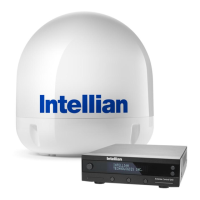
Overview of the Intellian i3/i3L/i4/i4P digital satellite antenna system for vessels.
Highlights the system's ability to provide high-quality broadcasting in harsh marine conditions.
Describes the use of high-tech parabolic antenna technology for marine environments.
Explains the WRS algorithm for quick satellite detection and tracking.
Mentions single RF cable installation, modular design, and proven components.
Notes the GPS system enhances satellite signal acquisition speed and performance.
Details the Ethernet port for remote monitoring, control, and diagnostics via TCP/IP.
Explains wireless connectivity via Wi-Fi for monitoring and control using PCs or smartphones.
Describes the auto skew control system for maintaining optimal signal strength on the i4P model.
Mentions certification against stringent marine equipment standards like LR, DNV, and EN60945.
Explains the need for connections and separate purchases for proper system function.
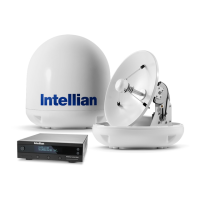
Lists and describes the components of the Antenna Unit: Mechanical Unit, Control Unit, RF Unit, and Radome.
Details the functions of the Antenna Control Unit (ACU) and its role in controlling the antenna system.
Lists the items included in the installation kit for securing the antenna unit and ACU.
Lists various supplied parts such as RF cables, power cables, connectors, software, and manuals.
Shows and lists the necessary tools for performing the antenna installation, like drills and spanners.
Provides guidelines for installing the antenna unit to ensure maximum performance and avoid obstacles.
Offers points to consider before installing system cables, including protection and routing.
Details the power requirements for the system, including DC voltage range and the need for converters.
Mentions RF cable length and options for extending cables, noting performance impact.
Advises checking antenna dimensions and ensuring sufficient space for installation.
Guides on marking the antenna mounting position using a template and considering mounting surfaces.
Details how to drill holes for bolts and cable routing during antenna installation.
Explains how to connect the RF cable to the antenna's RF connector using a spanner.
Provides the physical dimensions of the Antenna Control Unit (ACU).
Describes how to attach the antenna using bolts, washers, and a spanner.
Guides on choosing a suitable location for the ACU (dry, cool, ventilated, accessible).
Provides step-by-step instructions for installing the ACU using mounting brackets and screws.
Details the steps for connecting the system cables for a single IRD setup.
Explains how to connect two IRDs to the antenna system.
Describes how to connect multiple IRDs using a multiswitch.
Provides instructions for connecting an external NMEA 0183 GPS to the ACU.
Explains the use of the DC OUT port for connecting MIM or SDM without an AC-DC adaptor.
Explains when and why the LNB skew angle needs adjustment for linear polarized satellites.
Provides manual steps for adjusting the LNB skew angle on the i3/i3L/i4 antennas.
Details the automatic skew angle adjustment system embedded in the i4P model.
Outlines methods for establishing data communication between a PC and the ACU.
Details how to connect the ACU to a PC using a serial port connection.
Explains how to set up a Wi-Fi connection between the PC and the ACU.
Describes how to establish a TCP/IP connection via the ACU's Ethernet port.
Introduces the section on setting up the Satellite TV System after ACU installation.
Lists the various functions and settings available within the ACU's Setup Mode.
Identifies and describes the function of the soft keys on the ACU.
Details the start-up sequence and operation in the ACU's Normal Mode.
Explains how to change the target satellite in both Dual-Sat and Tri-Sat modes.
Shows how the antenna status is displayed on the ACU screen and what each status means.
Describes how to put the antenna into sleep mode and what happens if tracking is lost.
Provides step-by-step instructions to enter the ACU's Setup Mode.
Guides on changing the satellite pair to receive service from different providers.
Explains how to set up and modify GPS information to enhance antenna functionality.
Details how to modify existing or input new satellite information into the ACU.
Explains the different methods for verifying satellite tracking.
Describes the options for supplying voltage to the LNB.
Explains the different methods for DiSEqC control.
Guides on changing antenna parameters, noting it's for advanced users.
Explains how to select a local frequency for the LNB, with instructions for single band LNB.
Provides instructions for setting local frequency when using a Universal LNB.
Explains how to select the DiSEqC method from the ACU.
Details how to enable DiSEqC 1.2 setting on the ACU for IRD compatibility.
Guides on setting the LNB skew angle manually for the i4P model.
Shows how to view the installed versions of antenna and ACU software.
Details how to view the voltage information for the antenna, ACU, and IRD.
Explains how to register remote control keys for various functions.
Guides on manually controlling the antenna's position using the ACU.
Explains how to move the antenna in 1º steps using the ACU.
Details how to run antenna diagnostics and interpret the results.
Guides on loading region-specific information for the antenna system.
Explains how to restore the antenna to its factory default settings.
Introduces the Intellian Antenna PC Controller Software, Aptus®.
Provides instructions for installing the Aptus® software on a PC.
Details how to establish communication between the PC and ACU.
Guides on connecting the ACU to the PC via a serial port.
Explains how to connect the ACU to the PC using Ethernet or Wi-Fi.
Describes the AutoUpdate function for maintaining the latest software version.
Explains the command buttons and menus available in the Aptus® toolbar.
Details the functions related to user layouts, default layouts, and work views in the software.
Explains re-establishing communication channels via Serial or Network.
Covers accessing software information and technical support.
Displays the current mode of the antenna (Search, Tracking, Initialize, Setup, Sleep, Unwrap).
Allows display or setting of current tracking satellite and tracking information.
Shows signal level thresholds and the signal level bar's color indication.
Displays the current GPS location and indicates status light for GPS input.
Displays voltage information for the antenna and ACU.
Shows the versions of antenna and ACU firmware.
Displays antenna and ACU serial numbers, model, and name.
Indicates when an error occurs and how to view the diagnostic report.
Guides on modifying settings within the Work View by clicking Setup and Set.
Provides antenna GPS location, skew, and angle information in a graphic user interface.
Offers information on Parameter Setting, Threshold Setting, and Flag Setting for advanced users.
Displays satellite name, longitude, verification method, and LNB local frequency.
Provides information on signal, elevation, azimuth, and heading in graphical formats.
Allows monitoring of all data received from the ACU, including parameters and debug logs.
Enables Antenna Diagnostic Testing and Network Settings configuration.
Shows a graphical representation of current antenna position and satellite alignment.
Explains how to arrange and format Work View Tabs for customized layouts.
Outlines procedures to secure the antenna internally for safe transportation and prevent damage.
Details the 3-year parts and 1-year labor warranty and its exclusions.
Specifies requirements for warranty claims, including purchase receipt and RMA.
Lists general specifications for i3/i3L, including approvals, dimensions, weight, and environmental.
Details the antenna system's performance parameters like frequency, EIRP, and motion response.
Lists general specifications for i4/i4P, including approvals, dimensions, weight, and environmental.
Details the antenna system's performance parameters like frequency, EIRP, and motion response.
 General
| Frequency Band | Ku-Band |
|---|---|
| Antenna Type | Parabolic |
| Stabilization | 3-axis stabilized |
| Type | VSAT |
| Tracking | Automatic |
| Polarization | Linear |
| Ship Motion | Roll: ±25°, Pitch: ±15° |
| Power Supply | 24 VDC |


 To Next Page