39
To disable MAC address binding feature, do as follows:
1) Select the port number that is already bound to a specific MAC address, say, 1
2) Select Disable from the Binding drop-down list
3) Click OK to complete your configurations
3.5.3 QoS
1. QoS Overview
Quality of service is the ability to provide different priority to different applications, users, or data flows, or to
guarantee a certain level of performance to a data flow. For example, a required bit rate, delay, jitter, packet
dropping probability and/or bit error rate may be guaranteed. Quality of service guarantees are important if the
network capacity is insufficient, especially for real-time streaming multimedia applications such as voice over IP,
online games and IP-TV, since these often require fixed bit rate and are delay sensitive, and in networks where the
capacity is a limited resource, for example in cellular data communication.
QoS addresses network latency and congestion issues. Non-critical (elastic) applications like web browsing or
emailing do not rely on QoS as they function however much or little bandwidth is available. However, for critical
(inelastic) services or applications that require a certain minimum level of bandwidth and a certain maximum
latency to function, QoS is indispensable. QoS can prevent critical traffic flow from being discarded or delayed on
a congested and overloaded network, thus ensuring a mix of real-time/interoperative and
non-real-time/non-interoperative traffic without meltdown.
2. Widely used priority types
Port Priority
The port priority is based on switch's physical ports. To config it, click Port Management→ Port Configuration.
Note that available values range from 0 to 7. It is used to determine the forwarding sequence of packets not
carrying priority identifiers.
802.1p Priority
The 802.1p priority, contained in the Ethernet header, is used by QoS disciplines to differentiate traffic on layer 2
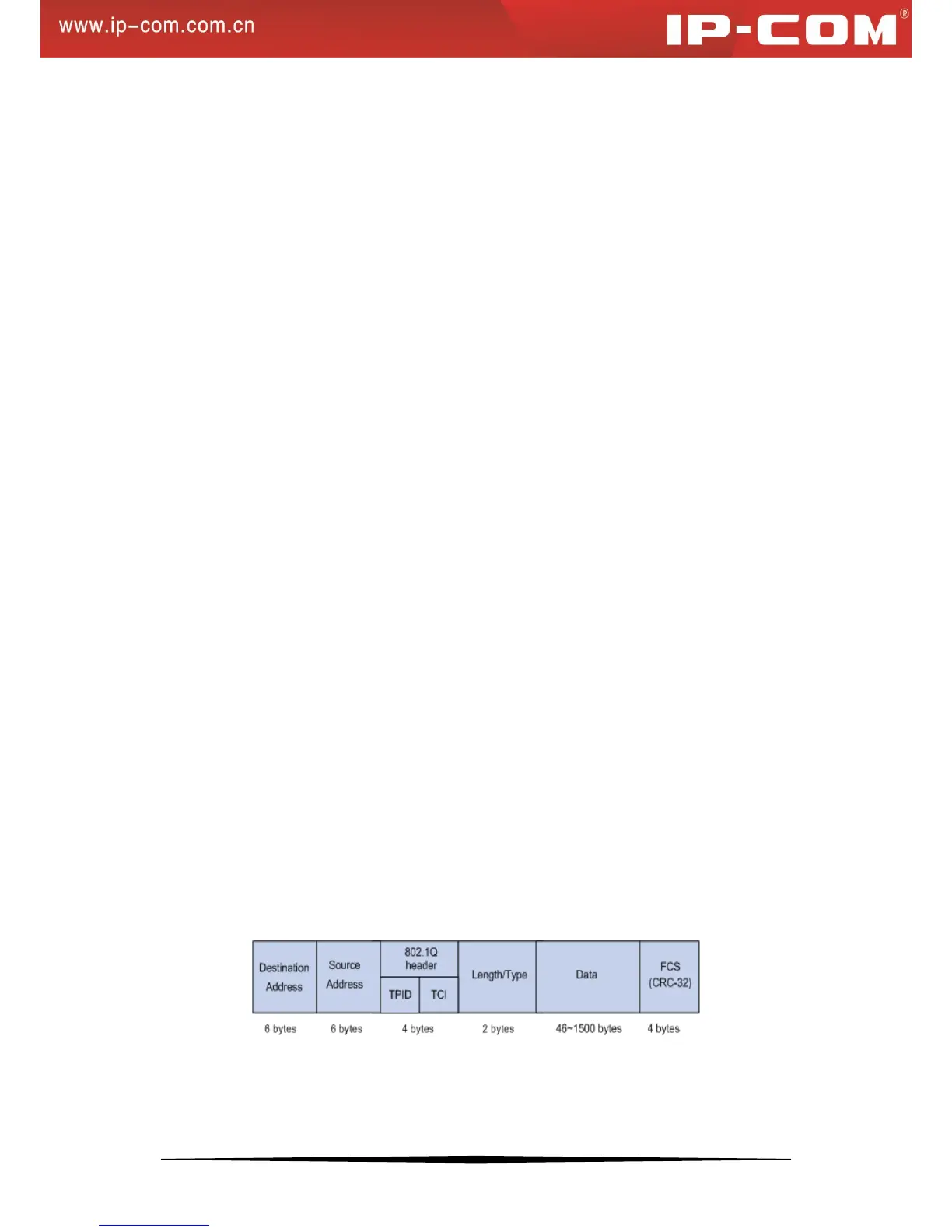
where analyzing IP header is not necessary. 802.1p priority is available only in an IEEE 802.1Q tagged frame. As
seen below, the 4-byte 802.1Q tag contains a 2-byte TPID(Tag Protocol Identifier, value: 0x8100)and a 2-byte TCI
(Tag Control Information).
802.1Qtagged Ethernet frame
Below displays a detailed view of an 802.1Q tag. 802.1p priority, also known as class of service (CoS), is contained
in the priority field of the TCI. It is made up of 3 bits and with available values ranging from 0 to 7.


 To Next Page