For the test between secondary and ground, the neutral ground
must be removed and the CT isolated from its burden; then, both
ends of the secondary shall be connected to one HV end, while
the other end will be connected to the ground.
NOTE: if in this test relays are left connected, it is necessary to
verify the relay specification prior to testing with voltages higher
than 500 V. Many solid-state relays incorporate surge suppressors
connected from input terminals to ground, which would be
damaged during the test.
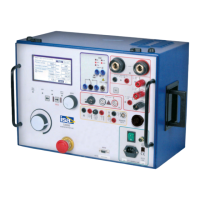
HV cables shall be connected while T 2000 is powered-off. HV
clamps shall have a minimum clearance of 20 mm with respect to
all conductive surfaces, so to avoid discharges during operation.
After connections, the area around the HV clamps shall be
isolated, so that no accidental contact can occur. If something
goes wrong for any reason, power-off T 2000 before getting close
to HV connections.
One of the two test leads will be connected to ground;
unfortunately, this fact reduces the safety margin. The contact to
ground of the other lead causes a short circuit to the HV output,
with immediate disconnection of the test set. Much worse, the
accidental contact of the operator with the other lead would
submit him to the high voltage, WITH NO PROTECTION FROM THE
TEST SET. So, take all care while performing this test.
As the test is performed aT 2000 V, when you press test START
button (56), the following message will be displayed.
The HV is generated only while the START button (56) is kept
pressed: this is an additional safety feature. The operator will
have both hands occupied: one for the knob (6), the other for the
button (56); however, this is much safer than starting the HV
generation, and then forgetting it in the ON state.
You have to turn ON the HV key (28), and adjust the voltage to
the desired level by the adjustment knob (6); the screen shows
the applied voltage and the corresponding leakage current. The
display shows also the test elapsed time: usually, one minute.



 To Next Page