91
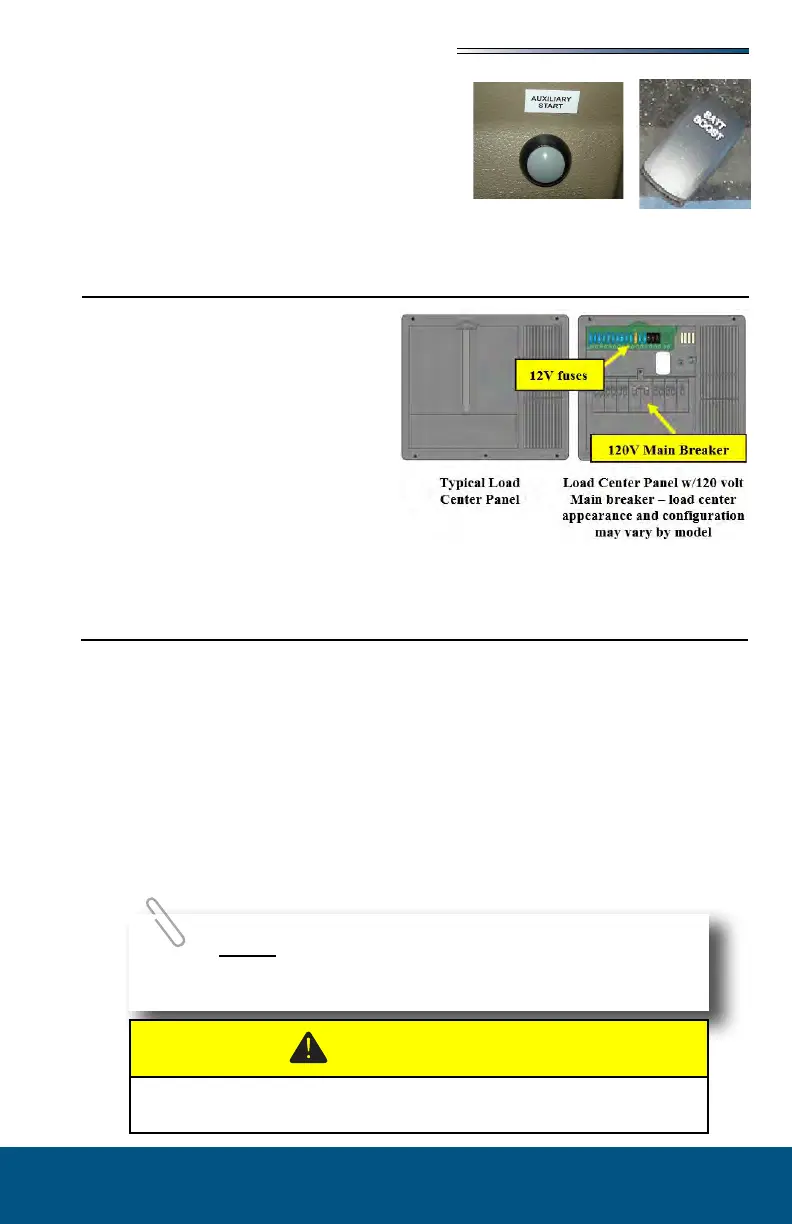
The auxiliary start switch can momentarily connect
both the house and chassis batteries should the
chassis battery become discharged.
To operate, depress either the “Aux. Start” switch
(located on the front driver’s dash) or the Battery
Boost switch on the driver console and hold it down.
While the “Aux. Start” switch or Battery Boost
switch is depressed use the ignition key to start the chassis engine. Release the “Aux. Start”
switch after the engine has started.
Load Center
The Load Center contains 12VDC fuses
and 120VAC circuit breakers for almost
all of the electrical appliances and circuits
in the RV. The 120V main breaker may
be located in this panel and will turn o
all 120-volt power to the RV. Locations
will vary by model. Refer to the diagram
inside the load center for specic fuse
assignments. Not all load centers will
include a main breaker.
Motor homes may have separate small
panels for breakers and fuses. They
are normally located in close proximity to each other typically in the bed platform. The
converter is also mounted separately (typically under the bed platform).
120-Volt Circuit Breakers
The 120-volt AC circuit breakers located inside the load center protect all 120-volt wiring
and components from circuit overloads and short circuits. Should a circuit overload or short
circuit occur the circuit breaker protecting the aected circuit will “trip” preventing the ow
of electricity through that circuit.
If a circuit breaker trips, shut “o” the appliance on that circuit (i.e., power converter etc.)
and allow the circuit breaker to cool down for a brief period of time. After it cools down,
reset the circuit breaker by moving its lever “o” and then back to the “on” position. If the
circuit breaker re-trips or frequently trips, contact your dealer to have the electrical problem
diagnosed and repaired.
A circuit breaker identication label is permanently attached to the inside surface of the 120-
volt Load Center.
Load Centers may not always include a main circuit
breaker.+
Circuit breakers and fuses will not oer complete protection of the electrical
system in the event of power surge or voltage spike.






 To Next Page