Section 6 - Maintenance
6-8 5376000277
Drum Winding
When wire rope is wound onto a sheave or drum, it should bend in the manner in
which it was originally wound. This will avoid causing a reverse bend in the rope.
Always wind wire rope from the top of the one reel onto the top of the other. Also
acceptable, but less so, is re-reeling from the bottom of one reel to the bottom of
another. Re-reeling may also be done with reels having their shafts vertical, but
extreme care must be taken to ensure that the rope always remains taut. It should
never be allowed to drop below the lower fl ange of the reel. A reel resting on the fl oor
with its axis horizontal may also be rolled along the fl oor to unreel the rope.
Wire rope should be attached at the correct location on a fl at or smooth-faced drum,
so that the rope will spool evenly, with the turns lying snugly against each other in
even layers. If wire rope is wound on a smooth-face drum in the wrong direction, the
turns in the fi rst layer of rope will tend to spread apart on the drum. This results in
the second layer of rope wedging between the open coils, crushing and fl attening the
rope as successive layers are spooled.
RWI T T RIT
T A R
T A
RWI
RWI RIT T T
T A R
T A
RWI
TART R AT
T A
TART R AT
RIT A
RWI T T RIT
RIT A R
RIT A
RWI
RWI RIT T T
RIT A R
RIT A
RWI
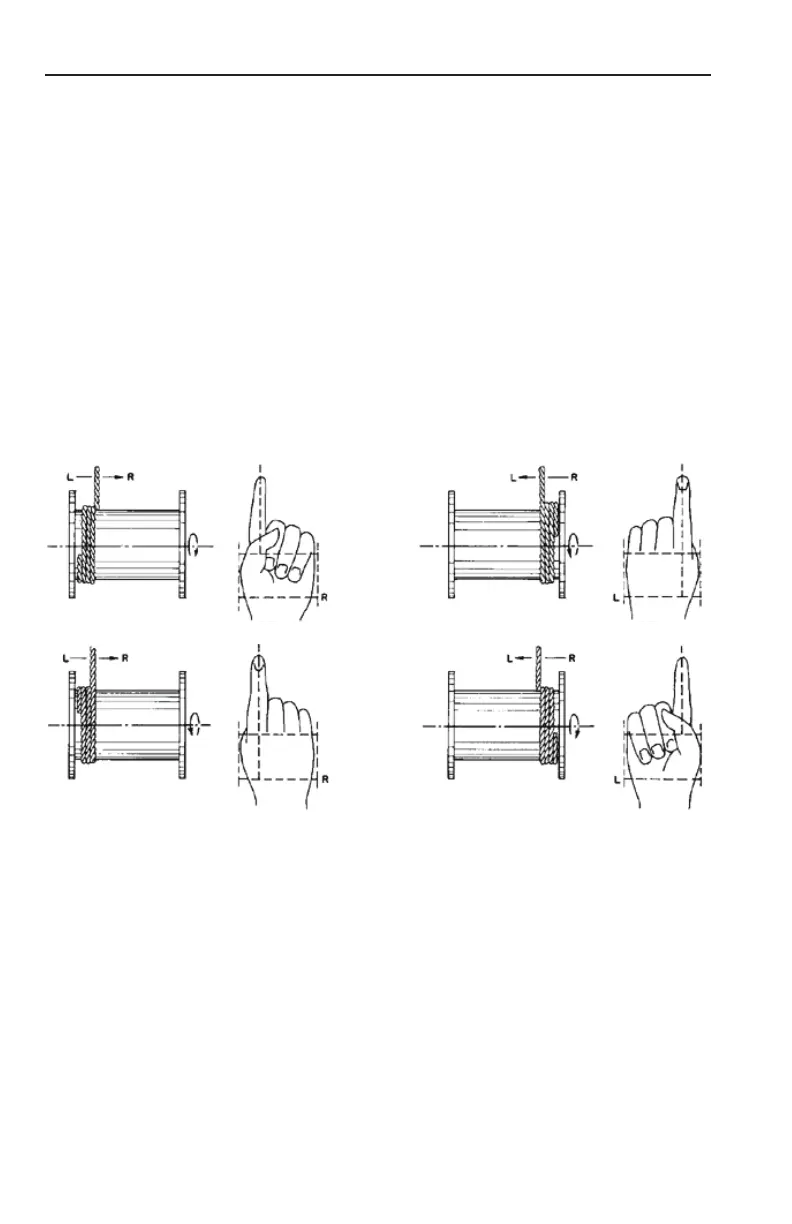
A simple method of determining how a wire rope should be started on a drum is
shown above. The observer stands behind the drum, with the rope coming towards
him. Using the right hand for right-lay wire rope, and the left hand for left lay wire
rope, the clenched fi st denotes the drum, the extended index fi nger the oncoming
rope.



 To Next Page