5-1
CIRCUIT DESCRIPTION
SECTION 5 CIRCUIT DESCRIPTION
5.1 GENERAL TRANSCEIVER DESCRIPTION
5.1.1 INTRODUCTION
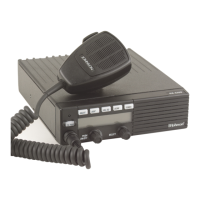
The E.F. Johnson 5300 is a microcontroller-based
radio that uses a Digital Signal Processor (DSP) to
provide the following modes of operation:
Narrowband Analog - FM modulation with a
maximum deviation of 2.5 kHz. This mode is usually
used in systems where the channel spacing is 12.5
kHz. Call Guard (CTCSS or DCS) subaudible squelch
signaling can be used in this mode.
Wideband Analog - FM modulation with a maximum
deviation of 5 kHz. This mode is usually used in
systems where the channel spacing is 25 kHz or 30
kHz. Call Guard (CTCSS or DCS) subaudible squelch
signaling can be used in this mode.
Project 25 Digital - The voice is digitized, error
corrected, optionally encrypted and transmitted using
C4FM modulation according to the Project 25
standard. This mode can be used in channel spacings
of 12.5 kHz.
The DSP processes the received signals and
generates the appropriate output signals. The micro-
controller controls the hardware and provides an inter-
face between hardware and DSP.
5.1.2 PC BOARDS
The 5300-series mobile contains the following
PC board assemblies:
RF Board - Contains the receiver, synthesizer, and
exciter sections.
PA Board - Contains the transmitter power amplifier,
power control, and main DC power switching sections.
Logic Board - Contains the digital signal processing
(DSP), control logic, and audio processing sections.
Interface Board - A small board that provides the
electrical connections between the logic and RF/PA
boards. It also contains the audio amplifier and volume
control circuits for internal and external speakers.
Display Controller - Contains a microcontroller
which provides an interface between the controller on
the logic board and the front panel display and
switches.
Display Board - Contains the liquid crystal display,
option switch keypad, and display drivers. In addition,
it contains the backlight for the display and keypad.
5.1.3 CIRCUIT PROTECTION (FUSES)
Circuit protection is provided as follows:
• A 15-ampere fuse (35-ampere with 100W models)
in the power cable provides overall transceiver
protection.
• A 2-ampere fuse on the RF board protects circuits
on that board.
• F1 (2-ampere) on the display controller board
protects the Sw B+ output of the microphone
connector.
• F1 on the logic board protects the Sw B+ output of
universal interface connector J5.
• The various voltage regulators provide circuit
protection by automatically limiting current.
NOTE: The next two sections (5.1.4 and 5.1.5)
describe operation with the revised logic (Version C in
Section 1.12.2). Generally, the Digital IF chip on the
revised RF board replaces the ABACUS chip on the
early version, and the CODEC on the revised logic
board replaces the ADSIC chip on the early version.
5.1.4 ANALOG MODE DESCRIPTION
Receive Mode
The signal is routed from the antenna connector
to the RF Board where it is filtered, amplified, and
mixed with the first local oscillator frequency gener-
ated by the synthesizer. The resulting IF signal is also
filtered and amplified and sent to the AD9864 digital
IF chip.


 To Next Page