GENERAL INFORMATION
1-2
• SMARTNET
®
/SmartZone
®
trunked analog or
digital
• Analog conventional
NOTE: Multi-Net operation can be programmed with
Ascend models only.
1.2.4 AVAILABLE MOUNTING OPTIONS
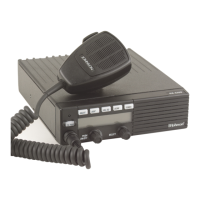
Front Mount - The operating controls are on the front
on the radio, so the radio must be mounted within
reach of the user.
Remote Mount, Single Control Unit - The operating
controls are located on a remote mounted control unit.
The radio does not have operating controls.
Remote Mount, Dual Controls - A remote control
unit is connected to the front mount radio. This allows
control from the front panel and the remote control
unit.
Remote Mount, Dual Remote Control Units - Two
remote control units are connected to the remote
mount radio. This allows control from both remote
control units.
1.2.5 SYSTEMS, CHANNELS, AND ZONES
A zone and channel are selected to place and
receive calls. The following describes the relationship
between systems, channels, and zones.
Systems
A system is a collection of channels or talk
groups belonging to the same repeater site. It defines
all the parameters and protocol information required to
access a site. Up to 16 systems of any type can be
programmed. The maximum number of channels
assignable to a system is limited to approximately 256
(or the available memory space as described in the
following information).
Channels
A channel selects a radio channel or talk group in
a system as follows:
Conventional Analog Mode - A channel selects a
specific radio channel, Call Guard (CTCSS/DCS)
squelch coding, and other parameters unique to that
channel.
Conventional Project 25 Mode - A channel selects a
specific radio channel, NAC squelch coding, talk
group ID, and other parameters unique to that channel.
Trunked Project 25 Mode - A channel selects a
specific talk group ID and other parameters unique to
that talk group.
SmartNet/SmartZone and Project 25 Trunked
Operation - A channel selects a specific talk group,
announcement group, emergency group, and other
parameters unique to that talk group.
As previously described, a maximum of up to 256
channels can be programmed. Although it is theoreti-
cally possible to program any combination of systems
that produces up to 256 total channels, the maximum
number may be limited by the available memory. For
example, since more memory is required to program a
SMARTNET system than a conventional system, the
total number of channels decreases as the number of
SMARTNET systems increases. The programming
software displays a bar graph which shows the amount
of available memory space that is used by the current
data. Refer to Section 4 for more information.
Zone
s
A zone is a collection of up to 16 channels of any
type. For example, a zone could include 12 conven-
tional channels and 4 SMARTNET channels. One use
of zones may be to program the channels used for
operation in a specific geographical area. Up to 16
zones can be programmed.
1.2.6 PROGRAMMING
Transceiver programming is performed using a
PC-compatible computer and an EFJohnson RPI
(Remote Programming Interface) and PCConfigure
programming software (see Table 1-1). Programming
is described in a separate included manual. Refer to
Section 4 for more information.
1.2.7 ALIGNMENT
Transceiver alignment is performed using the
same computer and RPI used for programming (see


 To Next Page