1-1
GENERAL INFORMATION
SECTION 1 GENERAL INFORMATION
1.1 SCOPE OF MANUAL
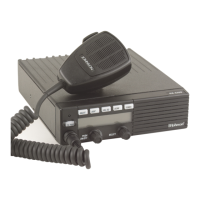
This service manual contains operation, program-
ming, alignment, and service information for the
EFJohnson 5300 series mobile radio. The 53SL and
Ascend (Multi-Net) models are similar in appearance
and covered by separate manuals. The distinguishing
characteristics of the 5300, 53SL, and Ascend models
are as follows:
5300 Series Mobile
• Part No. 242-53xx-xxx (see Section 1.4)
• “RS-5300” label on top edge of front panel
• Black front panel bezel
53SL Series Mobile
• Part No. 242-54xx-xxx (see Section 1.4)
• “53SL” label on top edge of front panel
• Grey front panel bezel
Ascend Series Mobile
• Part No. 242-5580-xxx (see Section 1.4)
• “ASCEND” label on top edge of front panel
• Black front panel bezel
1.2 TRANSCEIVER DESCRIPTION
1.2.1 GENERAL
The 5300 series mobile transceivers can operate
on various types of channels and with various signaling
protocols (see following information). Models are
available for operation in the following bands. Repeater
talk-around is also available with all bands.
VHF 136-174 MHz (35-watt models)
146-174 MHz (100-watt models)
UHF 380-470 MHz (Federal users only)
403-470 MHz
800 MHz 806-870 MHz (see following)
Power Output
Power output is user switchable for low and high
levels in the following ranges:
VHF 10-50W standard version,
50-100W high-power version
UHF 7-15W low power version*
10-40W med power version*
800 MHz 10-35W
*
Version A and B models are available in the 15W configu-
ration only, and Version C models are available in the 40W
configuration only (see Section 1.12 for Version A/B/C
information).
1.2.2 ANALOG/DIGITAL OPERATION
The 5300 transceivers use a digital signal
processor (DSP) to provide IF and audio filtering and
signal modulation functions. This allows operation on
the following types of channels, backwards compati-
bility with existing equipment, and also the ability to
operate on various types of radio systems.
Narrow Band Analog
- FM modulation is used with a
maximum deviation of 2.5 kHz. This mode is usually
used in systems with a channel spacing of 12.5 or
15 kHz.
Wideband Analog
- FM modulation is used with a
maximum deviation of 5 kHz. This mode is usually
used in systems where the channel spacing is 25 kHz
or 30 kHz.
Project 25 Digital
- Operates on Project 25 compatible
systems. The voice is digitized, error corrected,
optionally encrypted, and then transmitted using
C4FM modulation according to the Project 25 stan-
dard. This mode uses a channel spacing of 12.5 kHz.
1.2.3 OPERATING PROTOCOLS
The 5300 transceivers can be programmed for all
the following operating protocols. The conventional
analog protocol is standard and the others are optional
(available only if enabled by factory programming).
Refer to Section 3 for more operation information.
• APCO Project 25 (digital) conventional
• APCO Project 25 (digital) trunked


 To Next Page