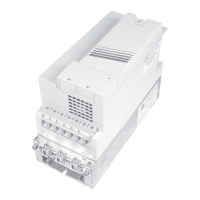
The KEB COMBIVERT R5-C is a DC supply unit designed for the supply of frequency inverters with DC power, offering high demands on security and reliability. This instruction manual specifically describes the 400-V range, covering units from 30 kW to 250 kW. Its specified application is exclusively for providing DC supply to frequency inverters; operation with other electric consumers is prohibited and can lead to unit destruction.
Function Description:
The COMBIVERT R5-C operates by charging the connected frequency inverters through a current source. This pre-charging process enables the loading of very high DC link capacities. The charging time is dependent on the value of the connected DC link capacities and the mains voltage. After successful pre-charging and a ground fault check at the DC bus, the thyristor block is released. The thyristors are driven with a 0° control angle, mimicking the behavior of a B6-rectifier bridge, without executing phase angle control. A "RUN" signal is set at the control terminals, indicating the power supply unit is ready for operation and can be processed by the master control. Load current can only be drawn after the "RUN" signal is set; otherwise, the pre-charging unit will power off, and an error message will be output. Power-off occurs by disconnecting the mains voltage and/or the starting signal at the control card.
The unit incorporates extensive protection features against overcurrent, ground fault, and temperature. It is also short-circuit proof when corresponding dimensioned mains fuses are used. An error signal is output, and thyristors are switched off upon tripping of protective functions. Supervised operating conditions include heat sink temperature, current, and ground fault detection via differential current measurement. A pre-warning is issued if the heat sink temperature is too high, allowing for controlled deceleration. If no action is taken, the thyristors are blocked when the heat sink temperature reaches 90°C.
Important Technical Specifications:
The COMBIVERT R5-C units are available in various sizes (19, 23, 25, 27, 28, 29) with different housing sizes (R, U).
- Chargeable Inverter Power: Ranges from 30 kW (size 19) to 250 kW (size 29).
- DC Nominal Output Current: Ranges from 90 A (size 19) to 610 A (size 29).
- Max. Short Time Current: Ranges from 135 A (size 19) to 915 A (size 29) for 1 minute, with an overload cycle of 300 seconds (duty class 2 EN60146-1-1).
- Input Current (RMS): Ranges from 79.8 A (size 19) to 500 A (size 29).
- Mains Voltage: 3-phase, 305-504 V AC RMS (+/- 0%).
- Output Voltage: 430-713 V DC.
- Maximal Permissible Mains Fuse: Ranges from 100 A (size 19) to 710 A (sizes 27, 28, 29).
- Protective System: IP20 for sizes 19, 23, 25; IP00 for sizes 27, 28, 29.
- Power Loss at Nominal Operating: Ranges from approximately 220 W (size 19) to 1600 W (size 29).
- Max. Heat Sink Temperature: 90°C.
- Storage Temperature: -25°C to 70°C.
- Operation Temperature: -10°C to 45°C.
- Braking Option: Internal braking option with max. braking current of 133 A (sizes 19, 23) to 250 A (sizes 25, 27, 28, 29). Minimum braking resistor values range from 6 Ohm (sizes 19, 23) to 3.2 Ohm (sizes 27, 28, 29).
- DC Link Capacity: Max. loadable DC link capacity is 100,000 µF. Exceeding this capacity triggers a "charge time out" error (E.cto).
- Cooling: Default (A).
- Control Card: Version C (2C.F5).
Usage Features:
- Installation: Designed for vertical installation, requiring minimum distances of 150 mm above, 100 mm below, and 30 mm to the sides for proper ventilation.
- Mains Connection: Absolutely requires a line reactor. For interconnected operation with multiple supply units, refer to information sheet 00.R5.0DM-1000. Switching at the input without waiting for an under-potential error (E.UP) can cause high wear of switching contacts and trigger fuses/overcurrent protection units.
- Terminal Strips: All terminal strips comply with EN60947-7-1 (IEC60947-7-1) requirements.
- Braking Resistor Connection: It is crucial to monitor the braking resistance temperature switch to detect overheat, which can be caused by incorrect dimensioning or high input voltage. The brake transistor current is also monitored, and input thyristors are switched off in case of a short circuit. Braking resistors can reach very high surface temperatures and must be installed as safe-to-touch as possible. Evaluation at terminals T1 and T2 for temperature monitoring is switched off by default and must be activated (application mode Pn.12="7").
- Temperature Detection: An external temperature sensor/switch can be connected to terminals T1, T2. The unit switches off with error message E.OH upon tripping. This feature is also switched off by default and requires activation (application mode Pn.12="7").
- EMC-Conform Installation: To prevent coupled-in noise, line-supply cables, motor lines, and control/data lines (low-voltage <48V) must be separated by at least 15 cm. Shielded/drilled cables should be used, with the shield laid on one side of the inverter onto earth potential. Power and control cables should be laid separately (10-20 cm distance) and at right angles. Low-resistance high-frequency connections, earthing, and shielding must be in metal-to-metal contact with the mounting plate over as large an area as possible. Inductive control elements (contactors, relays) should be equipped with suppressors. All connections must be kept short and close to earth. Connection cables should be straight, and flow/return circuits twisted if not shielded. Metal cable glands with shield connection are recommended.
- Operation: An operator (local or external) is necessary for programming. The frequency inverter must be in "nOP" status (open control release) before plugging/removing the operator to avoid malfunctions. The unit always starts with the last stored values/factory settings.
- Keyboard: The keyboard allows changing parameter values and numbers. Parameter values are generally accepted and stored non-volatile immediately, but for some, a point appears behind the last digit, indicating it's not immediately accepted. Error messages overwrite the display and can be reset by ENTER, but the error itself requires removing the cause or a power-on reset.
- Parameter Summary: CP parameters are used for functional monitoring. CP.0 is for password input, CP.1 for status display, CP.2-CP.15 for various current, voltage, temperature, and gain measurements.
- Password Protection: The unit is supplied without password protection. After parameterization, the inverter can be secured against unauthorized access.
- Braking Option: The brake transistor is controlled when the DC link voltage reaches 740 V DC.
Maintenance Features:
- Error Monitoring: The unit continuously monitors operating conditions such as heat sink temperature, current, and ground fault.
- Pre-warnings: A pre-warning for high heat sink temperature allows for controlled deceleration before the unit automatically blocks thyristors at 90°C.
- Diagnostic Interface: HSP5 diagnostic interface (X6B) and RS232/RS485 interface (X6C, X6D) are available for troubleshooting and data transfer.
- Unit Identification: The unit identification code (e.g., 23.R5.C 1 R-90R0) provides detailed information on cooling, version, voltage, housing, options, control card, unit type, and size, which is useful for maintenance and ordering spare parts.
- Documentation: The instruction manual must be made available to the user, and familiarity with it is required before working with the unit, especially regarding safety and warning indications. Technical changes and misprints are reserved.

 Need help?
 General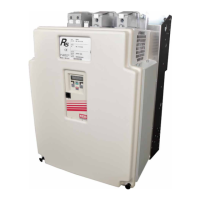

 To Next Page