6 Settings & Controls
51
6.8 Mode
In the SSB, CW and AM modes, the 10.8 kHz IF signal obtained after the 3rd Mixer is
inputted the DSP, and IF filter. Detection is carried out during digital signal processing.
The design of the IF filter and detection is adapted to the handheld transceivers based on
the design of our HF transceivers.
SSB 6.8.1
In the SSB mode (LSB, USB), the high-cut frequency can be adjusted in the receiving filter
configuration. A high-cut frequency can be selected from 2.2 kHz/ 2.4 kHz/ 2.6 kHz/
2.8 kHz/ 3.0 kHz. The low-cut frequency is fixed at 200 [Hz]. Changing the high-cut
frequency switches in the IF band pass filter (BPF).
For example, if the high-cut frequency is configured to 2.4 kHz, the passband of the IF filter
becomes 2.2 kHz.
Menu No. 120
CW 6.8.2
In the CW mode, the passband (Band Width) can be adjusted in the receiving filter
configuration. The passband can be selected from 0.3 kHz/ 0.5 kHz/ 1.0 kHz/ 1.5 kHz/
2.0 kHz. Changing the passband switches the IF filter (BPF).
Menu No. 121
In addition to the receiving filter, there are also configurations including pitch frequency and
CW reverse. Pitch frequency refers to the frequency for playing back the Morse signals
received as demodulated audio signals when the carrier coincides exactly with the receiving
frequency.
A pitch frequency can be selected from 400 Hz/ 500 Hz/ 600 Hz/ 700 Hz/ 800 Hz/ 900 Hz
/ 1000 Hz.
Menu No. 170
CW reverse is a configuration for determining whether to carry out detection in the CW
mode as LSB or USB. CW reverse can be selected from Normal / Reverse. USB is
chosen in the Normal mode and LSB in the Reverse mode.
Menu No. 171
AM 6.8.3
In the AM mode, the high-cut frequency can be adjusted in the receiving filter configuration.
A high-cut frequency can be selected from 3.0 kHz/ 4.5 kHz/ 6.0 kHz/ 7.5 kHz.
The low-cut frequency is fixed at 200 Hz. Changing the high-cut frequency switches the IF
filter (BPF). The passband of the IF filter in the AM mode is double that of the high-cut
frequency.
For example, when the high-cut frequency is configured to 4.5 kHz, the passband of the IF
filter becomes 9 kHz.
Menu No. 122
IF Signal Output, Detection Signal Output 6.8.4
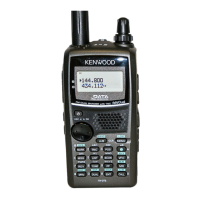
In addition to the received audio signals, the TH-D74A/E is also able to output IF signals or
detection signals to the built-in speaker, external speaker jack or USB audio. When the IF
signal is selected in the "Detect Out Select" menu, IF signals for the SSB or AM mode are
converted into IF signals with a center frequency of 12 kHz and output. When detection
signal is selected, the signal before the De-Emphasis filter output in the FM mode, while the
signal after the detection is output in the SSB, CW and AM modes. When IF signal or
detection signal is selected, the RX Equalizer will not be applied to the audio output.
Operation of the "Detect Out Select" Menu, output of IF signals and output of detection
signals work when the transceiver is in the Single Band mode and the operating band is
band B.
Menu No. 102
Note: There are some restrictions on the operation and behavior during output of IF or
detection signals. For more details, please refer to the user manual.


 To Next Page