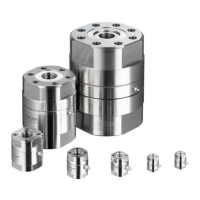
Press Force Sensor
Type 9323AA, 9323A, 9333A, 9343A, 9363A, 9383A, 9393A
Page 42 9323A_002-476e-11.24
6.3 Resolution of the measuring signal
The resolution is the smallest possible change in the
measurand able to be measured by the system. It is deter-
mined by the signal-to-noise ratio at the signal output of
the charge amplifier. In the case of industrial charge ampli-
fiers, the resolution with the highest gain is typically
In combination with the sensitivity of the Press Force
Sensor such as Press Force Sensor Type 9323AA:
–9,6 pC/N, the resolution amounts to:
6.4 Quasistatic measurements
With the piezoelectric measuring principle, purely static
measurements over any length in time are not possible.
Because the charge amplifier is not an ideal component,
the charge stored in the range capacitor is not retained for
an unlimited time. Leakage currents produce a drift in the
order of magnitude of ±0,05 pC/s. During measurement,
the zero point of the output signal as a function of time
drifts in a positive or negative direction. This can be mea-
sured with the charge amplifier in the <Operate> or
<Measure> position with the sensor unloaded or constant-
ly loaded.
Strong drift can be due to inadequate insulation resistance
of the measuring chain. It is therefore important to keep
the cable and connector clean and dry at all times.
The time during which so-called quasistatic measurements
can be carried out is determined by the accuracy required.
The value for the sensitivity of the sensor such as Press
Force Sensor Type 9323AA: –9,6 pC/N can be used to
estimate the drift in mechanical units.
The example of a Press Force Sensor Type 9323AA and a
ControlMonitor Type 5867 produces the following me-
chanical drift:
Sensitivity –9,6 pC/N
Drift ±0,1 pC/s
mN/s5,21
pC/N9,6–
pC/s0,05
±=
±
mN/s10,42
pC/N9,6–
pC/s,10
±=
±


 To Next Page