Need help?
Do you have a question about the Konftel 300IPx and is the answer not in the manual?
Describes Konftel's patented OmniSound audio technology for clear, full-duplex audio.
Warnings against exposing the device to water or opening its casing.
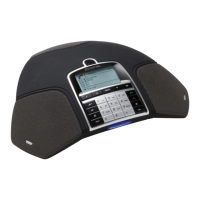
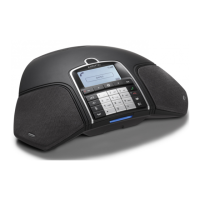
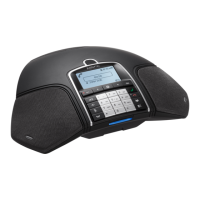
Provides an overview of the Konftel 300IPx's innovative features and benefits.
Instructions on cleaning the Konftel 300IPx with a soft, dry cloth.
Guides on connecting and registering the conference phone.
Explains the meaning of different LED light indicators for call status.
Details the functions of each button on the Konftel 300IPx keypad.
Explains how to enter characters using the alphanumeric keypad.
Describes the display screen when the phone is not in use.
Describes the display screen when the phone is in an active call.
Explains the meaning of different line status icons and symbols.
How to switch between and manage active phone lines.
Explains how to navigate through the phone's menu system.
Detailed guide on using arrow buttons and OK to navigate menu options.
Explains how menu paths and instructions are presented in the guide.
Visual representation of the phone's menu structure and options.
Steps for answering an incoming call and indicators.
How to answer a second call while the first is on hold.
Instructions for dialling numbers directly or via confirmation.
How to redial the last number or browse the call list.
How to call contacts stored in the phonebook.
Using the Konftel 300IPx with a computer for VoIP calls.
How to adjust the audio volume during a call.
Explains how to mute the microphone and place calls on hold.
How to end an active call.
Information about secure data connections and how to identify them.
How to add new participants to an ongoing call.
How to initiate calls to pre-defined conference groups.
Choosing which account to use for making new calls.
Adding another participant to an ongoing call using account selection.
How to manage multiple participants in a conference call.
Putting other call participants on hold to speak privately.
Switching between active calls with different participants.
Connecting multiple parties into a single conference call.
Merging all active lines into one conference call.
Removing an individual line from a multi-party call.
How to transfer an ongoing call to another telephone.
How to log in and use personal user profiles for settings and contacts.
Steps to safely log out of a user profile.
How to modify profile names and PIN codes via the web interface.
Methods for finding contacts in the phonebook.
Steps to add new contacts to the phonebook.
How to modify existing contact details.
Removing individual contacts from the phonebook.
Erasing all conference groups from the phonebook.
Checking the current status and capacity of the phonebook.
How to search for and call contacts from an external LDAP phonebook.
How to initiate calls to pre-defined conference groups.
Adding a new participant to an ongoing call.
Viewing the members of a specific conference group.
Creating new conference groups with members and numbers.
Modifying existing conference groups, adding or removing members.
Removing a specific conference group.
Erasing all conference groups.
Checking the status and capacity of conference groups.
Instructions on how to begin recording a call.
How to mute the microphone during a call.
How to place a call on hold, affecting recording status.
How to stop recording a call.
How to play back recorded calls on the device or computer.
Adjusting volume during playback of recorded calls.
How to pause and resume playback of recordings.
Navigating through a recording during playback.
How to stop playback of a recording.
Renaming recorded files.
Removing individual recorded files.
Erasing all recorded files.
Configuring the audible beep that indicates recording.
Checking the status of recording features and memory card capacity.
Configuring fundamental device settings like accounts, language, and tones.
Choosing the primary account for calls.
Changing the display language of the phone.
Disabling the sound made when pressing keypad buttons.
Setting the volume for incoming calls.
Adjusting the audio pitch (soft, neutral, bright).
Configuring auxiliary ports for headsets or PA systems.
Configuring internal microphone and speaker settings for PA systems.
Selecting the display format for time (12-hour or 24-hour).
Resetting user profile settings to factory defaults.
Notes that advanced settings require administrator access.
Accessing settings like Headset, PA, Phone Book during an active call.
Disabling internal speakers for headset use.
Adjusting the microphone volume when using a PA system.
Manually calibrating the duplex performance for PA systems.
Restarting the phone's software application.
Rebooting the entire conference phone.
Resetting the device to its original factory configuration.
Viewing status information for accounts, network, and transfer protocols.
Checking the status of the first SIP account.
Checking the status of the second SIP account.
Verifying the network data transfer protocol.
Checking network configuration details like IP address and DHCP.
Checking NAT traversal status for firewall compatibility.
Checking priorities for audio codecs and DTMF signalling.
Checking time server and time zone settings.
Viewing the phone's serial number and software version.
Managing paired devices with Konftel Unite.
Disconnecting a paired device.
Removing information about a paired device.
Deleting all previously paired devices.
Checking the status of paired devices.
Finding the IP address to access the web interface.
Steps to log into the web interface using the network address and PIN.
Adding, changing, deleting, and importing contacts via the web interface.
How to add new contacts through the web interface.
Modifying existing contacts via the web interface.
Removing contacts via the web interface.
Importing contacts from a CSV file using the web interface.
Removing conference groups via the web interface.
Importing conference groups from a CSV file.
Exporting conference groups to a CSV file.
Adding, editing, and deleting conference groups via the web interface.
Creating new conference groups through the web interface.
Modifying existing conference groups via the web interface.
Viewing incoming, outgoing, and missed calls via the web interface.
Configuring basic settings like PIN, language, and sound via the web interface.
How to change PIN codes and profile names using the web interface.
Setting the default account for calls via the web interface.
Changing the phone's display language via the web interface.
Adjusting the ring tone volume via the web interface.
Enabling or disabling keypad tones via the web interface.
Configuring the recording indicator beep via the web interface.
Configuring auxiliary ports for headsets or PA systems via the web interface.
Setting the time format via the web interface.
Adjusting the sound equalizer via the web interface.
Setting custom display text for the phone.
Restarting the phone application or the entire device via the web interface.
Managing Konftel Unite pairing and devices via the web interface.
Viewing hardware, software, and network status information.
Instructions for downloading and installing the Konftel Unite app.
Steps for pairing the Konftel 300IPx with a mobile device.
Using the app to manage calendar bookings and conference calls.
How to connect to meetings using Konftel Unite's automation.
Starting calls manually via the Konftel Unite app.
Controlling the Konftel 300IPx during a call using the app.
Configuring Konftel Unite app settings like search, notifications, and calendars.
Connecting the Konftel 300IPx to a computer via USB.
How calls are made using IP phones and associated costs.
Understanding IP phone numbers and network addresses.
Information on network, USB, Bluetooth, and NFC connections.
Details on network addressing, protocols, and audio support.
Technical details about the OmniSound technology, microphone, and speaker.
Environmental operating conditions like temperature and humidity.
Details about the two-year warranty provided.
Information on service options after the warranty expires.
Contact information for Konftel support in Europe and North America.
 General
| USB port | Yes |
|---|---|
| USB version | 2.0 |
| USB connector type | Mini-USB B |
| Ethernet LAN (RJ-45) ports | 1 |
| Frequency range | 200 - 20000 Hz |
| Warranty period | 2 year(s) |
| Number of persons | - person(s) |
| Operating temperature (T-T) | 5 - 40 °C |
| Operating relative humidity (H-H) | 20 - 80 % |
| Compatible memory cards | SD, SDHC |
| Input voltage | 100 - 240 V |
| Output voltage | 13.5 V |
| AC adapter output voltage | 14 V |
| Quantity per pallet | 72 pc(s) |
| Harmonized System (HS) code | 85258900 |
| Quantity per master (outer) case | 6 pc(s) |
| Control type | Buttons |
| Display type | LCD |
| Product type | IP conference phone |
| Certification | EMC: 2014/30/EU, EMC Regulations 2016, LVD: 2014/35/EU, Electrical Equipment (Safety) Regulations 2016, WEEE: 2012/19/EC, RoHS: 2011/65/EU, REACH: EC 1907/2006 |
| Product color | Black |
| Volume control | Digital |
| Display resolution | 128 x 64 pixels |
| Security algorithms | SRTP |
| Networking standards | IEEE 802.3ab, IEEE 802.3af |
| Sound pressure level | 90 dB |
| Recommended room size | Medium room |
| Ethernet LAN data rates | 10, 100 Mbit/s |
| Ethernet interface type | Fast Ethernet |
| Microphone pick-up range | 4.5 m |
| Microphone direction type | Omnidirectional |
| Cables included | AC, LAN (RJ-45), USB |
| Sustainability certificates | Low Voltage Directive (LVD), REACH, RoHS, WEEE |
 Weight and Dimensions
| Width | 240 mm |
|---|---|
| Height | 77 mm |
| Weight | 1000 g |
| Package depth | 300 mm |
| Package width | 270 mm |
| Package height | 150 mm |
| Package weight | 2220 g |
| Dimensions (WxDxH) | 240 x 240 x 77 mm |

 To Next Page