Transducer installation
43
857-164688 / E
Inside the hull
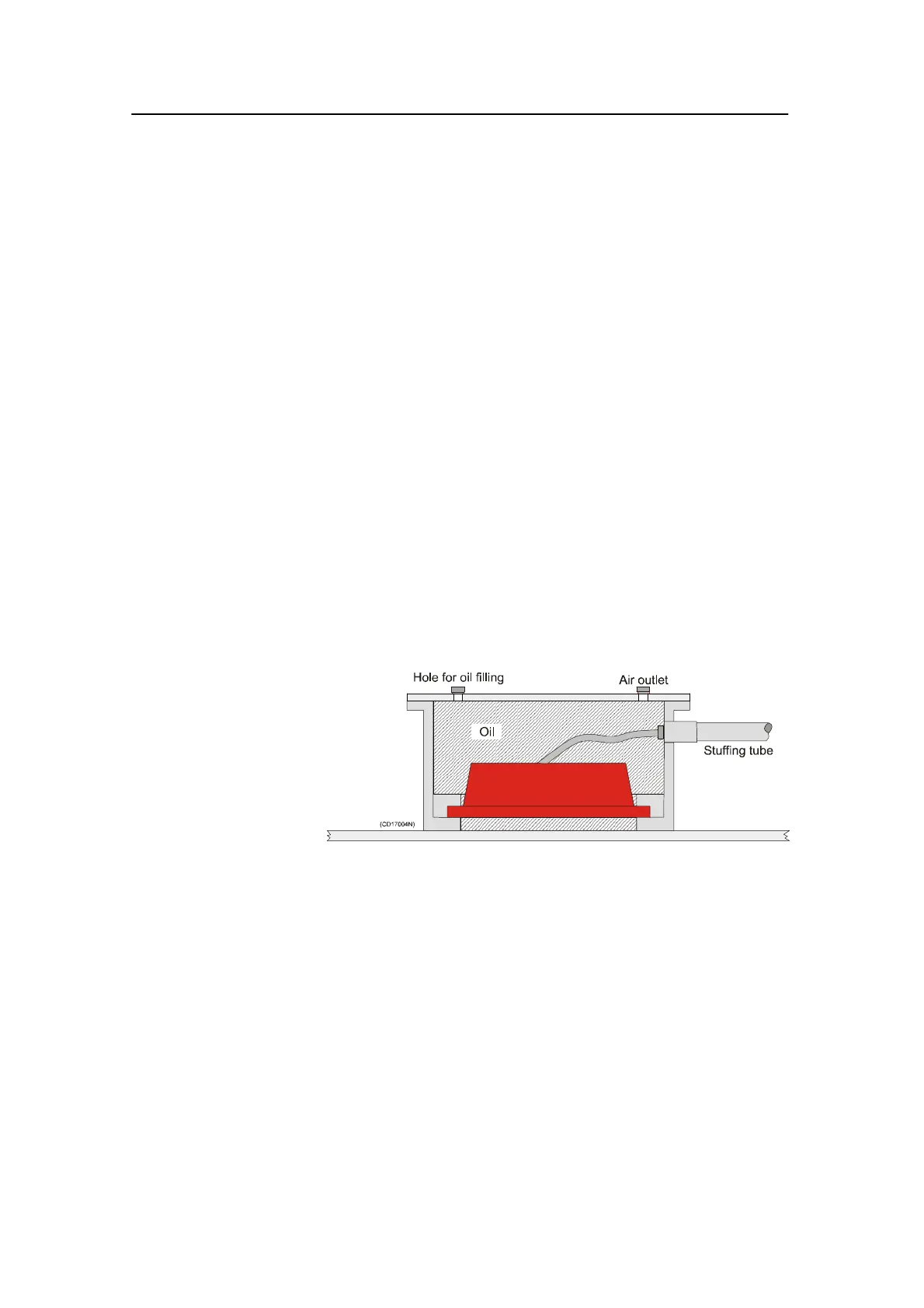
An installation of the transducer inside the hull, and sounding
through the hull, requires a good acoustic contact between the
transducer face and the hull. Build a tank around the transducer
and fill it with a liquid. Oil used in hydraulic systems is a well
suited liquid for this purpose. It contains no gas bubbles and is
non-corrosive.
The tarnsducer can be mounted inside the hull. A substantial
loss must be expected when the sound passes through the hull.
→ Refer to figure 14.
Typical values of the two way loss are 3 dB for polyester, 6 dB
for aluminium and 10 dB for steel. Hulls made of wood or a
sandwich type with foam in the middle, attenuate the sound so
much that through hull sounding must be regarded as
impossible. The loss varies with the distance between transducer
face and the hull. The best result is obtained when the distance
is half a wavelength. Consult Kongsberg Maritime for advice. In
addition to the loss, the beam pattern is degraded, because a
larger area of the hull is set into vibrations.
Figure 14 Transducer
mounting inside the hull
It is strongly recommended to lay a steel conduit from the
transducer to the echo sounder transceiver, and draw the
transducer cable through the conduit. There are two reasons for
this procedure.
• First, it will make it easier at a later stage to replace the
transducer.
• Second, noise and interference from other electrical
equipment is greatly reduced.
With a steel conduit the installation satisfies the EU regulations
for EMC interference. Without a steel conduit, there is a risk of
reduced echo sounder performance.





 To Next Page