1.2. Operating principle
The KB operates on a proven, non-contact reflection principle. The light source can be either RGB
LED (red, green, blue) or IR LED (infrared). The optical sensor is placed above or under the web.
Applications include paper or board webs, wires or felts. Thanks to the unique RGB detection
method the color of the product or the felt has no effect on the measurement reliability. The sensor
is neither affected by dirt, steam nor temperatures up to 180 °C (356 °F) when installed according
to Kajaani Process Measurements specifications. There are no electronic components located in the
sensor head.
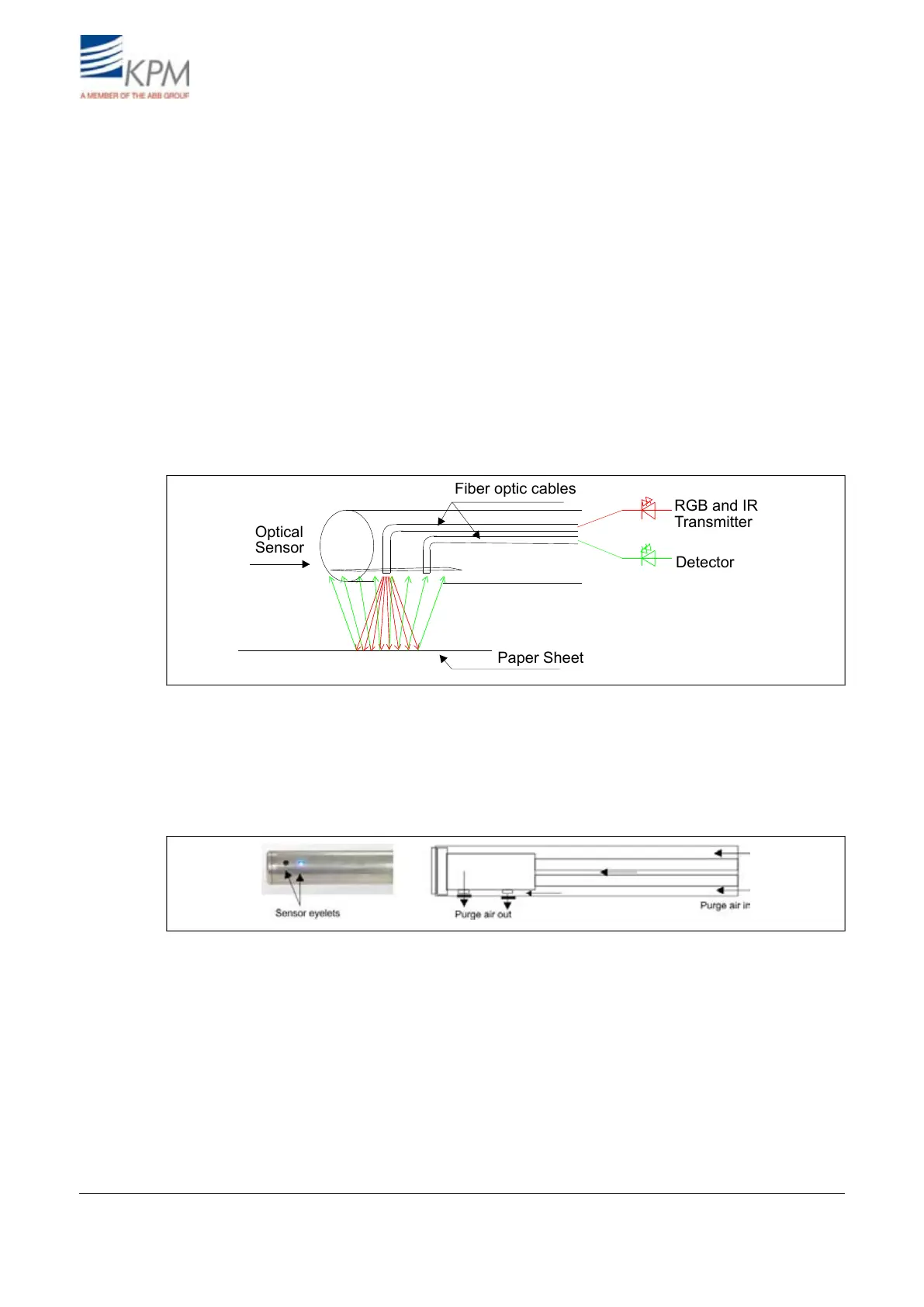
The optical sensor is connected through a fiber-optic cable to the RGB/IR light source located in the
display unit. The RGB/IR LEDs emit pulsed red, green, blue, or IR light onto the web surface. The
reflected light is received and transmitted through the fiber-optic cable to the detector. All light
components are analyzed fast for a reliable break detection.
A break activates a relay, which can be connected to the logic control of a paper machine. The reflected
light intensities are also available as optional 4 - 20 mA analog outputs.
Optical
Sensor
RGB and IR
Transmitter
Detector
Fiber optic cables
Paper Sheet
Fig. 1.2. Operating principle.
The self-cleaning sensor head is a 33.7 x 1500 mm (1" x 59") stainless steel tube with two holes
serving as eyelets for the fiber-optics and outlets for purge air. Continuous airflow through the
stainless steel enclosure keeps positive pressure around the sensor head's eyes and keeps the eyelets
free of steam, dust or debris. The openings should be located towards the surface being monitored.
Fig. 1.3. Sensor eylets and purge air operation.
KB² Man W41100099V1.24August 2012


 To Next Page