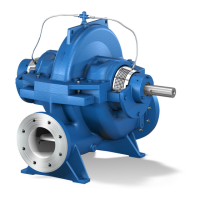
60 Hz Submersible Borehole Pumps
8
Selection for Deep Wells
Pump Selection
The following data are required for a first rough selection of a
submersible borehole pump:
-- Capacity Q in m
3
/h (l/s)
-- Pressure at well head H
A
in m
-- Well diameter D in inches or mm
-- Temperature of fluid handled t
A
in °C
-- Pump head H
P
in m
While Q, H
A
, D and t
A
are usually specified by the customer, the
head H
P
to be developed by the pump needs to be calculated.
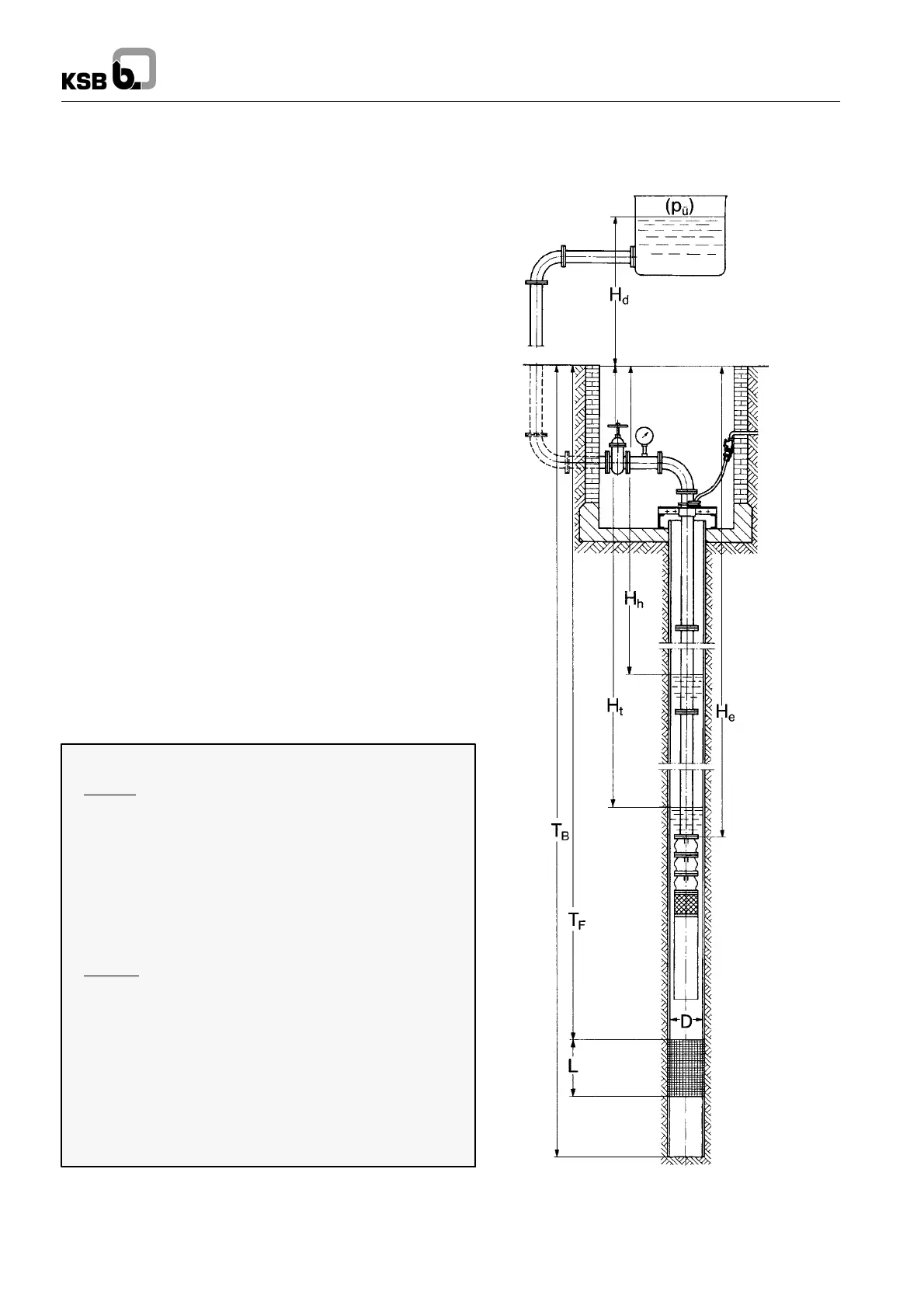
There are two typical applications to be considered (see the
drawing on the right):
1. Pumping into an open overhead tank
H
P
=H
A
+H
t
+H
v
+H
S
[m]
with ...
H
A
= Required pressure at well head
H
t
= Lowest water level (dynamic water level)
H
v
= Head losses in the check valve (see characteristic
curves for different stage numbers for UPA 150S
and above).
H
S
= Head losses in riser pipe up to well head
(see page 10).
H
e
= Installation depth
2. Pumping into a closed tank
H
p
=H
A
+H
t
+H
v
+H
S
+p
ü
[m]
with ...
p
ü
= Gauge pressure (also air cushion) in a tank
Example
Given ...
" Q
A
= 120 m
3
/h,
" H
A
= 100 m,
" t
A
=+15°C,
" 50 Hz,
" 400 V,
" d.o.l. starting,
" well diameter D = 300 mm (12 inches),
" H
t
=33m,
" H
e
=60m
Found ...
1. step: pump type UPA 200B/250C
(for Q
A
taken from selection chart on page 4).
2. step: pump size UPA 250C - 120
(for Q
A
taken from selection chart on page 50).
3. step: pump set UPA 250C-120/3f + UMA 200D 65/21
(for H
p
=H
A
+H
t
+H
V
+H
S
= 100 + 33 + 0.5 + 1.5 = 135 m.
with H
V
taken from characteristic curves for different stage.
numbers on page 61)..
Pump efficiency: η
P
= 81 % (without check valve).
3300:54/3
Figure: Deep well with submersible borehole pump and
overhead tank or closed tank at a pressure above atmospheric
pressure of p
Ü.


 To Next Page