
 Need help?
Do you have a question about the Kuka LBR iisy and is the answer not in the manual?
Instructions for removing the packaging lid and sides, keeping the robot in the box.
Guidance on taking out all components, accessories, and cables, leaving the robot inside.
Lists and illustrates the main components included in the robot's packaging.
Instructions for securing the robot with a sling and preparing for lifting.
Details on safely lifting the robot using a hoist and transporting it.
Directs users to safety instructions and mounting patterns via QR code.
Connects the grounding wire to the KR C5 micro controller.
Connects the data and engine cables between the robot and controller.
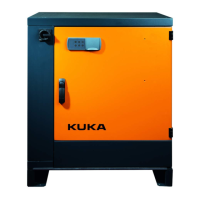
Connects the smartPAD Pro and power cables to the KR C5 controller.
Guidance on mounting the tool to the robot flange and downloading toolbox software.
Ensure all cables are properly connected before powering on the controller.
Highlights the need for basic safety configuration and contacting KUKA for assistance.
Provides QR codes to access the iiQKA User Forum, Help Portal, and Ecosystem Marketplace.
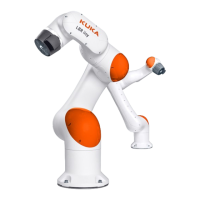
The KUKA LBR iisy is a collaborative robot designed for quick setup and versatile applications, as detailed in its Quick Setup Guide. This guide outlines the essential steps for unboxing, checking components, transporting, mounting, connecting cables, and setting up end-of-arm tooling.
The LBR iisy is a robotic arm primarily used for automation tasks, particularly those requiring human-robot collaboration. Its design emphasizes ease of use and rapid deployment, making it suitable for various industrial and research environments. The robot is controlled by the KR C5 micro robot controller and operated via the KUKA smartPAD pro. It is designed to be integrated with different end-of-arm tooling (EOAT) based on specific application requirements, with support for toolboxes from the iiQKA ecosystem or manual configuration. The system includes a basic safety configuration out of the box, with options for advanced safety features like collision detection and free space reaction to be configured by the user.
While specific numerical technical specifications like payload, reach, or axis speeds are not explicitly listed in the provided pages, the manual highlights key components and operational aspects:
The LBR iisy is designed for user-friendly operation and quick integration:
While the manual primarily focuses on initial setup, it implicitly suggests aspects related to maintenance through its design and resource provision:


 To Next Page
 General