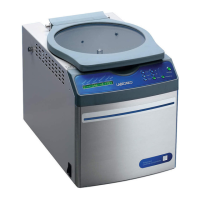
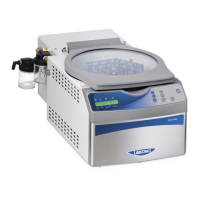
The Labconco CentriVap DNA Centrifugal Concentrator is a laboratory instrument designed for the rapid drying of DNA and RNA precipitates. It utilizes a combination of centrifugal force, heat, and vacuum to achieve efficient sample concentration. This process eliminates bumping and foaming that can occur when vacuum is applied, while also concentrating the solute at the bottom of the vial, enabling recovery from sample volumes as small as a few microliters.
Function Description:
The CentriVap Concentrator operates by applying centrifugal force to samples, which prevents bumping and foaming during the evaporation process. Simultaneously, a vacuum is applied to lower the boiling point of the solvents, and a 300-watt heater warms the chamber to further accelerate evaporation. The instrument includes a timed outlet for the vacuum pump, which delays the pump's start until the rotor reaches its operating speed, ensuring optimal conditions for concentration. Safety features include a switch that prevents the concentrator from starting when the lid is open and a latch that prevents the lid from being opened while the rotor is turning. The compact, low-profile design allows for convenient placement on a benchtop or other laboratory work surface.
The system's microprocessor controls the heater and motor, providing precise regulation and reproducibility of protocols. A manually preset timer allows for signaling the end of a run. The device can store up to nine different protocols in memory, facilitating easy repetition of exact test parameters.
Important Technical Specifications:
- Power Requirements: Available in 115V (60 Hz) and 230V (50/60 Hz) models.
- 115V models require a 15 Amp circuit breaker or fuse.
- 230V models require an 8 Amp circuit breaker or fuse.
- Heater Power: 300 watts.
- Rotor Speed: Up to 1,725 RPM.
- Wetted Parts: All wetted parts within the pump are made of PTFE or other chemical-resistant fluoropolymers.
- Traps: Includes a glass trap to remove liquid before it enters the pump and a second glass trap on the outlet side to collect expelled liquid.
- Environmental Conditions:
- Indoor use only.
- Maximum altitude: 6562 feet (2000 meters).
- Ambient temperature range: 41° to 104°F (5° to 40°C).
- Maximum relative humidity: 80% for temperatures up to 88°F (31°C), decreasing linearly to 50% relative humidity at 104°F (40°C).
- Main supply voltage fluctuations not to exceed ±10% of the nominal voltage.
- Transient overvoltages according to Installation Categories II (Overvoltage Categories per IEC 1010). Temporary voltage spikes on the AC input line may be as high as 1500V for 115V models and 2500V for 230V models.
- Used in an environment of Pollution degrees 2 (i.e., where normally only non-conductive atmospheres are present). Occasionally, however, a temporary conductivity caused by condensation must be expected, in accordance with IEC 664.
Usage Features:
- Control Panel: Features an LCD display showing set point parameters and actual measured conditions.
- Program Buttons: Three dedicated buttons (PROG 1, PROG 2, PROG 3) allow for quick initiation of stored protocols. Up to nine programs can be stored and selected.
- Run/Stop Button: Initiates or halts a run.
- Preheat Button: Activates the heater to preheat the chamber before sample loading.
- Increase/Decrease Buttons: Adjust selected set points (temperature, run time, heater time).
- Set Point Select Button: Toggles through parameters for adjustment.
- Temperature Setting: Can be set from OFF to 99°C (displayed as "HI" for 100°C).
- Time Setting: "RUN TIME" can be set from 1 to 999 minutes or "ON" for continuous operation. "HEATER TIME" allows the heater to turn off before the run time expires, protecting heat-sensitive samples.
- Sample Loading: Samples should be loaded symmetrically in the rotor for balanced operation. Vials should be no more than half full.
- Emergency Access: A small screwdriver can be inserted into a hole on the left side of the case to unlock the lid latch mechanism if there is no electrical power.
- Exhaust Port: A .50 inch ID hose can be attached to the vacuum pump glass trap exhaust port and routed to a fume hood or other ventilation device if the CentriVap is not in a fume hood.
- Rotor Installation: Rotors are placed onto the shaft, engaging a drive pin with slots in the rotor hub.
- Accessories: Optional accessories include a glass lid for enhanced chemical resistance, a secondary chemical trap (acid, moisture, radiochemical, solvent, or ammonia trap inserts available), a vacuum gauge for monitoring vacuum levels, and a CentriZap Strobe Light for observing samples during rotation.
Maintenance Features:
- Cleaning: Spills should be cleaned immediately. Surfaces should be decontaminated using agents suitable for the spilled substance. The lid and gasket can be cleaned with a soft cloth, sponge, or chamois and a mild, non-abrasive soap or detergent.
- Trap Maintenance: Liquid collected in glass traps should be removed after each run by unscrewing the glass bowl. Optional chemical trap inserts should be replaced when they change color (for indicator types) or after each use (for radiochemical traps).
- Rotor Inspection: Rotors should be checked for loose or missing parts and tightened or replaced as needed. Damaged rotors should not be used.
- Chamber Inspection: The chamber should be inspected for cracks or structural damage.
- Electrical Continuity Check: Periodically check the continuity of the protective earth between the ground terminal on the power inlet and a bare metal housing panel.
- Rubber Components: Monthly, inspect all rubber hoses and gaskets for signs of hardening, permanent set, or deterioration, and replace as necessary.
- Glass Lid Cleaning: Monthly, clean the glass lid with a soft cloth, sponge, or chamois and a mild, non-abrasive soap or detergent. Liquid spray cleaners and polishes may be used on exterior surfaces, but solvents should not be used as they may damage the finish.
Safety Precautions:
- Always read the User's Manual before operating.
- Observe all safety symbols and warnings, including those related to lifting hazards, moving rotors, and electrical shock.
- Do not operate if the lid is scratched, nicked, or shows signs of damage.
- Never attempt to defeat the lid latch or open the lid while the CentriVap is running.
- Do not reach into the chamber if the rotor is turning.
- Ensure proper ventilation, especially when using solvents that may produce hazardous vapors.
- Use extreme caution and keep sources of ignition away from solvents.
- Operate the CentriVap inside a suitable fume hood or ventilation device when using flammable or hazardous solvents.
- Clean up spills immediately, especially if hazardous materials are involved.
- Properly dispose of all hazardous materials in compliance with applicable codes.
- Do not store or stack supplies or equipment on top of the CentriVap.
- Disconnect power before performing any corrective action or maintenance.
- If using hazardous, toxic, radioactive, or pathogenic microorganisms, refer to the World Health Organization Laboratory Biosafety Manual and wear appropriate eyewear, gloves, and safety apparel.

 Need help?
 General



 To Next Page