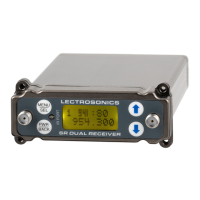
SRa5P and SRa Dual Receivers
LECTROSONICS, INC.
6
RF Front-End and Mixer
Eachantennasignalisrstpassedthroughahighqual-
itySAWltertorejecthighpowerRFsignalsaboveand
below the operating frequency. A high current amplifier
follows the SAW filters and passes the signal to an in-
ternal splitter so that both antenna signals are available
to both receivers for SmartDiversity™ reception.
The mixer in each receiver takes the signal from the
PLLtogeneratetherstIFsignal,withbothPLLcircuits
fed from a common reference oscillator to maintain
signalphasethroughtheIFsections.
Microcontroller, PLL and VCO Circuits
The 8-bit microprocessor is the “heart” of the SRa5P
andSRareceivers.Itmonitorsusercommandinputs
from the front panel control buttons and numerous other
internal signals such as RF level, audio levels, pilot tone
levelsandtransmitterbatterystatus.Outputsfromthe
microcontrollerdrivetheLCDdisplayandbacklight,
control the squelch and audio output attenuator, the
PLL/VCOcircuitsandtheantennaphaseswitch.
IF Amplifiers and SAW Filters
TherstIFstageat244MHzemploystwostate-of-the-
art SAW (surface acoustic wave) filters. The use of two
filters significantly increases the depth of filtering while
preserving sharp skirts, constant group delay, and wide
bandwidth. Though expensive, this special type of filter
allows primary filtering as early as possible, at as high
a frequency as possible, before high gain is applied, to
delivermaximumimagerejection.Sincetheseltersare
madeofquartz,theyareverytemperaturestable.
AftertheSAWlter,the244MHzIFsignalisconverted
to250kHzinreceiver1and350kHzinreceiver2.Only
thenisthemajorityofthegainapplied,justbeforethe
signal is converted to audio with a pulse counting detec-
tor.AlthoughtheseIFfrequenciesareunconventional
inawidedeviation(±75kHz)system,itoffersoutstand-
ingAMrejectiongureoveraverywiderangeofsignal
strengths and produces an excellent noise improvement
at low signal strengths.
Digital Pulse Counting Detector
The receiver uses an elegantly simple, yet highly effec-
tive digital pulse detector to demodulate the FM signal,
rather than a conventional quadrature detector. This
unusual design eliminates thermal drift, improves AM
rejection,andprovidesverylowaudiodistortion.
DSP-Based Pilot Tone
The Digital Hybrid system design uses a DSP gener-
ated ultrasonic pilot tone to control the receiver audio
muting (squelch). Brief delays are applied to eliminate
thumps, pops or other transients that can occur when
the power is turned on or off. The pilot tone frequency
is different for each of the 256 frequencies in the tuning
range of a system (frequency block). This eliminates
squelch problems in multichannel systems where a
pilot tone signal can appear in the wrong receiver via
intermodulation products. The DSP generated pilot tone
also eliminates fragile crystals, allowing the receiver to
survive shocks and mishandling much better than older
analog-based pilot tone systems.
Note:Thisdescriptionappliesonlyin400Series
mode.In200Seriesmode,onlyonepilottone
frequency is used on all channels, emulating
theoriginalcrystal-basedsystem.Inother
compatibility modes, no pilot tone is used.
SmartSquelch
™
Any squelching system faces inevitable trade-offs:
squelch too aggressively and valuable audio information
may be lost. Squelch too little and excessive noise may
be heard. Respond too rapidly and the audio will sound
“choppy.” Respond too sluggishly and syllables or entire
words can be cut off.
SmartSquelch
TM
combines several techniques to achieve
an optimal balance, removing distracting noise, without
thesquelchingactionitselfbecomingadistraction.One
of these techniques involves waiting for a word or syl-
lable to complete before squelching. Another technique
incorporates recent squelching history and recent signal
strength,adjustingsquelchingbehaviordynamicallyfor
the most serviceable result under variable conditions. Us-
ing these and other techniques, the SRa5P and SRa can
deliver acceptable audio quality from otherwise unusable
signals.
Smart Noise Reduction (SmartNR
™
)
Note: The SmartNR setting is user Selectable
onlyin400Seriesmode.Inothermodes,noise
reduction is applied in such a way as to emulate
the original analog system as accurately as
possibleandisnotuseradjustable.
The wide dynamic range of digital hybrid technology,
combinedwithatresponseto20kHz,makesitpos-
sibletohearthe-120dBVnoiseoorinthemicpre-
amp, or the (usually) greater noise from the microphone
itself. To put this in perspective, the noise generated
by the recommended 4k bias resistor of many electret
lavalieremicsis–119dBVandthenoiselevelofthe
microphone’selectronicsisevenhigher.Inorderto
reduce this noise the receiver is equipped with a Smart
Noise Reduction algorithm, which removes hiss without
sacrificing audio high frequency response.
The Smart Noise Reduction algorithm works by at-
tenuating only those portions of the audio signal that fit
a statistical profile for randomness or “electronic hiss.”
Because it much more than a sophisticated variable
low pass filter, the transparency of the audio signal is
preserved. Desired high frequency signals having some
coherence are not affected, such as speech sibilance
and tones.


 To Next Page