UHF Digital Hybrid Wireless
®
Rio Rancho, NM
7
The Smart Noise Reduction algorithm has three modes,
Selectable from a user setup screen. The optimal set-
tingforeachapplicationissubjectiveandselectedwhile
simply listening.
OFF-nonoisereductionisperformedandcomplete
transparency is preserved. All signals presented to the
transmitter’s analog front end, including any faint micro-
phone hiss, will be faithfully reproduced at the receiver.
NORMAL-enoughnoisereductionisappliedtoremove
most of the hiss from the microphone preamp and
some of the hiss from lavaliere microphones. The noise
reduction benefit is significant in this position, yet the
degree of transparency maintained is exceptional.
FULL - enough noise reduction is applied to remove
most of the hiss from nearly any signal source of rea-
sonable quality and some high frequency environmental
noise, assuming levels are set properly at the transmit-
ter.
Supersonic Noise-Based
Dynamic Filter and Squelch
InadditiontoSmartNR,allhybridreceiversare
equipped with a supersonic noise-based dynamic filter
and squelch system. The incoming audio is monitored
forenergyabove22kHz,pilottoneexcepted.Excessive
high frequency energy indicates that the received signal
is too weak to achieve an acceptable signal-to-noise
ratio. Under marginal conditions, a variable low pass
filter is rolled in dynamically, masking the noise while
preserving as much of the transmitted signal as pos-
sible. When the channel is too noisy even for the filter,
the audio is squelched.
This noise-based filter and squelch system replaces a
more or less equivalent system used for many years,
which based its operation on RF signal strength. Perfor-
mance of the two systems is virtually identical, but the
noise-based system requires no calibration and there
is no better way to track the signal-to-noise ratio than to
measure it directly.
RF-Controlled Digital Noise Filter
Inextremelyweaksignalconditions,anRFsensitive
variable frequency filter is applied to reduce the high
frequency response of the receiver. This filter does
nothinguntiltheRFsignalstrengthdropsbelow3uVat
which point it begins to roll off high frequencies. Usable
audio remains unaffected, but noise-ups or “hits” occur-
ring near the fringe of reception sound much less harsh.
Audio Output Level
Asetupscreenisprovidedforadjustingtheaudioout-
putlevelin1dBincrementsfrom-50to+5dBuusing
thefrontpanelUPandDOWNbuttons.
Test Tone
To assist in matching the audio levels of equipment
connectedtotheSRa5PorSRa,a1kHzaudiotest
tone,adjustablefrom-50to+5dBuin1dBincrements,
is available at the XLR connector. This tone is available
throughtheTONEsetupwindow.
Power Supply
TheSRa5PandSRaisoperatedfromanexternalDC
power source. The power supplies are protected from
damage to the receiver that could occur if a positive
ground power source is applied.
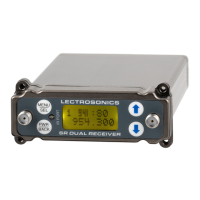
LCD Display
The display has four primary windows. Pressing the
Front Panel Sel button steps through each of these
windows.
Ifthebatterygetslowonthetransmitters,amessage
will interrupt the display every few seconds and flash a
low battery warning.
After power is turned off and back on again, the unit
defaults to the main window and to the most recent fre-
quency, audio level, transmitter battery type and other
user settings. These settings are retained even when
the power is turned off. After five minutes of no key ac-
tivity,theLCDbacklightgoesoffandthedisplayreverts
back to the main window.


 To Next Page