244
4-5. Using the driving support systems
crossing vehicles) may operate even
though there is no possibility of a collision.
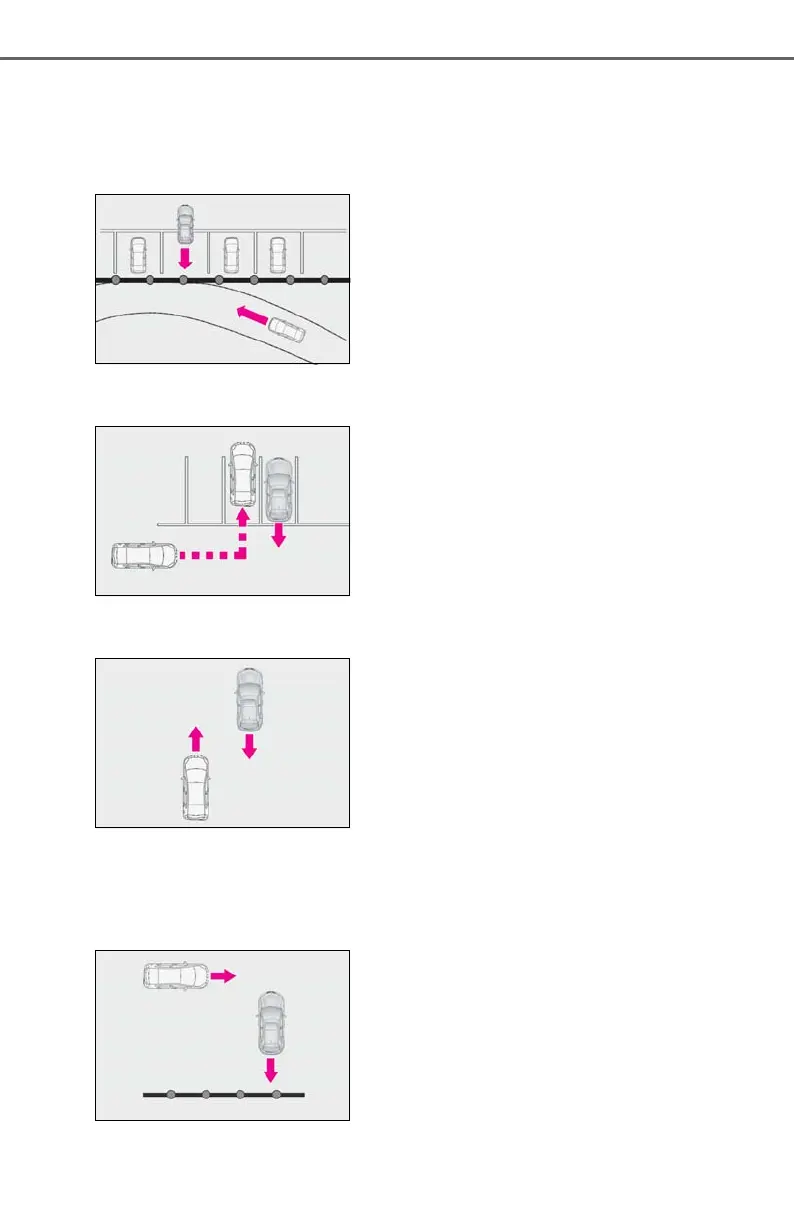
● When the parking space faces a street
and vehicles are being driven on the
street
● When a detected vehicle turns while
approaching the vehicle
● When a vehicle passes by the side of your
vehicle
● When the distance between your vehicle
and metal objects, such as a guardrail,
wall, sign, or parked vehicle, which may
reflect electrical waves toward the rear of
the vehicle, is short
● When there are spinning objects near
your vehicle such as the fan of an air con-
ditioning unit
● When water is splashed or sprayed
toward the rear bumper, such as from a
sprinkler
■ Situations in which the Parking Support
Brake function (rear-crossing vehicles)
may not operate properly
In some situations, such as the following, the
radar sensors may not detect an object and
this function may not operate properly
● Stationary objects
● When a sensor or the area around a sen-
sor is extremely hot or cold
● If the rear bumper is covered with ice,
snow, dirt, etc.
● When it is raining heavily or water strikes
the vehicle
● When the detection area of a radar sen-
sor is obstructed by an adjacent vehicle
● If the vehicle is significantly tilted
● When equipment that may obstruct a
sensor is installed, such as a towing eye-
let, bumper protector (an additional trim
strip, etc.), bicycle carrier, or snow plow
● If the suspension has been modified or
tires of a size other than specified are
installed
● If the front of the vehicle is raised or low-
ered due to the carried load
● If a sticker or an electronic component,
such as a backlit license plate (especially
fluorescent type), fog lights, fender pole
or wireless antenna is installed near a
radar sensor
● If the orientation of a radar sensor has
been changed
● When multiple vehicles are approaching
with only a small gap between each vehi-
cle
● If a vehicle is approaching the rear of
your vehicle rapidly
● Situations in which the radar sensor may
not detect a vehicle
• When a vehicle approaches from the
right or left at the rear of the vehicle while
you are turning while backing up



 To Next Page