Description
GA10218_002_C0 - 10/2016 - © Leybold GmbH 9
1 Description
The PHOENIX L300i is a leak detector for helium or hydrogen. This instrument may
be used to detect the location and the size of leaks on objects under test in two
different ways:
When the test sample has been evacuated first and is sprayed with helium on the
outside. It is required that a vacuum connection is provided between the PHOENIX
L300i and the test sample (vacuum mode).
or
when a helium overpressure is provided in the test sample and the test sample is
searched from the outside with a sniffer probe which is attached to the inlet port
(sniffer mode).
1.1 Design and Function
The PHOENIX L300i basically is a helium leak detector for vacuum applications, i.e.
the part under test is evacuated while the test is performed. The vacuum is achie
-
ved with a pumping system that is part of the PHOENIX L300i. In addition the
vacuum can be generated by pumps which are set up in parallel to the PHOENIX
L300i.
The PHOENIX L300i MODUL needs a fore vacuum pump, dry or wet version, to be
connected because this unit has no internal roughing pump. The connection
(DN25 KF) is on the side or under the bottom of the PHOENIX L300i MODUL (
Fig.
7).
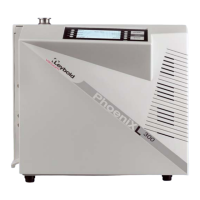
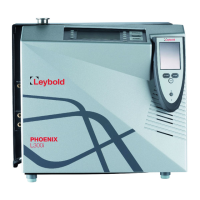
Fig. 1 View of the PHOENIX L300i
1 inlet flange 2 control panel


 To Next Page
 Loading...