EasyManua.ls Logo

Luxman 308 - Detailed Switches and Controls; Speaker Output and Power Management; Audio Tone and Equalization Features

Luxman 308
20 pages
Print Icon
To Next Page IconTo Next Page
To Previous Page IconTo Previous Page
Loading...
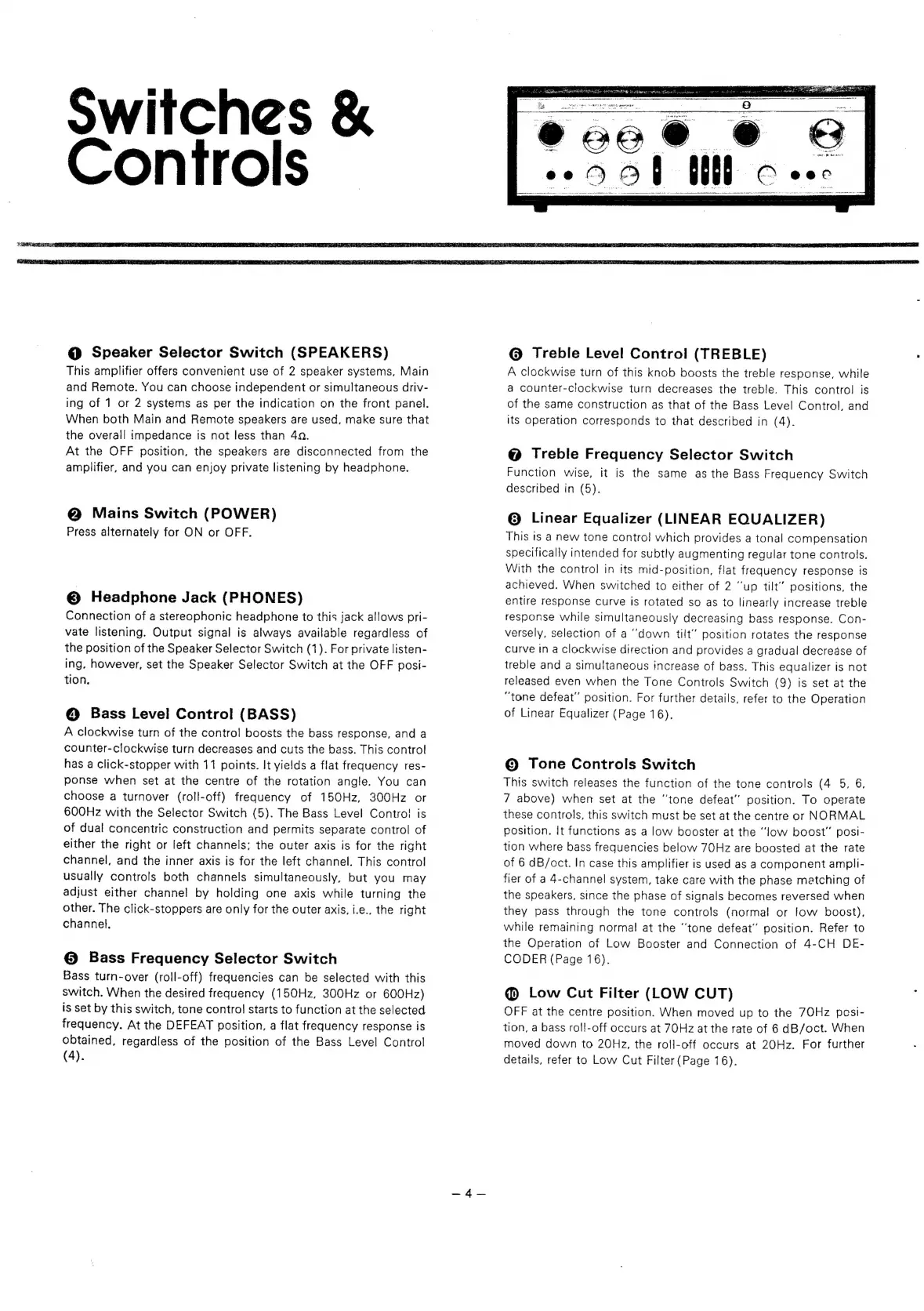
Switches
&
Controls
@
Speaker
Selector
Switch
(SPEAKERS)
This
amplifier
offers
convenient
use
of
2
speaker
systems,
Main
and
Remote.
You
can
choose
independent
or
simultaneous
driv-
ing
of
1
or
2
systems
as
per
the
indication
on
the
front
panel.
When
both
Main
and
Remote
speakers
are
used,
make
sure
that
the
overall
impedance
is
not
less
than
4a.
At
the
OFF
position,
the
speakers
are
disconnected
from
the
amplifier,
and
you
can
enjoy
private
listening
by
headphone.
@
Mains
Switch
(POWER)
Press
alternately
for
ON
or
OFF.
Headphone
Jack
(PHONES)
Connection
of
a
stereophonic
headphone
to
this
jack
allows
pri-
vate
listening.
Output
signal
is
always
available
regardless
of
the
position
of
the
Speaker
Selector
Switch
(1).
For
private
listen-
ing,
however,
set
the
Speaker
Selector
Switch
at
the
OFF
posi-
tion.
@
Bass
Level
Control
(BASS)
A
clockwise
turn
of
the
control]
boosts
the
bass
response,
and
a
counter-clockwise
turn
decreases
and
cuts
the
bass.
This
control
has
a
click-stopper
with
11
points.
It
yields
a
flat
frequency
res-
ponse
when
set
at
the
centre
of
the
rotation
angle.
You
can
choose
a
turnover
(roll-off)
frequency
of
150Hz,
300Hz
or
600Hz
with
the
Selector
Switch
(5).
The
Bass
Level
Contro!}
is
of
dual
concentric
construction
and
permits
separate
control
of
either
the
right
or
left
channels:
the
outer
axis
is
for
the
right
channel,
and
the
inner
axis
is
for
the
left
channel.
This
contro!
usually
controls
both
channels
simultaneously,
but
you
may
adjust
either
channel
by
holding
one
axis
while
turning
the
other.
The
click-stoppers
are
only
for
the
outer
axis,
i.e.,
the
right
channel.
@
Bass
Frequency
Selector
Switch
Bass
turn-over
(roll-off)
frequencies
can
be
selected
with
this
switch.
When
the
desired
frequency
(150Hz,
300Hz
or
600Hz)
is
set
by
this
switch,
tone
contro]
starts
to
function
at
the
selected
frequency.
At
the
DEFEAT
position,
a
flat
frequency
response
is
obtained,
regardless
of
the
position
of
the
Bass
Level
Control
(4).
PR
Ne
NN
ioe
Papers
“.
geet
ene
te
see
=
ais
wes!
+
hoot
"
wet
L
\
Yrs
7a
ter
oue
gt
cee
1
:
nod
“i
fs
tar
6
hee
vs
sort
Neamt
bane
@
Treble
Level
Control
(TREBLE)
A
clockwise
turn
of
this
knob
boosts
the
treble
response,
while
a
counter-clockwise
turn
decreases
the
treble.
This
contro!
is
of
the
same
construction
as
that
of
the
Bass
Level
Control,
and
its
operation
corresponds
to
that
described
in
(4).
@
Treble
Frequency
Selector
Switch
Function
wise,
it
is
the
same
as
the
Bass
Frequency
Switch
described
in
(5).
@
Linear
Equalizer
(LINEAR
EQUALIZER)
This
is
a
new
tone
control
which
provides
a
tonal
compensation
specifically
intended
for
subtly
augmenting
regular
tone
controls.
With
the
control
in
its
mid-position,
flat
frequency
response
is
achieved.
When
switched
to
either
of
2
“up
tilt’
positions,
the
entire
response
curve
is
rotated
so
as
to
linearly
increase
treble
response
while
simultaneously
decreasing
bass
response.
Con-
versely,
selection
of
a
‘‘down
tilt”
position
rotates
the
response
curve
In
a
clockwise
direction
and
provides
a
gradual
decrease
of
treble
and
a
simultaneous
increase
of
bass.
This
equalizer
is
not
released
even
when
the
Tone
Controls
Switch
(9)
is
set
at
the
“tone
defeat’
position.
For
further
details,
refer
to
the
Operation
of
Linear
Equalizer
(Page
16).
©
Tone
Controls
Switch
This
switch
releases
the
function
of
the
tone
controls
(4
5,
6,
7
above)
when
set
at
the
‘tone
defeat’
position.
To
operate
these
controls,
this
switch
must
be
set
at
the
centre
or
NORMAL
position.
It
functions
as
a
low
booster
at
the
“low
boost”
posi-
tion
where
bass
frequencies
below
70Hz
are
boosted
at
the
rate
of
6
dB/oct.
In
case
this
amplifier
is
used
as
a
component
ampli-
fier
of
a
4-channel
system,
take
care
with
the
phase
matching
of
the
speakers,
since
the
phase
of
signals
becomes
reversed
when
they
pass
through
the
tone
controls
(normal
or
low
boost),
while
remaining
norma!
at
the
‘‘tone
defeat”
position.
Refer
to
the
Operation
of
Low
Booster
and
Connection
of
4-CH
DE-
CODER
(Page
16).
@
Low
Cut
Filter
(LOW
CUT)
OFF
at
the
centre
position.
When
moved
up
to
the
7OHz
posi-
tion,
a
bass
roll-off
occurs
at
70Hz
at
the
rate
of
6
dB/oct.
When
moved
down
to
20Hz,
the
roll-off
occurs
at
20Hz.
For
further
details,
refer
to
Low
Cut
Filter
(Page
16).

Related product manuals