SPEAKER PHASING
To assure
the
best 4-channel or
Stereo
separation
and frequency response,
the
following tests will
verify
that
all
four
speakers are
correctly
phased.
1.
After
the
speakers are
connected
to
the
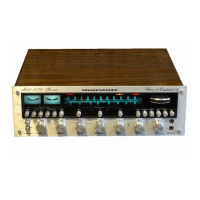
4270,
place all
four
speakers in
the
center
of
the
room.
2.
Set
MODE Switch
at
MONO. Play a record
(or radio or tape) with strong bass tones,
at
a
low volume level. Center
the
FRONT L-R
and REAR L-R BALANCE controls.
Set
FRONT-REAR BALANCE
control
at
extreme
FRONT position.
3. Position
the
front
(left and right) speakers
about
six inches apart, face-to-face. Listen,
particularly
to
the
apparent
loudness of
the
bass tones.
4. Next,
turn
off
all power,
but
do
not
disturb
the
volume,
tone
or balance settings. Reverse
connections on
the
right-front speaker only.
Turn
on
the
power, and listen again. If
the
bass
tones
now seem louder
than
in (3) ,
you
have corrected
the
phasing between
the
front
(left
and
right) speakers. If
the
bass
tones
now
sound
softer,
then
turn
off
all power and
re-connect
the
right-front speaker as you first
had it
connected
.
5. Now check phasing between
the
two
left
(front
and rear) speakers.
Set
both
FRONT
L-R
and
REAR L-R BALANCE
controls
at
extreme
L
position, and
set
FRONT-REAR BALANCE for
equal loudness from
the
two
speakers. Posi-
tion
the
two
speakers face-to-face,
about
six
inches
apart
, and listen for bass as in (3).
6.
Turn
off
power. Experimentally reverse con-
nections only on
the
left-rear speaker. Use
the
connection which gives
the
"best"
bass, as
in (4).
7. Last, check phasing between
the
two
rear
(left
and
right) speakers. Center
both
FRONT
and REAR BALANCE controls.
Set
FRONT-
REAR BALANCE control
at
extreme
REAR
position. Position
the
two
rear speakers face-
to-face as before. Listen for bass.
8. Turn
off
power. Experimentally reverse con-
nections
only
on
the
right-rear speaker. Listen
again
to
determine
the
"best
" bass
method
of
connecting
the
right-rear speaker. All speakers
will
then
be in phase, and you
may
use all
controls normally.
9. Once having phased
your
four
speakers, you
need
not
repeat
the
procedure in
the
future if
you now
code
the
speaker
connections
and/or
the
speaker cables.
Any
method
of
coding is
satisfactory, provided it enables
you,
in
the
future,
to
duplicate
your
now-correct
hookup
between speakers
and
amplifiers.
SPEAKER PLACEMENT
Experimentation will reveal
the
best
speaker
locations in
your
room.
The
placements are
shown in Figure 4.
5


 To Next Page