64 Appendix B: Technical information
The auxiliary signals are path independent; regardless of the acquisition path that
is being used to grab images, any of the auxiliary signals can be used. For more
information, see the Auxiliary signals section in Chapter 4: Matrox Rapixo CXP
hardware reference chapter for supported functionality.
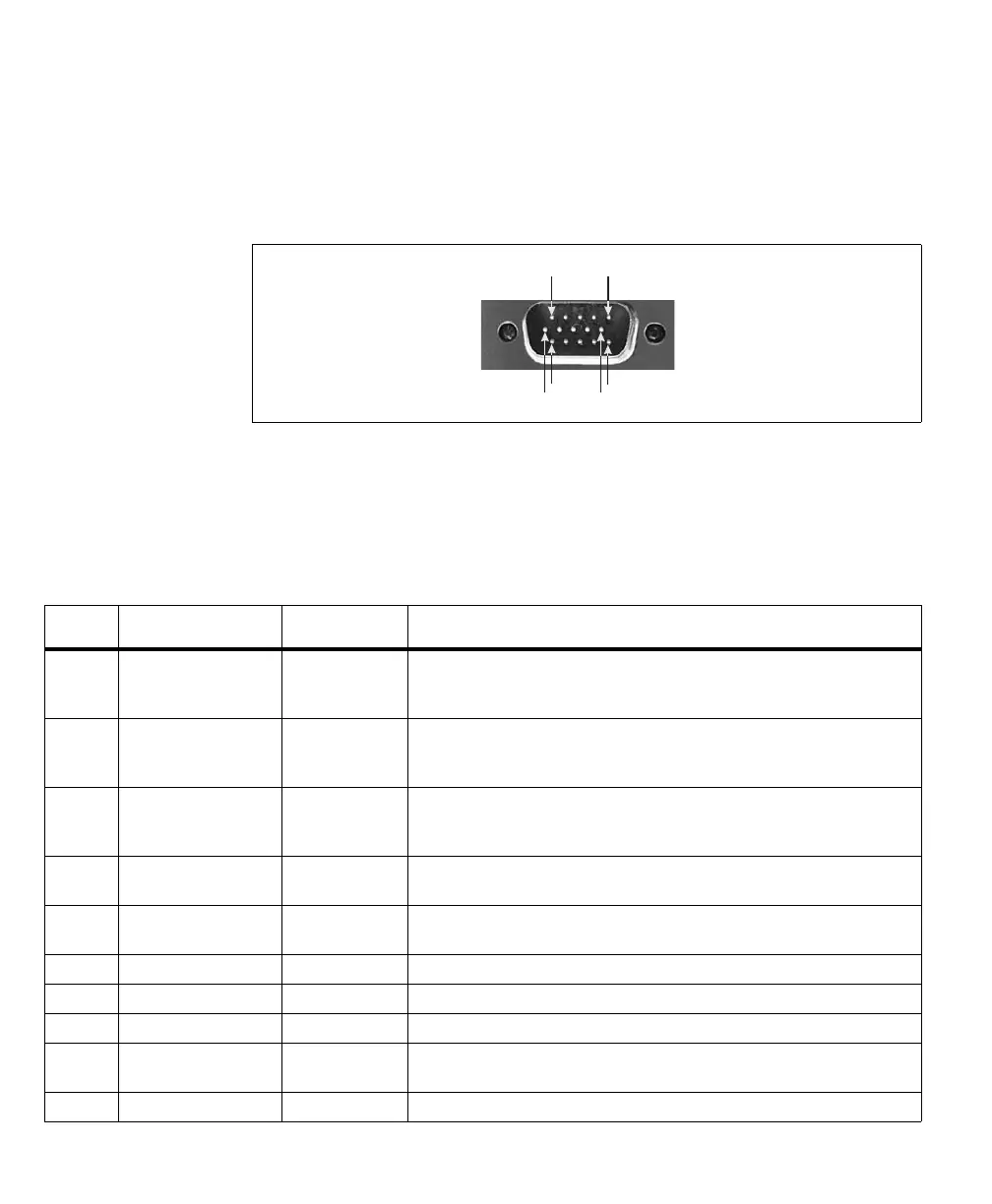
The pinout for auxiliary I/O connector 0 is as follows. Auxiliary I/O connectors
1, 2, and 3 have the same pinout as auxiliary I/O connector 0, except you must
add 8, 16, or 24, respectively, to the number at the end of their hardware signal
name and MIL constant. For example, AUX(TRIG)_TTL_IO_4 on connector 0
would be AUX(TRIG)_TTL_IO_12 on connector 1.
Pin Hardware signal name
MIL constant for
auxiliary signal
Description
1 AUX(TRIG)_TTL_IO_4 M_AUX_IO4 TTL auxiliary signal 4 (input/output), which supports: timer output
(M_TIMER1/M_TIMER2/M_TIMER3/M_TIMER4), trigger input, user input, or user
output (M_USER_BIT4).
2 AUX(TRIG)_TTL_IO_5 M_AUX_IO5 TTL auxiliary signal 5 (input/output), which supports: timer output
(M_TIMER1/M_TIMER2/M_TIMER3/M_TIMER4), trigger input, user input, or user
output (M_USER_BIT5).
3 AUX(TRIG)_TTL_IO_6 M_AUX_IO6 TTL auxiliary signal 6 (input/output), which supports: timer output
(M_TIMER1/M_TIMER2/M_TIMER3/M_TIMER4), trigger input, user input, or user
output (M_USER_BIT6).
4+,5- AUX(TRIG)_LVDS_IN2 M_AUX_IO2 LVDS auxiliary signal 2 (input), which supports: trigger input, user input, or
rotary/linear encoder input bit 0.
6+,8- AUX(TRIG)_LVDS_IN3 M_AUX_IO3 LVDS auxiliary signal 3 (input), which supports: trigger input, user input, or
rotary/linear encoder input bit 1.
7 GND N/A Ground.
10 GND N/A Ground.
12+,11- AUX(TRIG)_OPTO_IN1 M_AUX_IO1 Opto-isolated auxiliary signal 1 (input), which supports: trigger input or user input.
13+,14- AUX(EXP)_LVDS_OUT7 M_AUX_IO7 LVDS auxiliary signal 7 (output), which supports: timer output
(M_TIMER1/M_TIMER2/M_TIMER3/M_TIMER4) or user output (M_USER_BIT7).
15+,9- AUX(TRIG)_OPTO_IN0 M_AUX_IO0 Opto-isolated auxiliary signal 0 (input), which supports: trigger input or user input.


 To Next Page