3. PVC Pipes
The plastic PVC (polyvinyl chloride) pipes are light, generally inexpensive and corrosion resistant.
The pipes also have a very low friction factor (i.e. with smooth surface) which results in lower
pumping power and smaller pipe sizes. However, these pipes are not suitable for high
temperature applications as they losses strength rapidly at temperatures above ambient. The
pipes also have high coefficient of expansion, i.e. at high temperatures any pipe joint made may
become loose and leaks. Because of the weaker strength of the material, such pipes must be
installed with shorter support spans.
As a result of the above mentioned disadvantages, it is not recommended for PVC pipes to be
used for external applications, especially under direct exposure to sunshine. They may be
suitable for piping water indoors, e.g. under ceiling spaces, attics, plant rooms, etc.
The PVC material is classified as a thermoplastic. Generally, there are two types:
1. U-PVC (unplasticized PVC): for general usage up to 60°C
2. C-PVC (chlorinated PVC): for higher temperature applications.
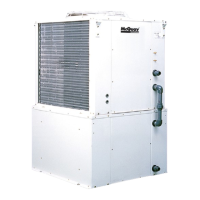
The PVC pipes and fittings used inside the mini chiller unit (factory assembled) are of DIN
8061/8062 standard. Therefore, use back pipes and fittings with the same standard when running
pipes from the chiller to the fan coil units. It is recommended that pipes with pressure rating of
PN16 (16 bar working pressure) to be used. See Appendix 3.
Do not use PVC pipes manufactured to other standard specifications, e.g. BS 3505/3506
as the fittings will not match with those used in the chiller. The pipe wall thicknesses are also
different.
The usual method of joining the pipes and fittings is with solvent cementing/welding. Some fittings
also have threads for joining purposes (with PTFE white tape).
It is recommended that 'IPS Weld-on PVC 717' solvent cement to be used. It is gray in
colour and used for heavy-body applications.
The following are some guidelines to ensure that the solvent cement joint is done properly:
a. Cut the pipe square and deburr. Clean and dry surfaces before coating the cement.
b. Apply a full, even layer of cement equal to the depth of the socket. Avoid excess and
puddling.
c. Assemble while the cement is wet. If not wet, recoat parts.
d. Ensure pipe fits snugly into socket. Give a twist of 1/8 to 1/4 turn.
e. Hold for 30 seconds to prevent push out and allow for initial set. Wipe off excess.
f. Allow curing time at least 5 minutes, up to 30 minutes. Longer curing time is better for
higher pressure/temperature applications.
Section: 3 Page 30


 To Next Page