Section 7: Insulation Material
In this section, we will look at the insulation material needed to be used for the chilled water
piping installed with the mini chiller unit.
The purpose of using the insulation material around the pipe is:
a) To prevent heat gain to or heat loss from the water in the pipes.
b) To prevent water condensation along the pipes due to the chilled water flowing in the pipes
c) To prevent injury due to the hot water flowing in the pipes
The type of insulation material used will depend on the pipe material used in the installation.
For black steel pipes, it is common to either use closed cell elastomeric insulation (e.g.
"Armaflex") or polyurethane foam with external aluminium cladding. For copper pipes, the closed
cell elastomeric insulation is used. Similarly, PVC pipes may use the same type of insulation as
the copper pipes.
It is important that the thickness of the insulation material used for the pipes are sufficient to fulfill
the above mentioned requirements. Hence, it is recommended that a calculation check to be
made to determine the insulation performance. To do this, the following items must be known:
1. Insulation material thermal conductivity coefficient (k)
2. Pipe Size
3. Air condition (dry bulb temperature and humidity / or wet bulb temperature) at the site
of pipe installation - use the most extreme conditions that exists at the site
4. Convective heat transfer coefficient (h)
The k-value of the insulation material describes how much heat is being conducted through
the insulation. A good insulation will have a low k-value. The amount of heat conducted
can be calculated as follows:
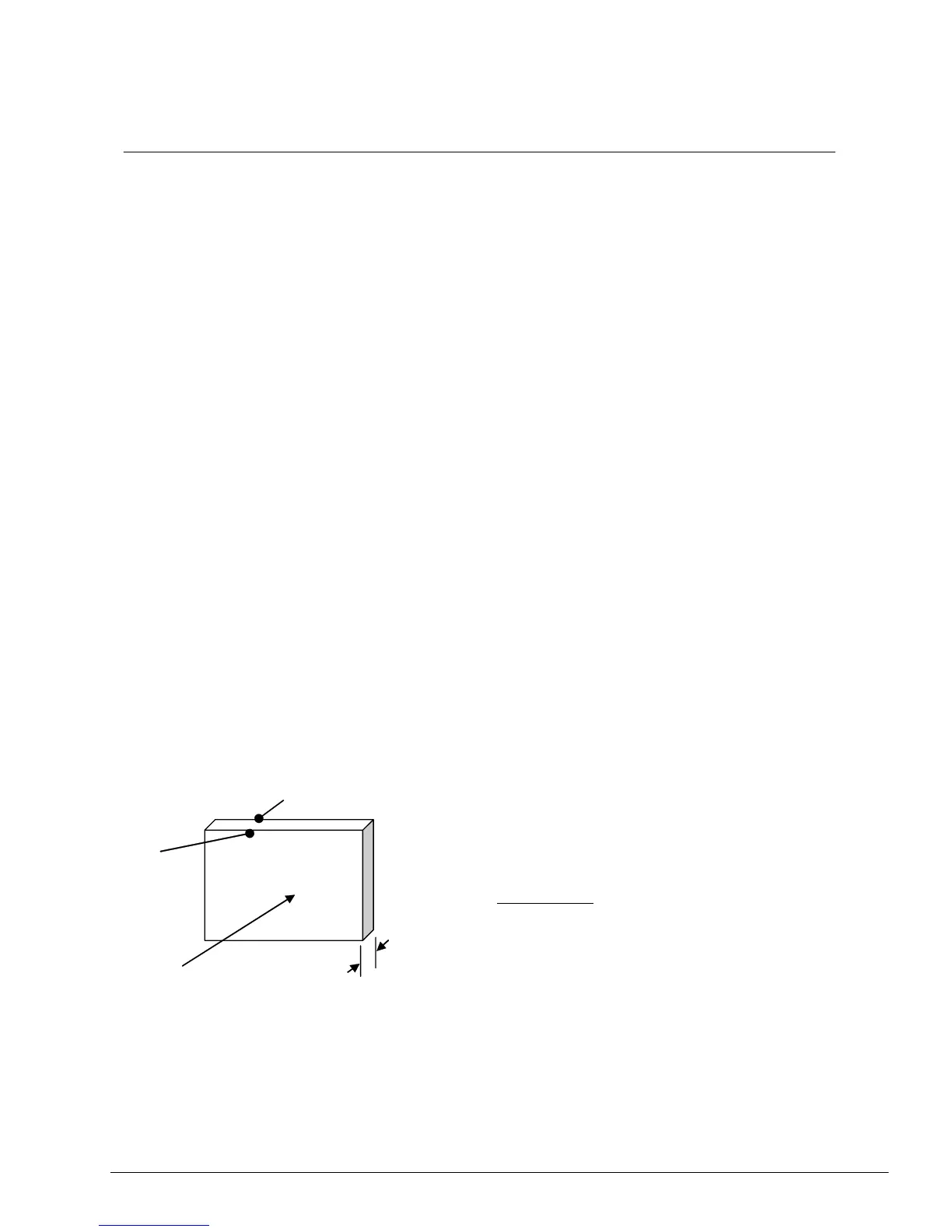
a. Through a slab of thickness, x
Q = - kA (dT/x) where A is the surface area of the slab
T2 dT is the temperature difference between the
the two slab surfaces, i.e. (T1 - T2) with
T1 > T2
T1
** This equation is also called as
Fourier's Law
x
Heat transfer, Q
Section 7 Page 94


 To Next Page