Now, if the friction loss in each branch is different, this will cause the flowrate in each branch to be
different also, say ϖ1 and ϖ2.
Therefore, the total flow to the load will become ϖ1 + ϖ2.
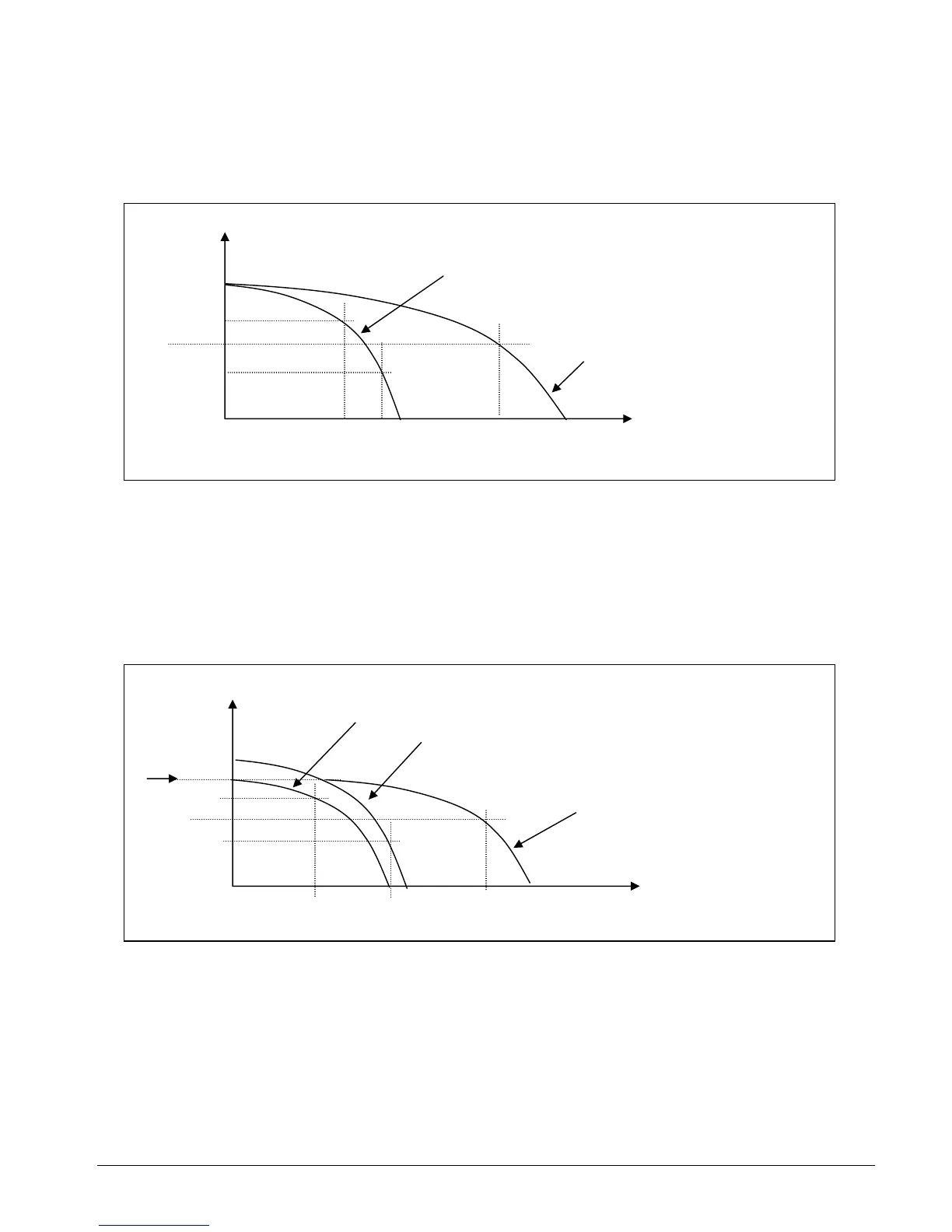
Thus, the pump curves will become:
Head
pressure single pump curve
P1
P3
combined pump curve
P2
ϖ1 ϖ2 ϖ1 + ϖ2 Flowrate
The two pumps will experience different head pressures P1 and P2.
Therefore, the pressure after the header will be P3 when the two flows combine together.
What happens when the two chillers C1 and C2 are of different model, i.e. pumps of different
characteristics?
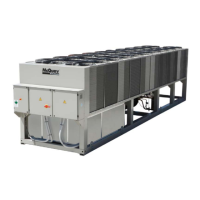
In such instances, we will still add the two curves together, and we will have the pump curves as
follows:
Head
pressure pump curve C1
pump curve C2
X
P1
P3 combined pump curve
P2
ϖ1 ϖ2 ϖ1+ϖ2 Flowrate
Of course, both the pumps will be operating under different head pressures P1
and P2, and then combines together to give a pressure of P3 at the header.
Section 5 Page 80


 To Next Page