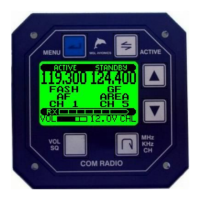
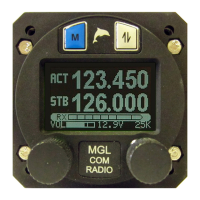
number 1 acts as a Garmin NAV/COM compatible communications port.
Note: This also works if the V16 and N16 is connected to an MGL EFIS via the V16 RS232
port number one at the same time.
Electrical state interfaces
PTT inputs
PTT inputs are realized as active low digital inputs with internal 2200 ohm pull up resistor to
3.3 Volts feeding the base of a transistor via a 10.000 ohm resistor. Open circuit voltage is
approximately 3V. PTT is activated when the voltage is pulled by an external device such as a
switch below about 0.8V.
It is common to connect a PTT switch to ground. The switch is closed when PTT is active.
The PTT input has a RF filter consisting of a ferrite beed feeding into a grounded capacitor.
Intercom Switch/Playback switch
The intercom switch input is realized identical to the PTT inputs. Active state is pulled low.
TX Interlock
The TX interlock is both input as well as output. It is realized as input with a pull up of 2200
ohm to 3.3Volts similar to the PTT inputs but also has an output transistor that can switch this
output to ground.
The TX interlock is grounded by the internal transistor whenever the transmitter is active.
Should this line be grounded by an external device while the transmitter is not active, the PTT
inputs as well as PTT commands from the communications interfaces are disabled.
If the TX interlock is grounded by an external device while the transmitter is active it will not
have any effect on the current transmission.
It is common to connect this line to the corresponding TX Interlock of a second V16 to prevent
simultaneous transmissions.
An alternate use of the TX interlock is to enable an external RF power amplifier during TX for
ground station use if higher TX power is desired. In this case, if the TX Interlock is at a level of
3.0Volts the power amplifier is disabled and the antenna is switched through to the V16
receiver directly.
RF feedback – cause and elimination
RF feedback is a phenomena very similar to microphone feedback on a sound stage. The
modulated RF signal during transmission is received by your microphones or microphone
cables and routed to the input of your intercom system or V16 transceiver.
Here, some of the modulated signal may be demodulated by non-linearities in the system,
particularly if the received RF is very strong (typically several volts).
This creates a common feedback loop that in a mild form will create an echo similar to


 To Next Page