“nuisance” squelch breaks due to a short transient signal).
Note: If squelch is open all the time (squelch value “0”) no recording takes place.
Power supply
The V16 airband transceiver is designed to be operated on a typical 12V DC aircraft power
system. The DC supply must be free of undesired transients and reasonably stable within the
acceptable supply voltage range of the V16.
It is possible to operate the V16 on 24/28V DC power supplies as well.
For operation with compromised power sources on aircraft it is advised to consider external
power conditioning such as the MGL Avionics AvioGuard isolated power supply.
Antenna
The V16 airband transceiver is designed to operate with standard 50 ohm impedance aircraft
VHF antennas.
The modular nature of the V16 allows placement of the V16 closer to the antenna, reducing
antenna cable length and losses.
A built in SWR meter provides information on RF power at the connector and reflected power
from the antenna as a ratio. Depending on the connected control equipment this information
may be displayed in a diagnostics mode or during every transmission.
The antenna connector provides a DC isolated path to the antenna. This includes the cable
sheath. This means there is no possibility of a DC current path from aircraft skin via antenna
and cable through the radio. This protects the radio against ground faults and prevents
ground loops.
Digital control interfaces
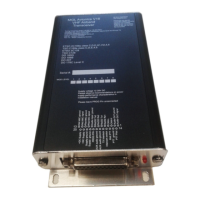
The V16 airband transceiver provides two RS232 ports as well as a CAN bus interface.
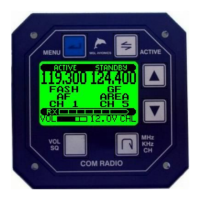
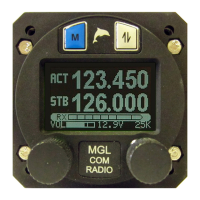
The CAN bus is typically used with control heads from MGL Avionics.
RS232 port 1 may be used with EFIS systems. RS232 port 2 is not currently used.
Applicable standards
The V16 airband transceiver meets or improves on the following standards:
ETSO 2C169a VHF Radio communication receiving equipment operating within the radio
frequency range 117.875 – 137 MHz
TSO C169a Minimum Operational Performance standards for Airborne Radio
Communications equipment standards
ETSO 2C128 Devices that prevent blocked channels used in two-way radio communications
due to unintentional transmissions
TSO C128a Equipment that prevents blocked channels used in two-way radio
communications due to unintentional transmissions


 To Next Page