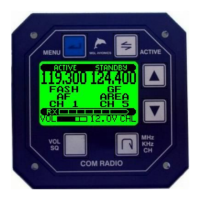
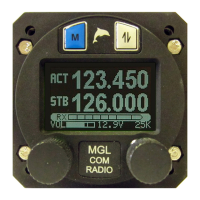
If you perform this selection from a connected CAN bus control head communications from
the head to the V16 will stop immediately as the new assignment is active.
Change the target V16 on the controller to the new assignment after you changed it on the
V16 to re-establish communications.
Note: In order to protect against accidental changes of the CAN bus addressing you have 30
seconds after applying power to the V16 to change this setting. Any attempt to change this
setting after the initial time window will be rejected.
Note: Only change this setting if you have ONE V16 connected to the CAN bus. If you have
two V16 transceivers connected, plug in the first one, assign the address (if required, the
default is COM1 anyway), then unplug it and plug in the second one and assign it as COM2.
Then you can plug in COM1 and they will then behave as two independent systems on the
CAN bus.
Note: Keep the CAN bus dedicated to the V16(s) and any of its control heads separated from
any other CAN bus in your system. The CAN bus for the V16(s) is private to these devices.
Do not share the same CAN connection with an EFIS CAN bus or any other CAN bus you
may have in your aircraft.
VSWR Antenna checks and tuning
The V16 transmitter provides a built in VSWR meter. To enable this device, please enable the
TX Information option of your display device. If enabled, you will be presented with the
forward power measurement at the transmitter output as well as the ratio of forward power to
reflected power from the antenna.
An antenna with an ideal behavior will look like a 50 ohm resistor to the V16. This results in a
VSWR reading of 1.0 which means no power is reflected.
Real antennas rarely get very close to this. As the airband frequency range is relatively wide
an antenna will be typically tuned to mid band (around 127Mhz) and will provide a good
match at that frequency but at lower or higher frequencies the match will get worse. Some
antennas may be designed to provide a more even match over the range using various
techniques.
What is a good antenna match ?
A typical good match is below 1.3 at the tuned frequency (preferably even lower) and not
worse than 1.5 at any other frequency.
It is usually sufficient to test at three frequencies: 118.000, 127.000 and 136.900 MHZ.
Literature suggests that VSWR readings of up to 2.0 are acceptable. However we would
strongly advise to aim for much better matching. The reason for this is not transmitter
protection but what happens with the power that is not radiated by the antenna. This power,
which can be significant tends to enter your aircraft's electrical wiring via the power supply
ground of the V16. Here it can provide significant issues to other electronic devices in your
aircraft, in bad cases even leading to damage.
A secondary effect of reflected power can affect your V16's intercom system – reflected power
contains the audio modulation you are transmitting and this can find its way into your
microphone leads and audio wiring. This sets the system up for RF feedback which can


 To Next Page