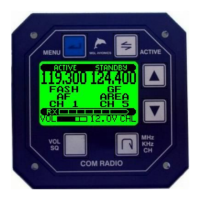
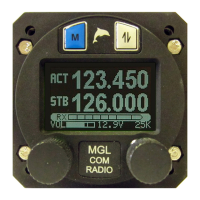
control heads and/or control by an EFIS system.
The Transmitter
The transmitter is designed to deliver a 10W un-modulated carrier into a 50 ohm matched
antenna load. Modulation is controlled fully digitally to achieve to 70% modulation index by
means of asymmetric gain control of the modulating audio signal. This permits ideal use of
available carrier power while providing a very power efficient transmitter with low heat
generation, while at the same time maximizing range.
The modulator is realized as a class-D circuit greatly adding to the overall power efficiency of
this design.
An optional transmit interlock output/input is provided which may be used in systems
employing two transmitters from preventing simultaneous transmissions.
Two PTT inputs are provided, one for each intercom input. If desired, these inputs may be
joined into a single PTT switch.
The transmitter fulfills the bandwidth requirements for both 25Khz and 8.33Khz channel
spacing operations.
The Receiver
The receiver is implemented as a direct conversion architecture. The signal to be received is
converted directly to audio baseband using a dual receiver chain with two identical receivers.
One of these produces a slightly delayed signal. These signals are known as I and Q. They
are then converted into digital using very high quality 24 bit converters and all further signal
processing takes place in a high performance processor. Here the original carrier is recreated
from the I/Q signals and following extensive processing the audio signal is recovered from the
carrier while unwanted signals are rejected.
In order to meet latest ICAO requirements for FM band immunity the receiver employs a
surface acoustic wave RF filter before any active amplification to reject any out of band
signals before they can inter-modulate with wanted signals. The overall receiver architecture
is designed to be able to handle very strong in band and out of band signals while managing
at the same time to provide good sensitivity to very weak signals.
The Receiver is designed to be able to operate in any currently known receiver class within
the 25Khz and 8.33Khz channel spacing systems including offset carrier operations.
The Receiver can be operated in scanning mode. In this mode both main and standby
frequencies are monitored. If a signal is received on main frequency (as determined by RX
squelch opening) that signal is routed through and no scanning of the standby frequency
takes place for the duration of the RX.
If a signal is received on the standby frequency, this signal is routed through. However, the
main frequency is monitored several times per second. Should a transmission be received on
the main frequency while there is a transmission being received on the standby frequency the
receiver will immediately switch to the main frequency.
Monitoring the main frequency while receiving a signal on the standby frequency results in
very short breaks in the received audio (while the main channel is quickly checked). These
breaks last only a few milliseconds and do not result in loss of audibility of the received signal.


 To Next Page