4 Getting Started
This chapter provides the basic information you need to set up your disk drives and arrays the way you
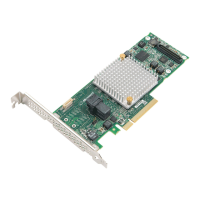
want them. It describes the options you have for installing your Microsemi Adaptec RAID controller and
disk drives and creating arrays for storage. It also describes how to prepare your controller for installation
into a low-prole computer cabinet.
4.1 Choosing a RAID Level
This section provides a brief overview of the RAID levels supported by your Microsemi Adaptec RAID
controller, including the minimum and maximum number of disk drives required by each.
Note: Before you begin, familiarize yourself with your controller's physical features and
the RAID levels that it supports (see Standard RAID Controller FeaturesRAID controllers
controllerscontrollers standard features on page 4).
• RAID 0 (Non-redundant Array)—Stripes data across multiple disk drives. Improved performance but
no redundancy (see Non-redundant Arrays (RAID 0)non-redundant arraysarrays non-redundantRAID
RAID 0RAID non-redundant arrays).
• RAID 1 Array—Created from two disk drives where one disk drive is a mirror of the other (the same
data is stored on each disk drive). Redundancy, but reduced capacity (see RAID 1 Arrays RAID RAID
1arrays RAID 1).
• RAID 1E Array—Similar to a RAID 1 array except that data is mirrored and striped, and more disk drives
can be included (see RAID 1 Enhanced ArraysRAID RAID 1Earrays RAID 1E).
• RAID 5 Array—Stripes data for improved performance and uses parity data to provide redundancy
(see RAID 5 ArraysRAID RAID 5arrays RAID 5).
• RAID 10 Array—Built from two or more equal-sized RAID 1 arrays, stripes and mirrors data across
multiple disk drives. Redundancy and improved performance (see RAID 10 ArraysRAID RAID 10arrays
RAID 10).
• RAID 50 Array—Built from multiple disk drives congured as two or more RAID 5 arrays, stripes stored
data and parity data across all disk drives (see RAID 50 ArraysRAID RAID 50arrays RAID 50).
• RAID 6 Array—Similar to a RAID 5 array except that it includes two independent sets of parity data
instead of one (see RAID 6 ArraysRAID RAID 6arrays RAID 6).
• RAID 60 Array—Similar to a RAID 50 array except that it includes four independent sets of parity data
instead of two (see RAID 60 ArraysRAID RAID 60arrays RAID 60).
See Comparing RAID Levels to see how many disk drives you must connect to your RAID controller to support
the RAID level you want.
4.2 Selecting Disk Drives and Cables
4.2.1 Disk Drives
Your RAID controller supports SAS disk drives, SATA disk drives, and SATA and SAS Solid State Drives (SSDs).
When selecting disk drives for your RAID array, ensure that all the disk drives have the same performance
level. You can use different-sized disk drives in the array, but the array will be limited to the capacity of the
smallest and slowest disk drive. For more information about arrays, refer to the maxView Storage Manager
User’s Guide or online Help. For more information about compatible disk drives, refer to
www.adaptec.com/compatibility.
12
Microsemi Proprietary and Condential. Installation and User's Guide Revision 5
Getting Started



 To Next Page